Disclosure: This post contains affiliate links. If you buy through them, we may earn a commission at no extra cost to you. We only recommend tools our editor has handled or researched in depth. Learn more
Not quite. A 2008 profile says Microplane’s cutting edges were made by chemical etching. An oroshigane (a Japanese grater) has raised teeth, and the copper ones from Ooya Seisakusho, a copper-grater maker in Wako, Saitama, are struck one tooth at a time by hand. Ooya will also re-set the teeth on its copper graters when they wear.
This guide draws on makers’ own pages, a 2008 magazine profile, and dated store listings, not hands-on testing. It covers how the teeth are made, what each grater is listed for, care and re-setting, and which to buy.
Struck, pressed, or etched: how the teeth are made
Copper, struck by hand
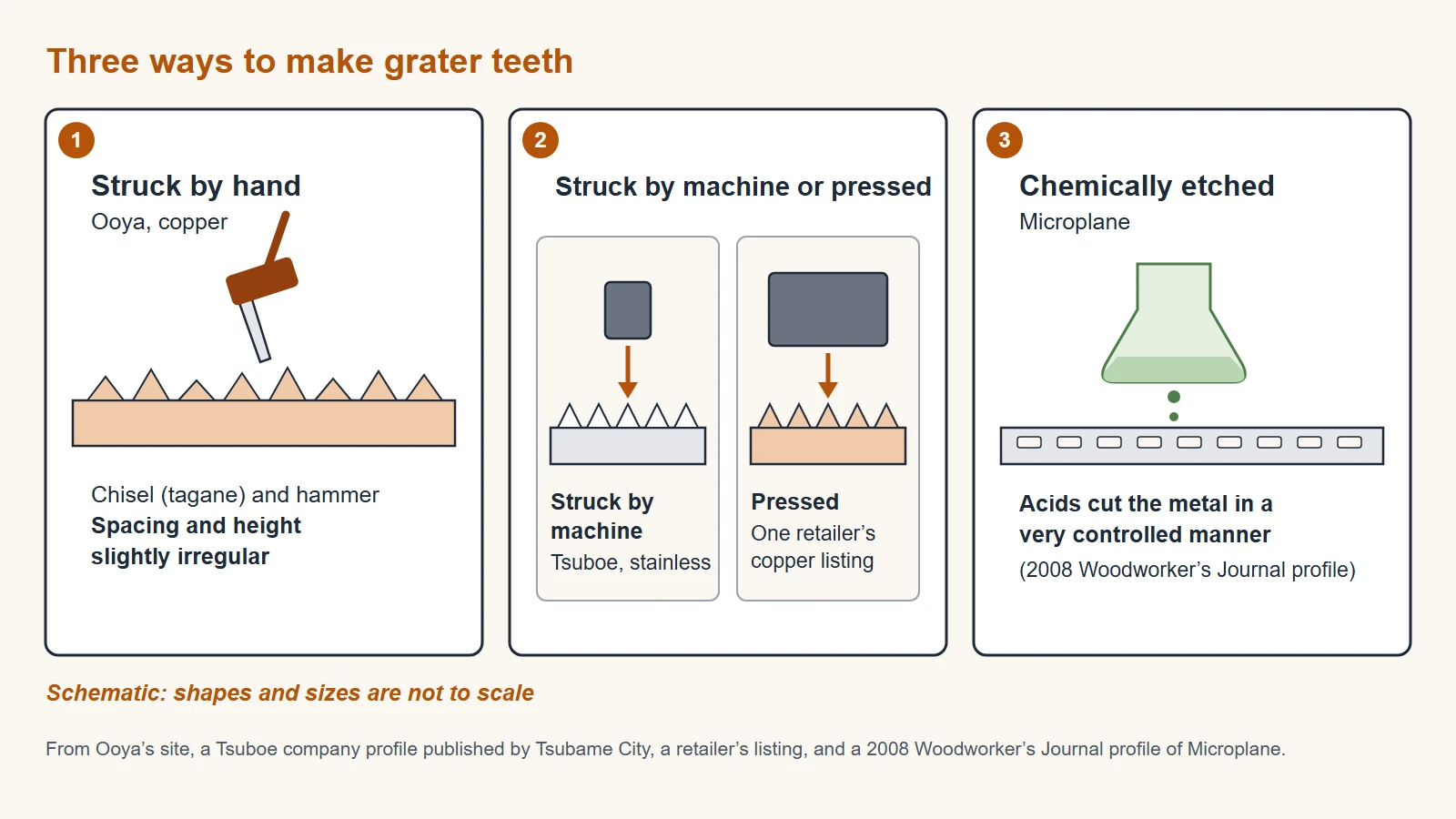
Ooya makes its graters from a plate of hard pure copper with tin plating. Its craftsmen raise the teeth one at a time with a chisel (tagane, 鏨) and a hammer. The teeth look even, but the spacing and height are slightly irregular.
Ooya’s own explanation for the hand-raised teeth is that they don’t crush daikon (Japanese white radish) cells, so water and fiber don’t separate and the grated daikon stays moist and fluffy even as it sits. This is the maker’s description, not a test result.
Stainless, struck by machine
Tsuboe, whose main business is stainless graters, describes the same chisel-struck method in its company profile, published by Tsubame City. The method is called hon-medate (本目立て) and dates to the Edo period; Tsuboe applies it to stainless steel with machines, because stainless is too hard to work by hand. Against teeth formed on an ordinary press, Tsuboe describes its own as sharp, hard, and strong.
Copper can be pressed, too: one retailer’s listing, checked Nov 3, 2026, describes its two-sided grater as “pressed, tin-coated copper”. So copper alone doesn’t tell you how the teeth were made. Our advice: if hand-struck teeth matter to you, look for a listing that says how the teeth are made.
The same profile describes copper graters as cutting sharply but wearing heavily because the metal is soft. Tsuboe’s main product is stainless, though its profile also shows copper graters.
Ceramic
Kyocera’s US cutlery site describes its ceramic grater as having rows of sharp teeth. The whole grater has a food-safe glaze, and a non-slip silicone ring on the bottom keeps it in place.
Microplane: etched, not struck
A 2008 Woodworker’s Journal profile of Microplane quotes the company’s PR and marketing coordinator: “Chemical etching is a process that uses acids to cut metal in a very controlled manner.” The profile says the tool moved from the woodshop to the kitchen thanks to feedback from one of the company’s customers.
Four graters and what each is listed for
The table sets four graters side by side on what their makers list.
| Grater | Material, as listed | How the teeth are made | Foods listed | Care, as listed | Size and weight | Price (dated) |
|---|---|---|---|---|---|---|
| Ooya two-sided copper, No. 4 | tin-plated hard pure copper | struck by hand, one tooth at a time | front: daikon, apple; back: wasabi, ginger, yuzu (a Japanese citrus), garlic, yamaimo (a Japanese yam) | neutral detergent, toothbrush on the plate, dry before storing; re-setting service | 22.5 × 13.0 cm (8.9 × 5.1 in), 320 g (11.3 oz) | ¥10,450 (tax included, as of Nov 1, 2026) |
| Ooya condiment grater, paddle shape (羽子板型) | pure copper | Ooya’s method | wasabi, ginger, yuzu, garlic | neutral detergent, toothbrush on the plate, dry before storing; re-setting service | 9.2 × 5.8 cm (3.6 × 2.3 in), 51 g (1.8 oz) | ¥2,530 (tax included, as of Nov 1, 2026) |
| Kyocera CD-18, 6.5″ Medium Grater | advanced ceramic, silicone | “rows of sharp teeth” | ginger, elephant garlic, daikon, parmesan, nutmeg | dishwasher safe; cleaning brush included | 17.0 × 21.1 × 4.1 cm (6.7 × 8.3 × 1.6 in), about 400 g (0.89 lb) | $33 (as of Nov 1, 2026) |
| Microplane graters (2008 profile) | — | chemically etched | nutmeg, hard cheese, lemon zest, chocolate | — | — | — |
From Ooya’s product list and FAQ and Kyocera’s US product pages (checked Nov 1, 2026). The Microplane row is from a 2008 Woodworker’s Journal profile and describes Microplane’s grater range then, not one current model; dashes mark details left blank. Yen prices include Japan’s consumption tax.
The condiment grater’s row says “Ooya’s method”, taken from the top-page description of Ooya’s own graters. The Ooya list also has one-sided daikon graters in the same sizes as the two-sided ones, and two more condiment shapes.
Kyocera’s smaller grater, the 3.5″ CY-10, is listed for garlic, ginger, chocolate, hard cheese, and lime, lemon, or orange zest, and also for nutmeg, elephant garlic, daikon, and parmesan. It measures 11.9 × 17.0 × 2.3 cm (4.7 × 6.7 × 0.9 in) and weighs about 120 g (0.26 lb).
Our reading of the table: Ooya’s and Kyocera’s lists overlap on ginger, garlic, and daikon, and Kyocera’s lists also name the nutmeg, hard cheese, citrus zest, and chocolate that the 2008 profile lists for Microplane’s graters. So the choice comes down more to care, size, and price than to which foods you can grate.
On Ooya’s two-sided grater the fine back is for condiments (yakumi, 薬味, such as wasabi and ginger). Tsuboe’s profile says a coarse front and a fine back is the basic layout for its graters.
Cleaning, wear, and new teeth
For its copper graters, Ooya’s FAQ says to wash with neutral dish detergent, use a toothbrush or similar on the copper plate, and rinse. Then pat the grater with a dry cloth or paper towel to take off the water, and let it dry before storing it. Care differs by material: the pressed copper grater’s retailer listing says hand-wash only, no soaking and no dishwasher, while Kyocera’s US site lists both ceramic graters as dishwasher safe, and the CD-18 comes with a small cleaning brush.
Sending a copper grater back for new teeth
After years of use, the tooth tips on Ooya’s copper graters wear and the grater cuts less well. Ooya will grind off the old teeth and raise new ones (re-setting the teeth, 目立て直し) for a fee.
- When: when the tooth tips are worn and daikon starts to slip. Age or discoloration alone doesn’t call for it.
- Cost: half the list price of a new grater of the same size. The FAQ’s example is the No. 4: ¥9,500 list, ¥4,750 to re-set (both before tax).
- After: the plate gets thinner and lighter.
- Turnaround: about three weeks.
- Other makers’ copper graters: generally accepted, though some may be refused. The price is 1.5 times Ooya’s own re-setting price for the same size, and the new teeth follow Ooya’s pattern, not the original maker’s.
Ooya’s FAQ says it pays the return postage (for jobs with only condiment graters, the customer pays ¥185) and sends a postal transfer form for payment at a Japanese post office. Our reading: if you live outside Japan, ask Ooya before sending anything. Ooya’s site is in Japanese and lists prices in yen.
Which one to buy
We haven’t used these graters, so the picks follow the makers’ descriptions. Our framing, in three lines:
- If you grate daikon often and want a maker that will re-set worn teeth, a two-sided copper oroshigane like Ooya’s comes with that service. The No. 4 above is ¥10,450 and the smaller No. 6 (19.0 × 10.5 cm, 7.5 × 4.1 in; 244 g, 8.6 oz) is ¥8,140, both tax included as of Nov 1, 2026.
- If you want to put it in the dishwasher, Kyocera’s US site lists its ceramic graters as dishwasher safe: $20 for the 3.5″ CY-10 and $33 for the 6.5″ CD-18 (as of Nov 1, 2026).
- If you already own a Microplane, the 2008 profile lists zest, hard cheese, and nutmeg among the foods Microplane’s graters were made for, so you may not need another grater for those foods. In our reading, the reasons to add a Japanese grater are the ones above: Ooya’s re-setting service or Kyocera’s dishwasher-safe ceramic.
For buying outside Japan, Bernal Cutlery (an affiliate partner) carries oroshigane in its Mills, Grinders & Graters category; check each listing for the material, how the teeth are made, and whether it’s in stock.
Graters and oroshigane at Bernal Cutlery
Related guides
- Benriner mandoline: which model to buy, another Japanese kitchen tool
- Japanese knife care routine, for the knives in your kitchen
- Japanese knife gift guide, if you’re shopping for Japanese kitchen tools as gifts
Sources
- Ooya Seisakusho: top page, company profile, product list, and FAQ
- Tsuboe company profile, published by Tsubame City (PDF)
- Kyocera’s US cutlery site: 6.5″ Medium Grater, 3.5″ Small Grater, and graters category
- Woodworker’s Journal, “Microplane: A Sharper Way to Shape Wood” (2008)
- Bernal Cutlery listing for a large two-sided copper oroshigane (checked Nov 3, 2026; sold out at the time)
Researched and written by the Japanese Toolbox AI editorial team and reviewed by Ken, our editor in Japan. Approved for publication by Ken on November 3, 2026. How we work · @JapaneseToolbox on X