Disclosure: This post contains affiliate links. If you buy through them, we may earn a commission at no extra cost to you. We only recommend tools our editor has handled or researched in depth. Learn more
Wash it by hand, dry it right away, don’t leave acidic food sitting on the blade, cut on a soft board, and never cut through bones or frozen food. Do that and a stainless Japanese knife will forgive the occasional slip; a carbon-steel one won’t. The hands-on part of this guide comes from our editor’s own kitchen knives in Japan — one stamped stainless, the other two with no steel type marked on the blade; everything about carbon steel is research from knife makers and retailers, clearly labeled, because our editor’s hands-on notes come from stainless and unmarked knives, and they don’t own a whetstone.
The daily routine, timed
The actual routine is short. Our editor timed washing, wiping, and putting a knife away with a stopwatch: about 50 seconds total. In practice it comes down to:
- Rinse and wash the blade with dish soap.
- Dry it with a cloth.
- Let it air dry.
- Put it back in its usual spot.
That’s it. There’s no oiling step in this routine: Sakai Ichimonji recommends oiling for knives used rarely or stored long-term, and a knife you wash, dry, and use daily isn’t in that group. Carbon steel does need a thin film of oil, which Seido recommends and which this guide covers in its own section below.
Do Japanese knives rust?
Short answer: stainless Japanese knives resist rust but aren’t rust-proof, and carbon-steel ones will rust if you leave them wet. That’s true of any kitchen knife, Japanese-made or not.
| Stainless | Carbon steel | |
| Rust risk | Resistant, not rust-proof | Rusts quickly if left wet |
| If it stays wet or has food on it | Can still develop rust spots from salt/chloride, dishwasher detergent, or contact with other metal | Rusts fast if left wet; with regular use it develops a protective patina (a dark, stable oxide layer) |
| Daily care | Hand wash, dry completely | Hand wash, dry completely, then a thin coat of oil before storing |
| Oil needed | Not needed if you wash and dry it daily | Yes for storage or infrequent use: a thin coat of camellia oil (tsubaki oil, a traditional Japanese knife oil) |
| Who it’s for | Readers who won’t always hand-dry a knife right away | Readers who enjoy the care routine and like watching a patina develop |
Why stainless can still rust
“Stainless” doesn’t mean rust-proof. According to Kai, a Japanese knife maker, stainless can rust from chloride ions and similar causes. Sakai Ichimonji Mitsuhide, a knife shop in Osaka that opened in 1953, puts it plainly: rust comes from water and oxygen, and even stainless can rust if you get careless with it. Knifewear, a knife retailer, adds that rust spots can form if a stainless blade stays wet for hours or days or has food left stuck to it, that chlorine in ordinary dish detergents can attack the chromium oxide layer that keeps stainless from rusting, and that contact with another wet metal object can cause small pinhole rust spots. Knifewear also says stainless generally has at least 10.5% chromium added, though exact thresholds vary by retailer, so treat that as a general guide rather than a hard cutoff. The dishwasher is a common culprit: Knifewear says it’s responsible for roughly 90% of the rusty knives the shop sees, which is their own estimate rather than an independent study.
Patina vs. rust on carbon steel (research only)
Our editor doesn’t have a knife confirmed as carbon steel to check this against, so everything below is sourced from retailers rather than confirmed firsthand. According to Okami Blades, a knife retailer, patina looks blue, gray, purple, or black and stays smooth and flush with the blade, while rust looks orange, red-brown, or yellow and feels rough, raised, or flaky; if your fingernail catches on the raised material, it’s rust, not patina. A developed patina actually helps by blocking moisture and oxygen from reaching the steel underneath.
What a real home knife looks like after years of plain care
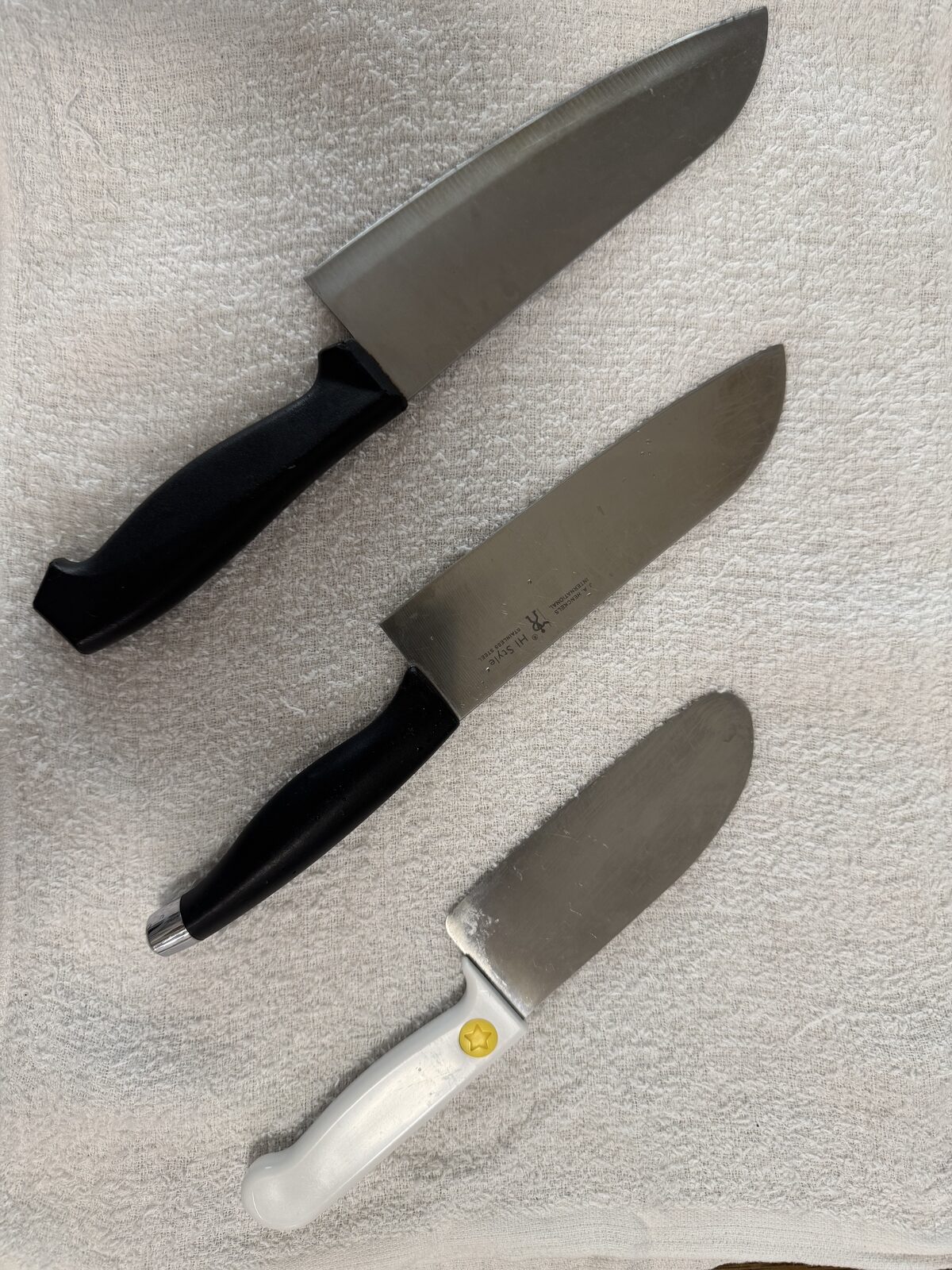
Our editor’s three kitchen knives are ordinary home knives. Their care is washing with dish soap, air-drying, and a small sharpener now and then when raw fish or meat gets hard to cut. Only the santoku’s stamp actually reads “Stainless Steel”; the Galaxy 777 and the children’s knife carry no steel marking at all, so we’re not assuming they’re stainless just because they look similar. That’s the point of this section: this is what plain care actually produces over years of real use, on knives whose steel we can and can’t confirm, not a knife polished up for a photo.
The santoku (a Japanese all-purpose knife) is stamped J.A. Henckels International, HI Style, Stainless Steel on the blade.
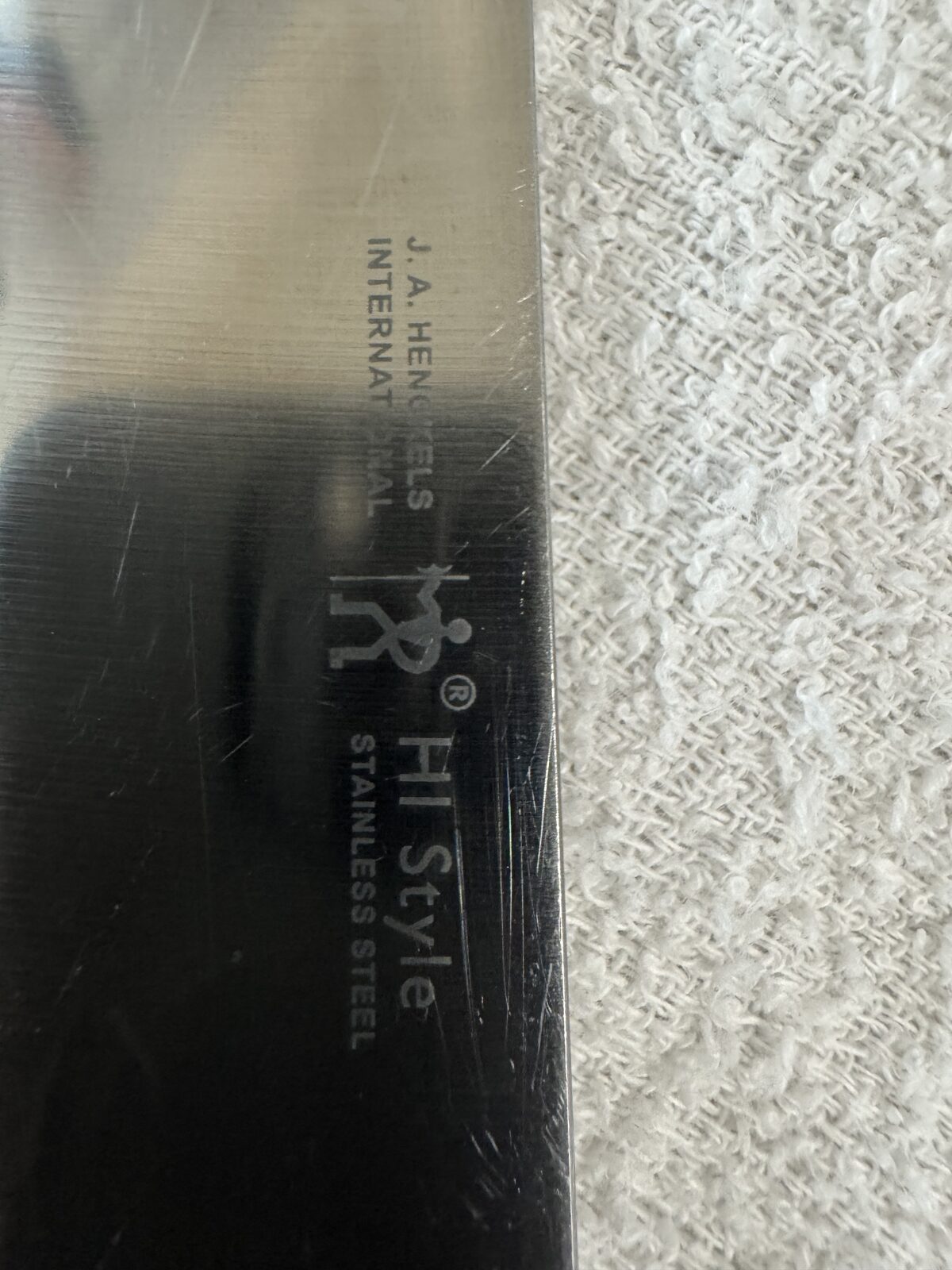
Henckels International is part of the Zwilling group. Zwilling says some of its own specially formulated steels are dishwasher-safe at 55°C (131°F) or lower, but the page doesn’t say which product lines use that steel, and it still recommends hand washing. We can’t confirm whether this specific HI Style santoku qualifies, so we treat it like any other knife here and hand wash it.
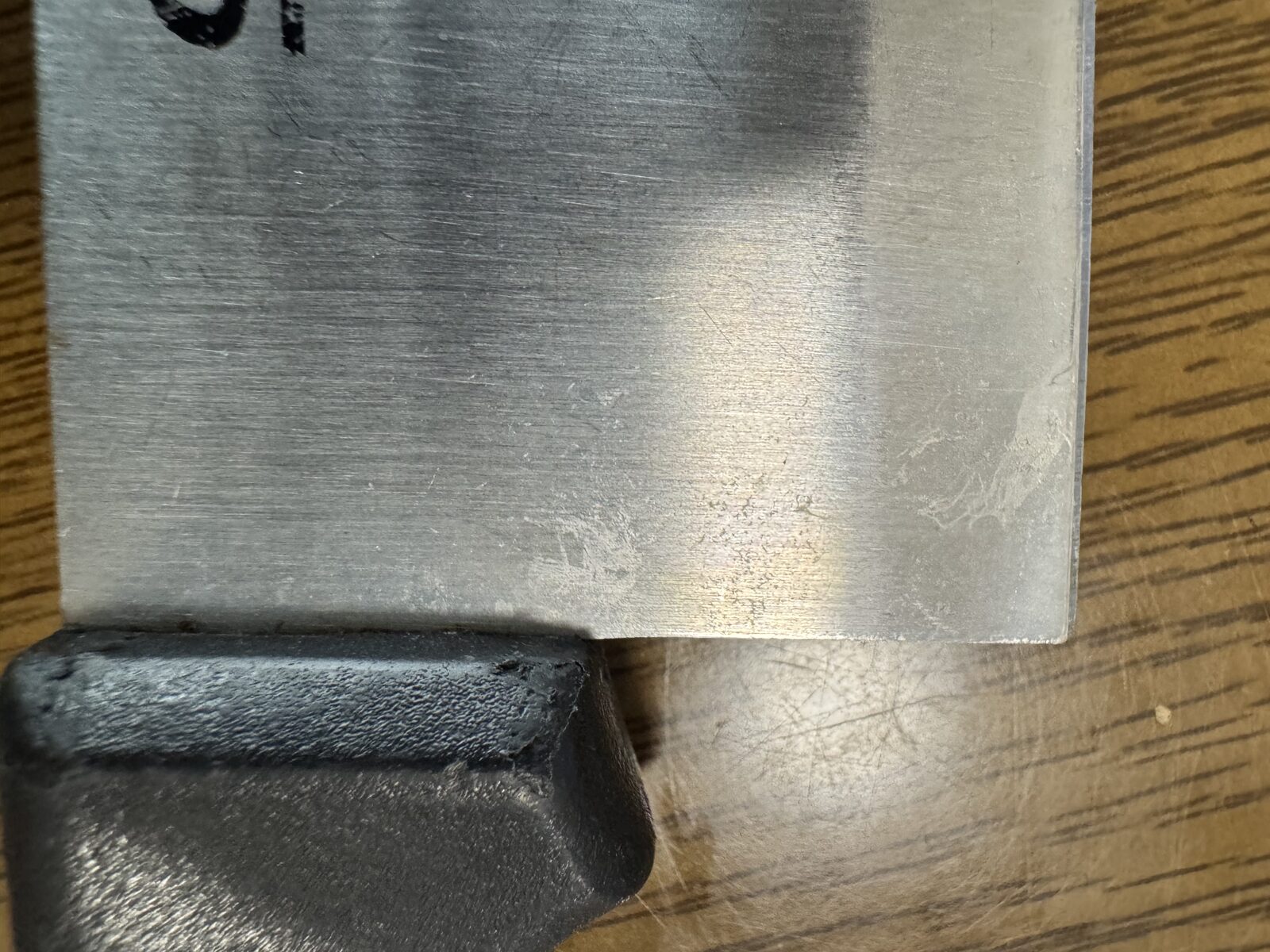
Our editor has used it for about 5 years. Under angled light, the blade shows fine scratches and some light cloudiness from years of use.
The Galaxy 777 has been in use for about 10 years. Unlike the santoku, its blade only has the name “Galaxy 777” printed on it, with no steel type listed.
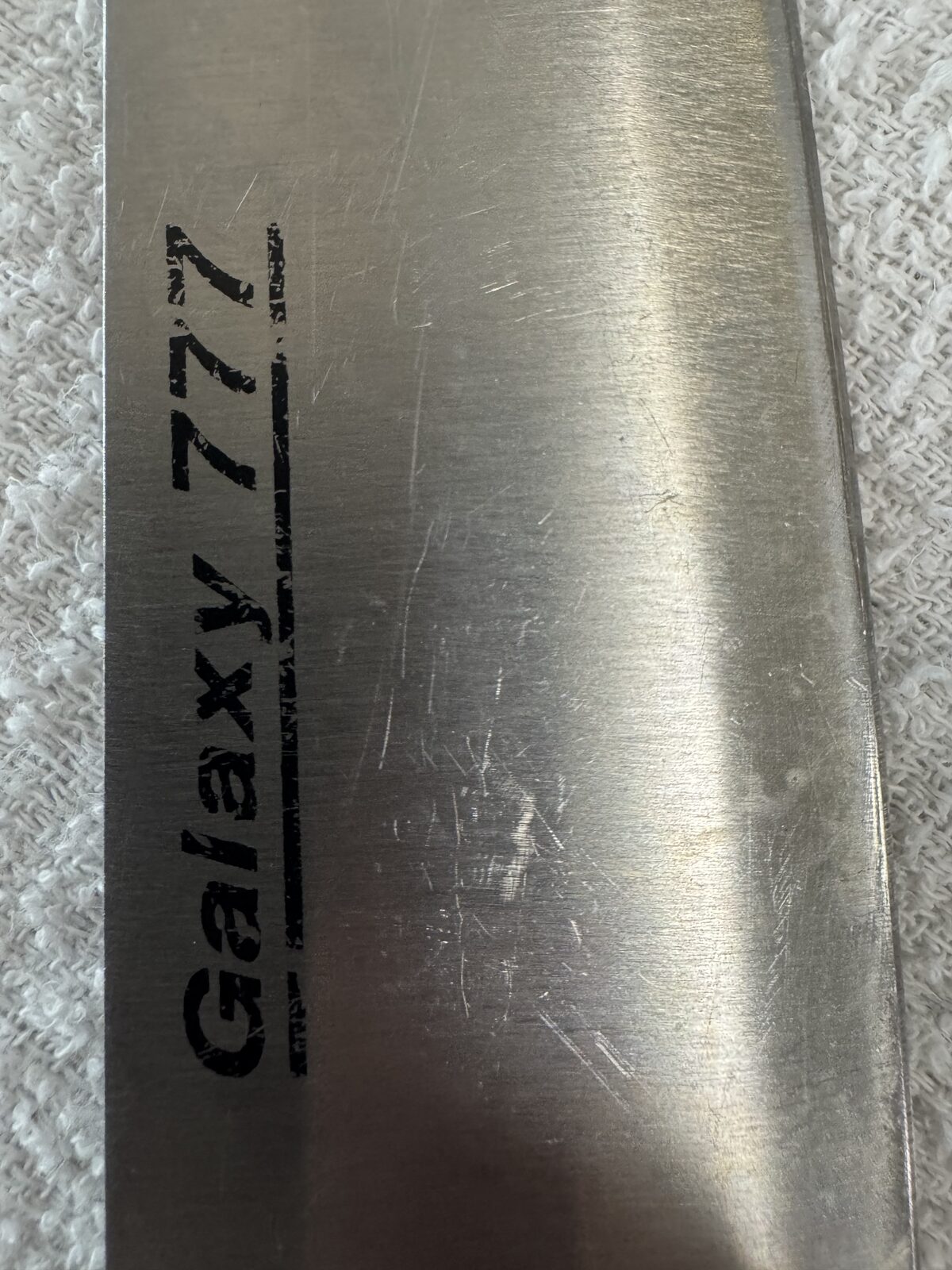
We don’t know what steel it’s actually made from, and we’re not going to assume it’s stainless just because it looks similar to the santoku. Its blade also shows fine scratches and some light cloudiness under angled light.
The children’s safety knife has a serrated edge and is stamped YAXELL, with no steel type listed either, and our editor has used it for about 2 years.
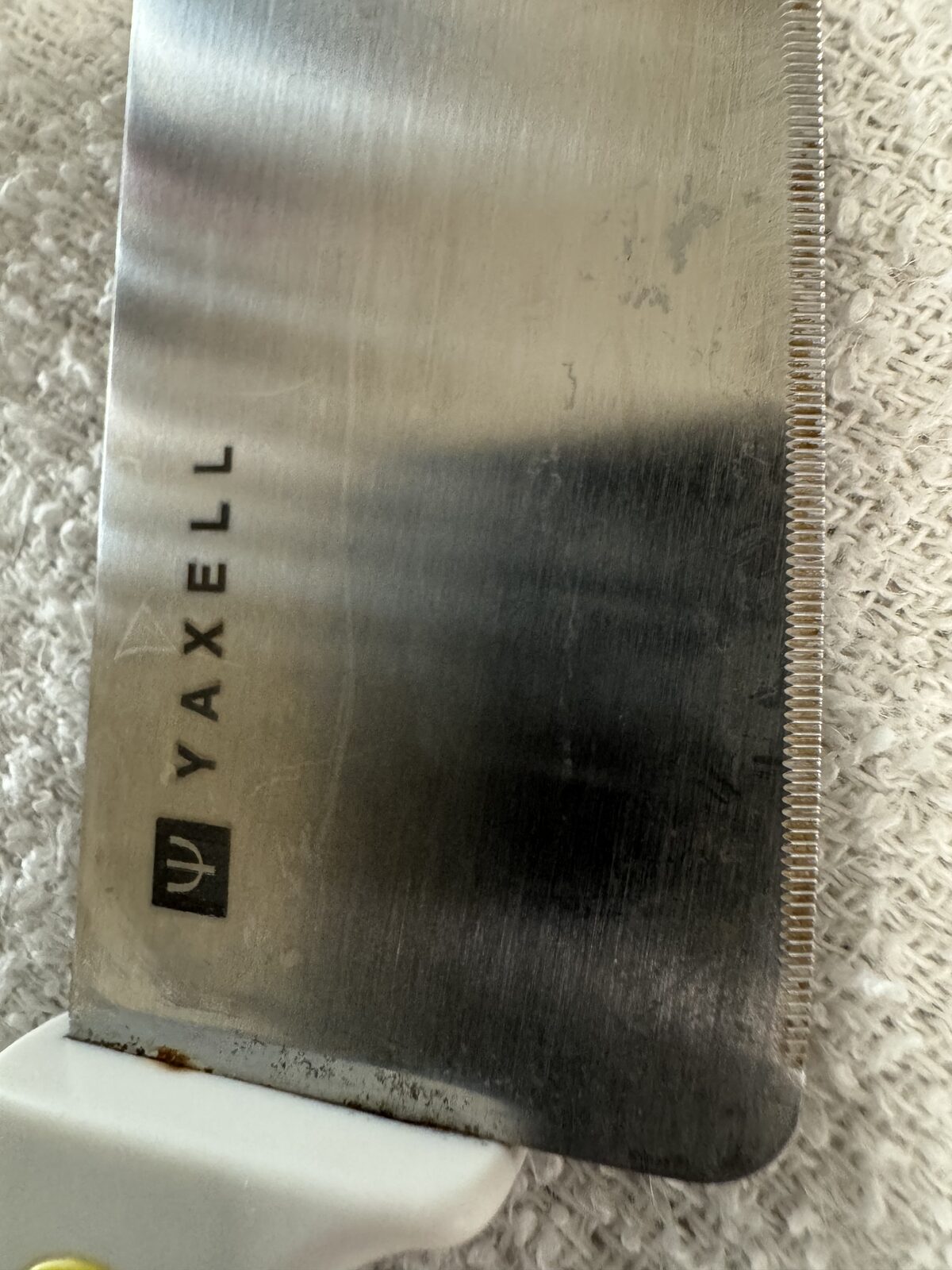
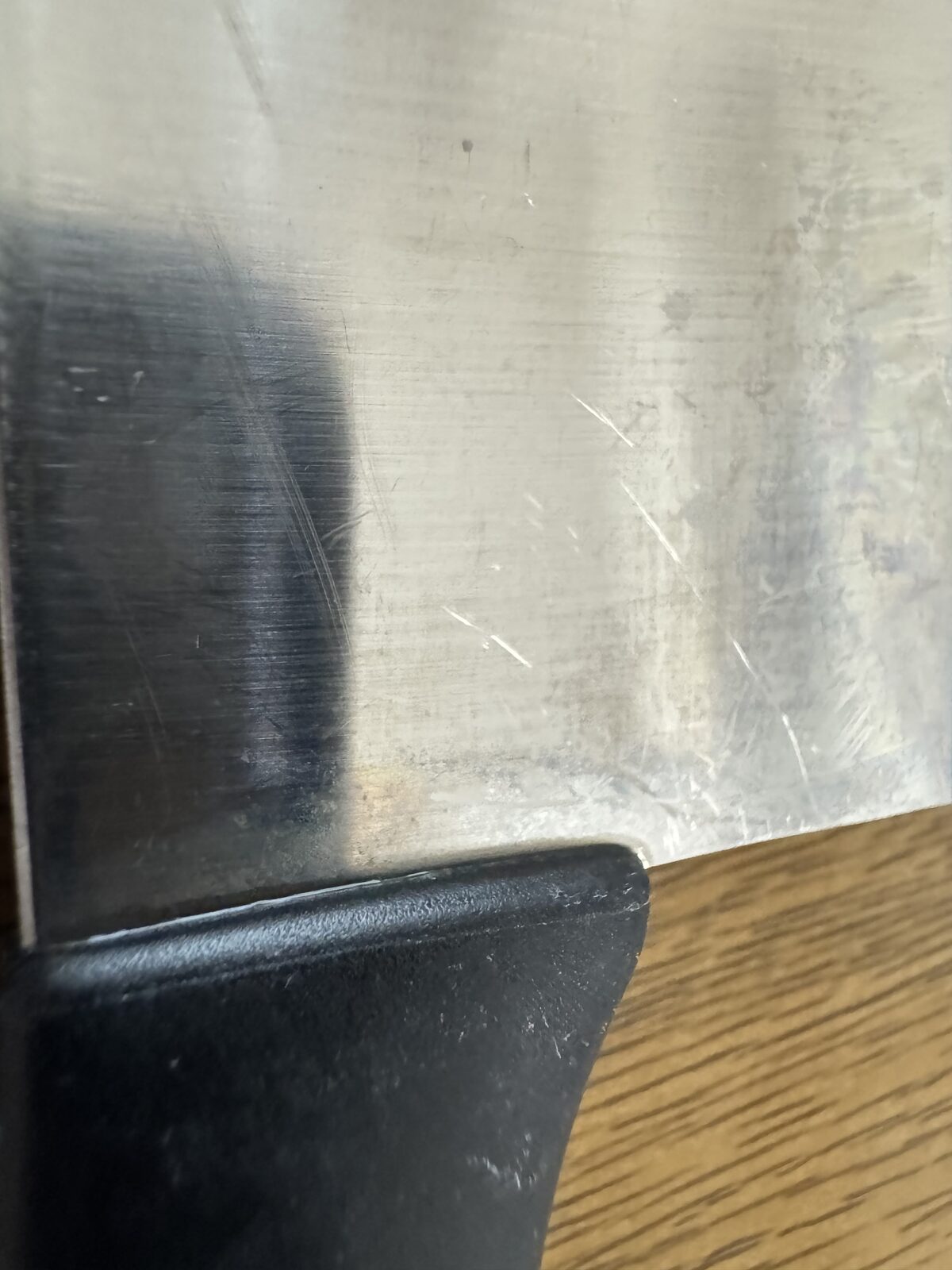
This one shows small orange-brown rust spots right along the joint where the blade meets the handle.
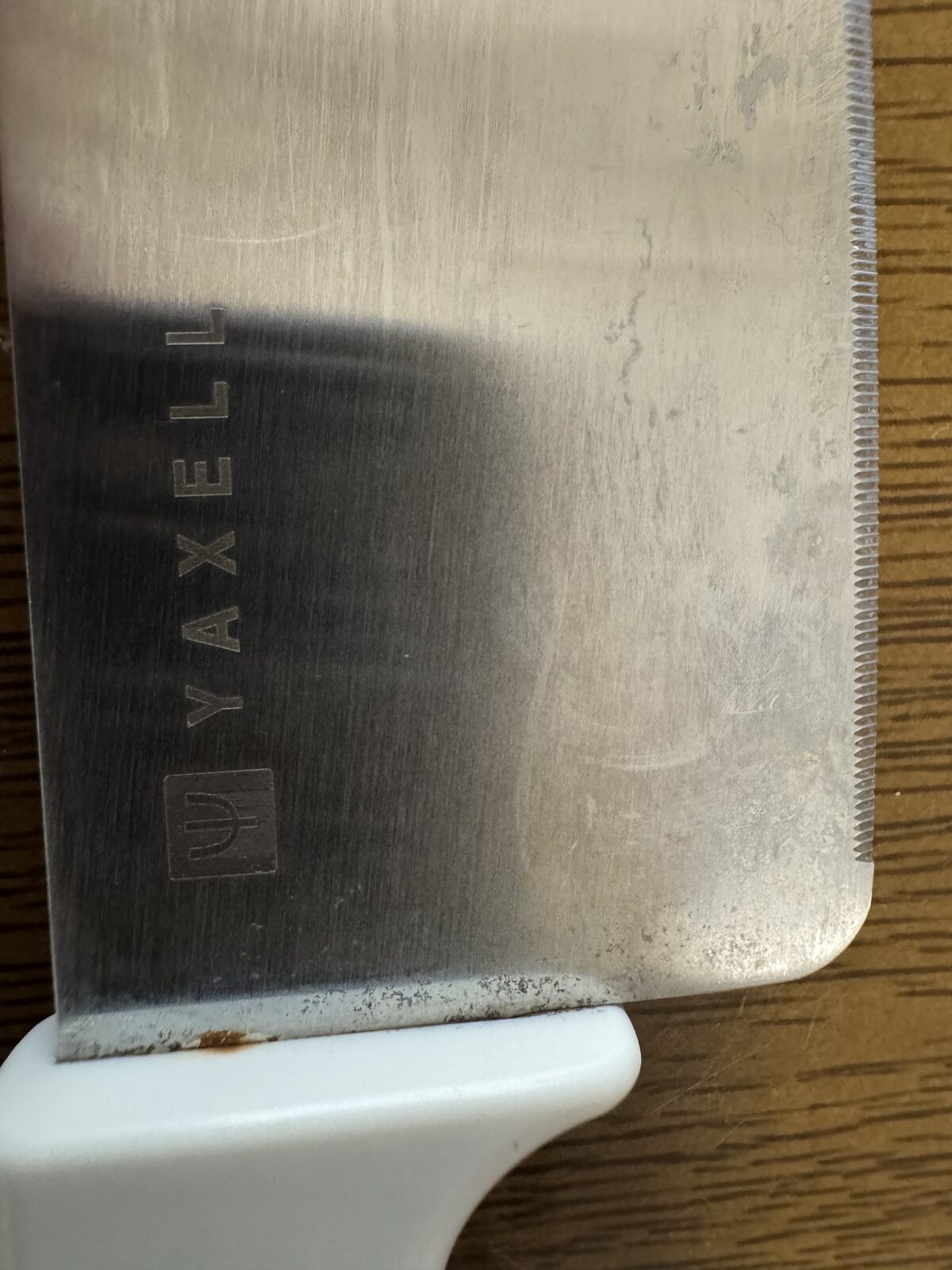
We can’t say this proves stainless rusts, since this knife’s steel isn’t marked. But the location fits what Knifewear names as a rust trigger: leaving a knife wet or with food residue on it. We’d guess a tight crevice like this stays damp longer after a quick rinse than the flat blade does, though we didn’t test that. It does line up with what our editor has noticed: rust tends to show up at the base of the blade, near the handle.
Across the knives, our editor also notices some cloudiness building up with regular use, but doesn’t polish it off.
Our tomato test: juice left on the blade for 5 minutes
This is a small, informal check on a single knife, not a lab test, so treat the result as a modest data point rather than a rule. Our editor cut a tomato with the santoku, left the juice on the blade for 5 minutes, then washed it as usual: no marks or cloudiness were left behind. We don’t have photos of this specific test, only the written result from our editor’s notes.
Washing and drying, step by step
Beyond the daily routine above, here’s how the makers we checked recommend doing it. Press the knife against the cutting board and scrub it with a sponge. A single wipe won’t fully dry a blade, so wipe it more than once, then let it sit somewhere well ventilated for about five minutes before you put it away. Kai also notes that pouring hot water over the blade speeds up drying and has a sanitizing effect.
What about the dishwasher?
Makers disagree here, but the safe default is: don’t. Shun/Kai USA and Seido both say never put a Japanese knife in the dishwasher. Seido points to the heat, alkaline detergent, and vibration against other items as the problems: they can dull the edge, damage the handle, and promote corrosion. Zwilling is more permissive but still cautious: it says knives made from its own special-formula steel are dishwasher-safe at 55°C (131°F) or lower, while noting that dishwashers generally shorten a knife’s life through harsh detergent tablets, high heat, and knocks against other items.
Our editor doesn’t own a dishwasher. During a restaurant part-time job, they put washed stainless knives into the restaurant’s dishwasher, and say they’d do the same at home if they had one. That’s a real habit, but our advice for a Japanese-style knife you care about is still to hand wash it.
Storage
Store a knife in a block (spine-first), on a magnet, or in a blade guard, rather than loose in a drawer where the edge can hit other things. For long-term storage, wrapping the knife in newspaper and keeping it somewhere dry helps prevent rust. Our editor stores knives handle-up, blades down, in a white slotted knife holder.
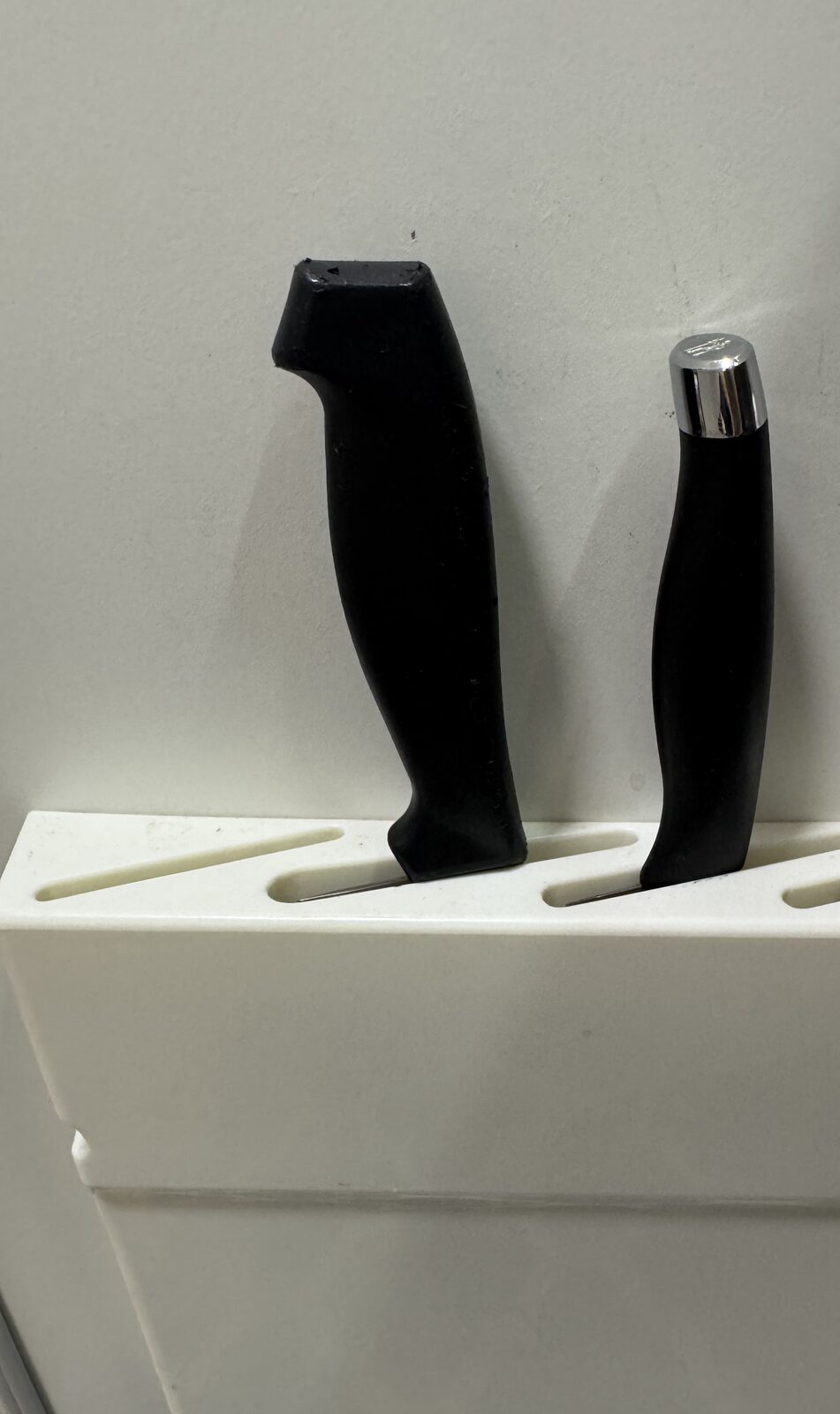
The spot has a little humidity but isn’t constantly damp.
Preventing chips
Use a soft cutting board rather than glass, marble, granite, ceramic, or titanium, which can chip a Japanese blade. See our guide to cutting boards for Japanese knives for what to look for. Avoid cutting bones, frozen food, or twisting the blade, and don’t scrape food off the board with the edge. For what it’s worth, none of our editor’s three knives has chipped so far.
Sharpening and honing (research only)
Sharpening is outside what our editor has done for this guide; a future article will cover it hands-on. If you are choosing a first stone, see our whetstone grit guide for beginners. Care guides don’t agree on how often to sharpen:
| Source | Recommended frequency |
| Musashi (retailer) | Every 1–2 months for a knife in regular use |
| Seido (retailer) | Every 3–6 months for regular home use |
| Shun/Kai USA (maker) | Once or twice a year for most home cooks |
The gap likely comes down to how often you cook and what you cut on. A simple everyday check: if the blade starts sliding across something like tomato skin instead of catching it, that’s a sign it’s due for attention.
Options include a whetstone, a professional sharpening service, or honing between sharpenings with a ceramic rod, which Seido recommends over a coarse honing steel. Our editor doesn’t own a whetstone. When raw fish or meat starts feeling hard to cut, they run the blade through a small sharpener rather than sharpening on a regular schedule. As an aside, our editor recalls that their family used a whetstone at home, usually outside in the backyard where they could run plenty of water without worrying about the mess, and figures doing it in the bathroom (the bath area) would leave it feeling grimy. That’s just one family’s impression, not a tested method.
If you find rust
Light rust on stainless usually comes off with a kitchen cleanser or a rust eraser. Seido suggests a baking soda paste rubbed along the grain, and Knifewear points to Bar Keepers Friend as another option. Deeper rust needs a whetstone or a professional, and it may leave a permanent mark even once it’s removed. Either way, dry the blade afterward, and for carbon steel, follow up with a thin coat of oil.
For light spot treatment, a dedicated rust eraser (sabitori) is a straightforward option we haven’t tested ourselves. Bar Keepers Friend, the cleaner Knifewear recommends for rust on stainless, is another option. We haven’t tested it on these knives.
Do you need camellia oil?
This section is research, not something we’ve tested. For a stainless knife used and dried daily, the care guides we checked don’t call for regular oiling. For knives used rarely or going into long storage, Sakai Ichimonji recommends a thin coat of camellia oil (tsubaki oil), a plant-based oil that doesn’t dry out or go sticky the way salad oil can. Musashi, a knife retailer, instead suggests oiling with camellia, mineral, or cooking oil after every cleaning. Sakai Ichimonji specifically advises against salad oil for this because it can turn sticky over time. Seido and Okami Blades both suggest food-safe mineral oil as an alternative. If you want to try it, Kurobara camellia cutlery oil is a dedicated tsubaki oil made for this (not tested by us).
Our verdict: buy stainless if…, carbon steel if…
Shipping rules for kitchen knives vary by country and state. Check the seller’s shipping policy and your local laws before ordering.
Buy stainless if you won’t reliably hand-dry a knife within a few minutes of washing it, you use a dishwasher out of habit, or you live somewhere humid without good knife storage. A stainless santoku or a stainless gyuto (a chef’s knife) is an easy-care starting point.
Our pick for a stainless gyuto: the Kanetsune KC-170 gyuto, 210 mm (8.3 in), stainless, double edged, 60–62 HRC, listed at $110.99 on Oct 8, 2026. We chose it from the shop’s listings; we haven’t used this exact knife.
Kanetsune 210 mm stainless gyuto at Hocho Knife
Consider carbon steel if you’re willing to hand wash and dry it every time, you don’t mind (or want) a patina developing, and you’re comfortable with occasional touch-up care. A carbon-steel gyuto is one option; our editor doesn’t have a knife confirmed as carbon steel, so this pick is a research-based suggestion rather than a personal recommendation.
FAQ
Can Japanese knives go in the dishwasher?
Generally no. Most makers we checked say to hand wash instead, and even Zwilling’s dishwasher-safe claim only applies to certain steels at 55°C (131°F) or lower, without saying which product lines qualify.
Do stainless Japanese knives need oil?
Not usually, if you wash and dry it after every use. Oil is mainly for carbon steel or for any knife going into long-term storage.
Is the discoloration on my carbon knife rust?
Check the color and texture: smooth blue, gray, purple, or black is patina; rough, raised, or flaky orange, red-brown, or yellow is rust. If your fingernail catches on it, it’s rust.
How often should I sharpen?
Recommendations range from every 1–2 months to once or twice a year, depending on how much you cook and what board you use. We haven’t tested sharpening ourselves yet.
Sources
The facts in this guide were checked against these pages (accessed September 2026), alongside our editor's own notes and photos. Pages marked (in Japanese) are written in Japanese.
- Sakai Ichimonji Mitsuhide: 包丁の錆止め (in Japanese)
- Seido: How to Properly Maintain a Japanese Knife
- Shun (Kai USA): Blog: Caring for Your Japanese Knives: Storage, Cleaning & Maintenance
- Kai: 包丁が錆びてしまいました。なぜでしょうか?お手入れはどうしたらよいのでしょうか? (in Japanese)
- Knifewear: Can Stainless Steel Knives Rust? (Yes, Here's Why)
- Okami Blades: Knife Rust vs Patina: How to Tell the Difference and What to Do
- Sakai Ichimonji Mitsuhide: 企業情報 | 堺一文字光秀 (in Japanese)
- Henckels: Our Family of Brands
- Zwilling: HOW TO CLEAN AND CARE FOR YOUR KNIFE
- Kai: 包丁のお手入れ方法|貝印包丁サイト (in Japanese)
- Musashi: Beginner’s Guide: 5 Easy Ways to Care For Your Japanese Knife
Related guides
- Cutting boards for Japanese knives
- Gyuto vs santoku: which Japanese knife to buy first
- Nakiri vs santoku: do you need a vegetable knife?
- Whetstone grit for beginners: which stone to buy first
More buying, sharpening, and steel-comparison guides will be added here as they publish.
Written by the Japanese Toolbox AI editorial team and reviewed by Ken, our editor in Japan, who uses the tools shown in the photos. Approved for publication by Ken on September 25, 2026. How we work · @JapaneseToolbox on X