Disclosure: This post contains affiliate links. If you buy through them, we may earn a commission at no extra cost to you. We only recommend tools our editor has handled or researched in depth. Learn more
A wa handle is typically an insert-style wooden handle fitted over a heated tang (nakago), the narrow part of the blade that goes into the handle, rather than riveted. Tojiro says it’s built so the same blade can be used for a long time by replacing the handle. Tojiro is a knife maker based in Tsubame, Niigata Prefecture, that makes and sells kitchen knives and cooking tools. A Western handle, also called a yo handle, is fixed to the blade with rivets, glue, or one-piece molding instead. Tojiro says a Western handle isn’t designed with replacement in mind. Tang construction is one factor in durability.
Our take: wa construction is designed for replacement, whereas Western handles generally are not, although wooden ones are sometimes replaced. Among the Western constructions Tojiro describes, full tang is its most durable and reliable. If you like the idea of re-handling a knife you plan to keep for years, choose wa. This guide is built from Japanese makers’ own pages, not hands-on testing. If you’re still deciding on the knife itself, see our guide to choosing between a gyuto and a santoku.
Wa vs Western handles at a glance
| Wa (Japanese-style) handle | Western (yo) handle | |
|---|---|---|
| How it’s attached | Typically a heated tang pushed into a wooden handle, not fully fixed with glue or rivets (Tojiro) · same heated-tang, insert-type construction (Takahashi Kusu) | Fixed with rivets, glue, or one-piece molding (Tojiro) |
| Designed to be replaced? | Yes — built so the same blade can be kept for a long time by replacing the handle (Tojiro) | Not designed with replacement in mind, though wooden Western handles are sometimes replaced (Tojiro) |
| What’s inside (tang) | A heated tang pushed into the wood (Tojiro) | Full tang, spine tang, or half tang, depending on the knife (Tojiro) |
| Common ferrule / handle materials | Buffalo horn or plastic ferrule, with a hou wood, ebony, or rosewood body (Jikko, Takahashi Kusu, Tojiro) | Wood with rivets, resin-molded, or one-piece handles made from rust-resistant stainless steel such as 18-8 (Tojiro) |
| Handle-specific care point | Tap the butt 2–3 times with a plastic hammer to fix a loose handle (Tojiro) | On spine-tang handles specifically, water can get in between the tang and wood and rust the tang (Tojiro) |
| Shapes | Oval (koban), chestnut (kuri), octagonal (Jikko) · round, shinogi, octagonal (Takahashi Kusu) | — |
How a wa handle is built
Heated tang, pushed into wood
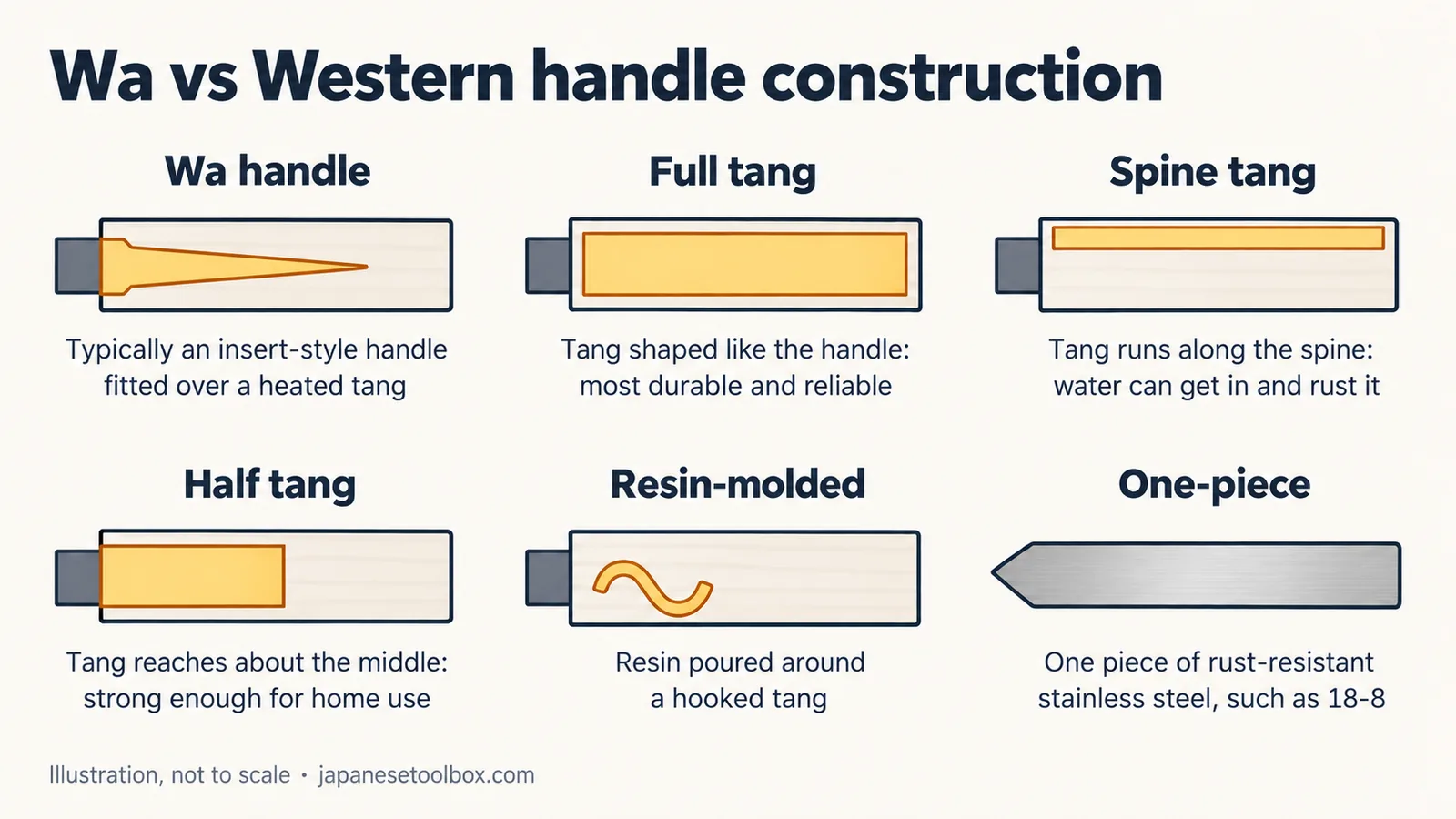
Wa handles are generally an insert-type construction, Tojiro says: the tang is heated and pushed into the wooden handle, and it isn’t fully fixed with glue or rivets. Tojiro describes this as built for natural wood, so the same blade can be kept for a long time by replacing the handle.
Takahashi Kusu (株式会社高橋楠, Takahashikusu Co., Ltd.), a knife manufacturer-wholesaler in Sakai, Osaka, founded in 1917, describes the same kind of construction: the tang is heated and inserted into natural wood, and the heat, together with the wood shrinking at the ferrule, makes the blade hard to pull out.
The ferrule (katsura)
The ferrule (katsura) — the collar at the blade end of a wa handle — affects how tightly a wa handle grips the tang. Tojiro says a buffalo horn ferrule shrinks over time and tightens its grip on the tang, and that it’s used on top-grade handles. Plastic ferrules made of hard resin or a rubber-type material are now common in place of buffalo horn, Tojiro says, and are not especially resistant to loosening compared with horn.
How a Western handle is built
A Western handle is fixed with rivets, glue, or one-piece molding, and Tojiro’s guide opens by saying Western handles aren’t designed with replacement in mind.
That said, “Western” doesn’t mean one fixed construction. Sakai Jikko, a Sakai knife company that makes and sells kitchen knives, run by its fourth-generation president, Toshiyuki Jikko, says its own knives (實光刃物の包丁) come with three main handle types: a wa type, where the blade is inserted into the handle; a Western type, where handle slabs sandwich the blade and are fixed with rivets; and an all-stainless type, where the blade and handle are made as one piece. In other words, on Jikko’s own range a Western-style knife like a gyuto (a chef’s knife) can come with a wa-style handle instead of a riveted one.
Full, spine, and half tang
Tojiro’s own guide breaks Western-handle tangs into three types:
| Tang type | What Tojiro says |
|---|---|
| Full tang (本通し) | The tang is the same shape as the handle — the most durable and reliable construction, and the one most used in professional knives, paired with a bolster (口金). |
| Spine tang (背通し) | The tang runs only along the spine side of the handle, used in lower-priced home and professional knives. Because there’s a gap between the tang and the wood, water can get inside and rust the tang, so care is needed. |
| Half tang (半中子) | The tang reaches only about the middle of the handle — less durable, but strong enough for home knives. For long use, Tojiro suggests choosing a spine-tang or full-tang knife instead. |
Tojiro’s page also names two more Western constructions: a resin-molded handle, made by pouring resin around a hooked tang, and one-piece handles made from rust-resistant stainless steel such as 18-8. For hollow monaka-style handles, Tojiro says internal metal plates may be used to adjust the balance with the blade.
When a handle wears out: replacement
Wa handle replacement
Hou wood — a light, water-resistant wood used for wa handles — is one of the woods used under a wa handle’s ferrule, as the materials table above shows. Tojiro says hou wood is fairly water-resistant but can rot with age, and when that happens, the wooden handle needs replacing. Tojiro offers wooden wa handle replacement as one of its repair services, and its support page lists handle replacement among the maintenance it offers. See Tojiro’s repair and maintenance page for its own service.
Western handle replacement
Tojiro says Western handles aren’t designed with replacement in mind, and separately notes that a wooden Western handle can wear out before the blade does, and handles are sometimes replaced.
Handle materials
How Japanese makers describe handle materials
| Material | What the maker says | Source |
|---|---|---|
| Plastic (PC) ferrule | Jikko: the cheapest handle, common on household knives; the wood part is hou. Takahashi Kusu: a black plastic ferrule with poplar wood below, the most reasonably priced option. | Jikko; Takahashi Kusu |
| Buffalo horn ferrule | Jikko: buffalo-horn-ferruled handles are the most common handle type on professional cooks’ knives, sturdier than the plastic handle, with the horn and wood wearing together so no step forms. Takahashi Kusu: the hou wood below is fairly sturdy and water-resistant, and people often say it’s the best handle. Tojiro: used on top-grade handles. | Jikko; Takahashi Kusu; Tojiro |
| Ebony | Jikko: hard and water-resistant, but weak to temperature changes and can crack. Takahashi Kusu: probably the hardest handle wood, with some weight to it, and harder to get lately. | Jikko; Takahashi Kusu |
| Rosewood | Jikko: chosen by people who want a dark handle when ebony is a little expensive. | Jikko |
| Hou wood | Jikko: easy to work, water-resistant, and lightweight. Tojiro: fairly water-resistant, but can rot with age. | Jikko; Tojiro |
Handle shapes
Jikko’s shapes
Oval (koban): used on deba (a knife for preparing fish), and easy to apply force with. Chestnut (kuri): used on sashimi knives, with a point you can hook a finger on. Octagonal: the most expensive shape, looking upscale and easy to grip.
Takahashi Kusu’s shapes
Takahashi Kusu names round, shinogi, and octagonal as its three handle shapes. Round is often used on deba, and shinogi handles are used on knives such as the usuba — a thin single-bevel vegetable knife. See our guide to nakiri vs santoku for more on single-bevel knives. Octagonal is a little upscale and is often used on higher-quality blades.
Care differences that come from the handle
For washing, drying, and storage, see our Japanese knife care routine — the points below are specific to the handle itself.
- Loose wa handle: Tojiro says to tap the butt 2–3 times with a plastic hammer, or knock it on a hard, flat floor, to remove the play.
- Spine-tang Western handles: take care, since water can get in between the tang and wood.
- Ebony: weak to temperature changes and can crack, per Jikko.
- Hou wood: can rot with age, per Tojiro.
How to choose your handle
Our take, as a synthesis of the maker guidance above:
- Start with wa or Western based on whether you want the option of re-handling the knife later: wa construction is designed for replacement, whereas Western handles generally are not, although wooden ones are sometimes replaced.
- If you’re leaning Western, check the tang type on the listing — full, spine, or half — since Tojiro ranks full tang as the most durable, spine tang as needing water-related care, and half tang as strong enough for home use but less durable for the long run.
- If you’re leaning wa, consider the ferrule material — buffalo horn or plastic — per Tojiro’s description of each.
- Weigh the handle material against the table above.
- If the listing names a shape, use the descriptions above to know what you’re getting.
For steel, see our guide to which steel to choose.
Shipping rules for kitchen knives vary by country and state. Check the seller’s shipping policy and your local laws before ordering.
Glossary
- wa handle — Typically an insert-style wooden handle fitted over a heated tang rather than riveted.
- Western (yo) handle — A Western-style handle, fixed to the blade with rivets, glue, or molding.
- tang (nakago) — The narrow part of the blade that goes into the handle.
- full tang (本通し) — A tang shaped like the handle.
- spine tang (背通し) — A tang that runs only along the spine side of the handle.
- half tang (半中子) — A tang that reaches only about the middle of the handle.
- ferrule (katsura / kuchiwa) — The collar at the blade end of a wa handle.
- hou wood — A light, water-resistant wood used for wa handles.
FAQ
Can you replace a Western knife handle?
Tojiro says Western handles aren’t designed with replacement in mind, but wooden Western handles can wear out before the blade and are sometimes replaced.
Can you replace a wa handle?
Yes — Tojiro says a wa handle is built so the same blade can be kept for a long time by replacing the handle, and Tojiro offers wooden wa handle replacement as one of its own services.
Why is my wa handle loose, and how do I fix it?
Tojiro says to tap the butt 2–3 times with a plastic hammer, or knock it on a hard, flat floor. Plastic ferrules are not especially resistant to loosening compared with buffalo horn ferrules, per Tojiro.
Is a half-tang knife OK for home use?
Tojiro says a half tang is less durable but strong enough for home knives; for long use, it suggests choosing a spine-tang or full-tang knife instead.
Can a gyuto (a chef’s knife) come with a wa handle?
On Sakai Jikko’s own range, yes — Jikko says its Western-style knives come with a wa-type handle option alongside the riveted Western type and the all-stainless type.
Is an ebony handle a good idea?
Jikko calls ebony hard and water-resistant, but weak to temperature changes and can crack. Takahashi Kusu calls it probably the hardest handle wood, with some weight to it, and harder to get lately.
Sources
The facts in this guide were checked against these pages (accessed September 2026). Pages marked (in Japanese) are written in Japanese.
- Tojiro: ハンドル・柄の構造 (in Japanese)
- Tojiro: 会社情報 – 燕三条製包丁の藤次郎株式会社 (in Japanese)
- Takahashi Kusu: 和包丁の柄 | 堺打刃物 株式会社高橋楠 (in Japanese)
- Sakai Jikko: 和包丁の柄の材質・種類について (in Japanese)
- Takahashi Kusu: 会社概要 | 堺打刃物 株式会社高橋楠 (in Japanese)
- Sakai Jikko: 会社概要 | 包丁通販なら明治33年創業の大阪 堺の實光刃物 (じっこう) (in Japanese)
- Sakai Jikko: 實光刃物とは (in Japanese)
- Tojiro: 牛刀とは?特徴・三徳との違い・おすすめサイズの選び方【包丁メーカー解説】 (in Japanese)
- Tojiro: 研ぎ直し・修理 (in Japanese)
- Tojiro: 和包丁の形状 (in Japanese)
Related guides
- Gyuto vs santoku: which Japanese knife to buy first
- Nakiri vs santoku: do you need a vegetable knife?
- VG-10 vs Aogami vs Shirogami: steel for a first knife
- Japanese knife care routine
Researched and written by the Japanese Toolbox AI editorial team and reviewed by Ken, our editor in Japan. Approved for publication by Ken on September 29, 2026. How we work · @JapaneseToolbox on X