Dento kogeishi (伝統工芸士) is a title for a person: a craftsperson certified in the traditional techniques of one of Japan’s officially designated traditional crafts. It is not a mark on the knife itself. It’s one of three different labels you’ll see on Japanese knife listings; the other two are a designation for a craft (which can come with an inspection sticker) and a registered trademark for a place name. This explainer draws on the text of Japan’s 1974 traditional crafts law, the certifying association’s own pages, and production-area cooperatives’ pages, not hands-on testing.
Three labels, three different promises
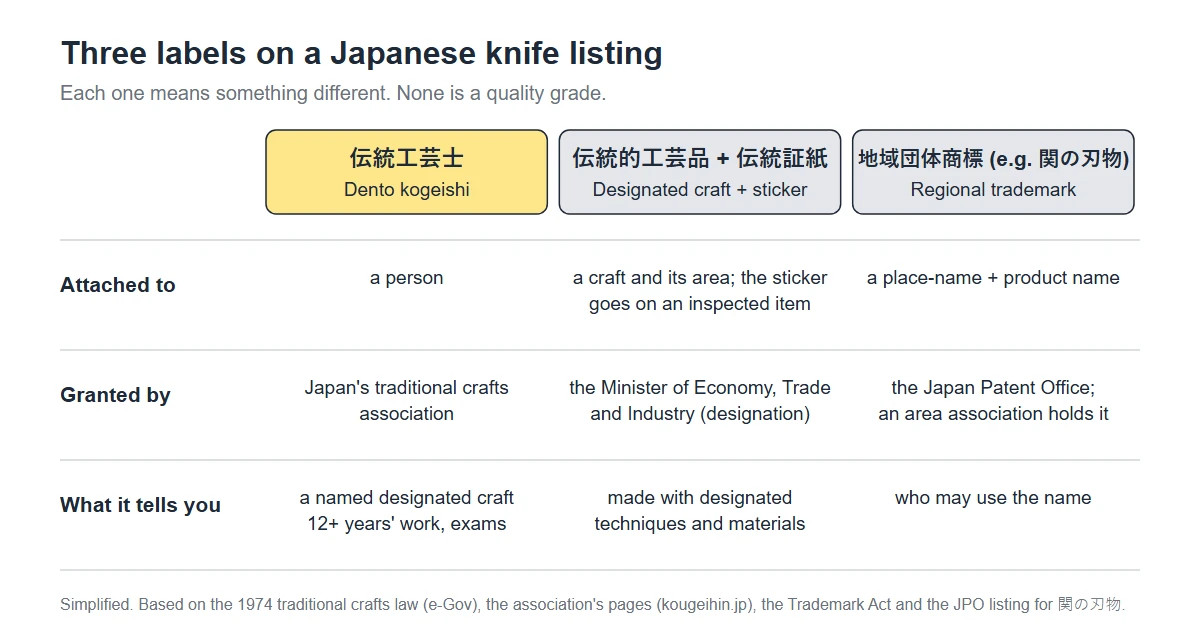
A listing that says “certified traditional craftsperson” is naming a person’s certification: Japan’s traditional crafts association grants this title to individuals for a named designated craft, under the 1974 law. The title alone doesn’t show what work, if any, that person did on this particular knife.
A listing that says “nationally designated traditional craft” is telling you about the craft and its region: the Minister of Economy, Trade and Industry designates the craft, and separately, an authorized production-area cooperative or equivalent body inspects individual items and can attach a sticker to the ones that pass. Both are about the craft and the item, not about the person who made it.
A registered name like 堺打刃物 (Sakai uchihamono) is telling you who is allowed to use that name. Sakai, in Osaka Prefecture, is known for knives. Under Japan’s Trademark Act, Article 7-2, qualifying associations can register a mark that combines a place name with a product name, for their members’ use. 堺打刃物 and 堺刃物 are registered trademarks held by Sakai’s knife-makers’ federation. The three labels don’t always appear together, and none of them is a grade or a quality score.
Dento kogeishi: a title for a person, tied to one craft
Dento kogeishi is a title the association gives to people who hold the traditional techniques of a craft the Minister of Economy, Trade and Industry has designated. In the association’s own words: 「伝統工芸士は、経済産業大臣指定伝統的工芸品の伝統的技術・技法を有している方の称号です」. The association certifies the title, not the ministry: 「当協会が認定を行っており、現在、全国で約3,200名の伝統工芸士が活躍されています。」. Its legal basis is the 1974 law, which lists among the association’s duties 「伝統的な技術又は技法に熟練した従事者の認定を行うこと」.
How someone earns the title
To be certified, a person needs at least 12 years of hands-on production experience in the craft’s production area, then has to pass practical, knowledge, and interview exams: 「伝統的工芸品の製造地域における製造実務経験を満12年以上積んだ上で、実技試験・知識試験・面接試験に合格することが必要です。」. After certification, the association checks skills again every five years to keep someone listed: 「認定後も5年毎に技量等の確認を行っており、伝統工芸士として相応しいと認められている方が、引き続き登録されています。」. About 3,200 people hold the title across all designated crafts, on a list dated February 25, 2026.
What it tells you about one knife, and what to ask
The title belongs to the person, for a designated craft — it doesn’t describe a specific knife on its own. In Sakai, knives are traditionally made by separate specialists for forging, sharpening, and handle-fitting, so one knife can pass through several people’s hands before it’s finished. That’s worth keeping in mind when a listing names a dento kogeishi: it’s reasonable to ask which step that certified person actually did on this particular knife.
Knifewear, a knife retailer, is one example of how this appears on a product page: it describes a smith as “certified as a traditional craftsperson (Dento Kogeishi), a mark of … skill and talent.” The certifying body, the requirements, and which craft is involved are covered above.
Designated traditional craft and the 伝統証紙 sticker
Dentō-teki kōgeihin (伝統的工芸品), or “nationally designated traditional craft,” is a craft that the Minister of Economy, Trade and Industry designates under the 1974 law; it refers to a craft, not a person. The Minister designates a craft after hearing the Industrial Structure Council: 「経済産業大臣は、産業構造審議会の意見を聴いて、工芸品であつて次の各号に掲げる要件に該当するものを伝統的工芸品として指定するものとする。」. The law sets five requirements for designation: mainly for daily use, mostly handmade, made with traditional techniques, made with traditional materials, and produced by a fair number of people in one area. The association glosses “traditional techniques” as roughly 100 years of continuity, 「100年間以上の継続を意味します」, and glosses the “fair number of people” requirement as an assumed scale of 10 companies or 30 people, 「ある程度の規模とは、10企業以上または30人以上が想定されています」. Designation also fixes the specific techniques, materials, and production area that apply to that craft. As of October 27, 2025, there are 244 designated crafts nationwide, 「経済産業大臣が指定する「伝統的工芸品」は全国に244品目あります」.
Forged-blade crafts on the list
“Uchihamono” (打刃物, forged blades) in a craft’s name doesn’t automatically mean kitchen knives. Of the 244 designated crafts, exactly seven are forged-blade crafts, according to the designated-craft list dated October 27, 2025.
| Craft (Japanese) | Prefecture | Designated | Main products as listed | Kitchen knives listed? |
|---|---|---|---|---|
| 越前打刃物 (Echizen uchihamono) | Fukui | Jan 12, 1979 | sickles, hatchets (nata), scissors, kitchen knives | yes |
| 信州打刃物 (Shinshu uchihamono) | Nagano | Mar 5, 1982 | sickles, kitchen knives, hatchets | yes |
| 堺打刃物 (Sakai uchihamono) | Osaka | Mar 5, 1982 | kitchen knives | yes |
| 越後与板打刃物 (Echigo Yoita uchihamono) | Niigata | Mar 12, 1986 | chisels, planes, axes, adzes, carving tools and other carpentry tools | not listed |
| 播州三木打刃物 (Banshu Miki uchihamono) | Hyogo | Apr 8, 1996 | saws, chisels, planes, small knives (kogatana) | not listed |
| 土佐打刃物 (Tosa uchihamono) | Kochi | May 6, 1998 | axes, saws, sickles, kitchen knives, hatchets, hoes and more | yes |
| 越後三条打刃物 (Echigo Sanjo uchihamono) | Niigata | Apr 28, 2009 | kitchen knives (庖丁), small knives, planes, chisels, hatchets, sickles, pruning shears and more | yes |
From the craft pages of the association’s site, kougeihin.jp (checked Oct 2026). “Not listed” means kitchen knives aren’t among the main products on that page, not that no knives are made there.
Masahiro, a knife maker in Seki, Gifu, calls Seki 「刃物の町」 (“a knife town”). Seki’s knives aren’t among the 244 crafts on the designated list as of October 27, 2025. Whether a specific knife carries the inspection sticker is a separate question, covered below.
The sticker: what passing inspection means
The 伝統マーク (dento mark) is the symbol for designated traditional crafts: 「伝統マークは、経済産業大臣指定伝統的工芸品のシンボルマークです。」. The 伝統証紙 (dento shoshi) is the sticker that carries that symbol. In the association’s words, it goes on products made with the designated techniques and materials that have also passed the production area’s inspection: 「経済産業大臣が指定した技術・技法・原材料で制作され、産地検査に合格した製品には、伝統マークのデザインを使った『伝統証紙』が貼られています。」. That inspection is carried out by an authorized production-area cooperative or equivalent body under its own rules, the 「伝統証紙表示実施規程」. The association describes what the sticker means this way: 「この伝統証紙が貼られている製品は、検査を実施したものであり、品質について誇りと責任をもってお届けする製品です。」 — in other words, products that have been inspected, and that the producers deliver with pride in and responsibility for their quality.
The law frames this as something authorized production-area cooperatives or equivalent bodies may do, not something they must do: 「特定製造協同組合等は、…伝統的工芸品として指定されているものであることの表示を付することができる。」.
Regional trademarks: who may use a place name
Japan’s Trademark Act, Article 7-2, lets cooperatives and similar associations register a mark made of a region name plus a common product name, for their members’ use, once the mark is widely recognized as identifying their or their members’ goods. This is a separate question from whether a craft is designated or whether an item carries the sticker.
堺打刃物 (Sakai uchihamono) and 堺刃物 (Sakai hamono) are registered trademarks held by Sakai’s knife-makers’ federation, registration numbers 5081094 and 5081093, in class 8, covering kitchen knives and scissors made in Sakai, Osaka and the surrounding area by methods originating there. Registration was finalized on October 5, 2007. The federation’s own page states plainly: 「『堺打刃物』『堺刃物』は堺刃物商工業協同組合連合会の登録商標です。」.
関の刃物 (Seki no hamono) is a registered regional collective trademark (地域団体商標), registration number 5150803, held by 協同組合岐阜県刃物会館, a knife-industry cooperative in Seki, Gifu Prefecture. Its designated goods include kitchen knives (ほうちょう類) whose main production steps take place in Seki and the surrounding area. The trademark’s own listing cites “700-plus years of history and tradition” behind the craftsmanship — a figure from the trademark holder, not an independent source. This is a useful contrast with the craft designation covered above: a registered trademark is a separate status from the nationally designated traditional craft list.
A trademark answers “who may use this name.” A craft’s designation and its sticker answer a different question: which craft this is, and whether this specific item passed the production area’s inspection.
Reading a Japanese knife listing with these labels in mind
These labels don’t settle whether a knife is worth its price. They’re worth decoding so you know what you’re actually looking at. A few questions to ask when you see one of these words on a listing:
- Is the label about a person, a craft, or a name?
- If it’s a person’s title, which designated craft is it for, and what did that person do on this knife?
- If it says “designated traditional craft,” is that the region’s designation, or does the item carry the inspection sticker?
- If a place name is used, is it a registered name held by a production-area body, as with 堺打刃物 or 関の刃物?
Japanese words worth looking for on boxes, tags, and photos: 伝統工芸士, 伝統的工芸品, 伝統証紙 / 伝統マーク, and ®.
How a knife actually performs at the cutting board comes down to things like the knife type and the steel and how it’s heat-treated. For how sharp a specific knife is out of the box, see how knife sharpness is actually measured.
Sources
The facts in this guide were checked against these pages (accessed September 2026). Pages marked (in Japanese) are written in Japanese.
- laws.e-gov.go.jp: e-Gov 法令検索 (in Japanese)
- kyokai.kougeihin.jp: 伝統工芸士について (in Japanese)
- kyokai.kougeihin.jp: 法律(伝産法) (in Japanese)
- Sakai City: 堺打刃物 堺市 (in Japanese)
- laws.e-gov.go.jp: e-Gov 法令検索 (in Japanese)
- sakaihamono.or.jp: 堺刃物商工業協同組合連合会/堺打刃物・堺刃物 商標について (in Japanese)
- Knifewear: Nao Yamamoto AS Kurouchi Tsuchime Damascus Santoku 165mm
- kyokai.kougeihin.jp: 伝統的工芸品について (in Japanese)
- kyokai.kougeihin.jp: 伝統的工芸品 指定品目一覧(業種別・令和7年10月27日現在) (in Japanese)
- kougeihin.jp: 越前打刃物 | 伝統工芸 青山スクエア (in Japanese)
- kougeihin.jp: 信州打刃物 | 伝統工芸 青山スクエア (in Japanese)
- kougeihin.jp: 堺打刃物 | 伝統工芸 青山スクエア (in Japanese)
- kougeihin.jp: 越後与板打刃物 (in Japanese)
- kougeihin.jp: 播州三木打刃物 (in Japanese)
- kougeihin.jp: 土佐打刃物 | 伝統工芸 青山スクエア (in Japanese)
- kougeihin.jp: 越後三条打刃物 (in Japanese)
- masahiro-hamono.com: 世界品質のものづくり。岐阜県関市の包丁専門メーカー。株式会社マサヒロ (in Japanese)
- kyokai.kougeihin.jp: 伝統的工芸品産業振興協会 (in Japanese)
- jpo.go.jp: 商標登録第5150803号 関の刃物(せきのはもの) (in Japanese)
Related guides
- Types of Japanese kitchen knives
- Japanese knife steel for beginners
- Gyuto vs. santoku
- Single bevel vs. double bevel
Researched and written by the Japanese Toolbox AI editorial team and reviewed by Ken, our editor in Japan. Approved for publication by Ken on October 4, 2026. How we work · @JapaneseToolbox on X