Disclosure: This post contains affiliate links. If you buy through them, we may earn a commission at no extra cost to you. We only recommend tools our editor has handled or researched in depth. Learn more
For most first Japanese knives, choose a stainless steel (ステンレス) — steel that resists rust — such as VG-10. Choose carbon steel (hagane, 鋼) — Aogami or Shirogami — only if you’re willing to dry the blade every time and to sharpen regularly. Between Aogami and Shirogami, Sakai Jikko, a Sakai knife company, frames the choice around your sharpening habits, not a ranking of one steel over the other.
VG-10 is a stainless blade steel made by Takefu Special Steel, a steel company in Echizen, Fukui Prefecture. Carbon steel can take a sharp edge but rusts more easily, and how easily it sharpens varies by alloy. Aogami (Blue steel) is White steel with chromium and tungsten added, and Shirogami (White steel) is a high-purity carbon steel on its own; both are registered trademarks of Proterial, a Japanese materials company (formerly Hitachi Metals).
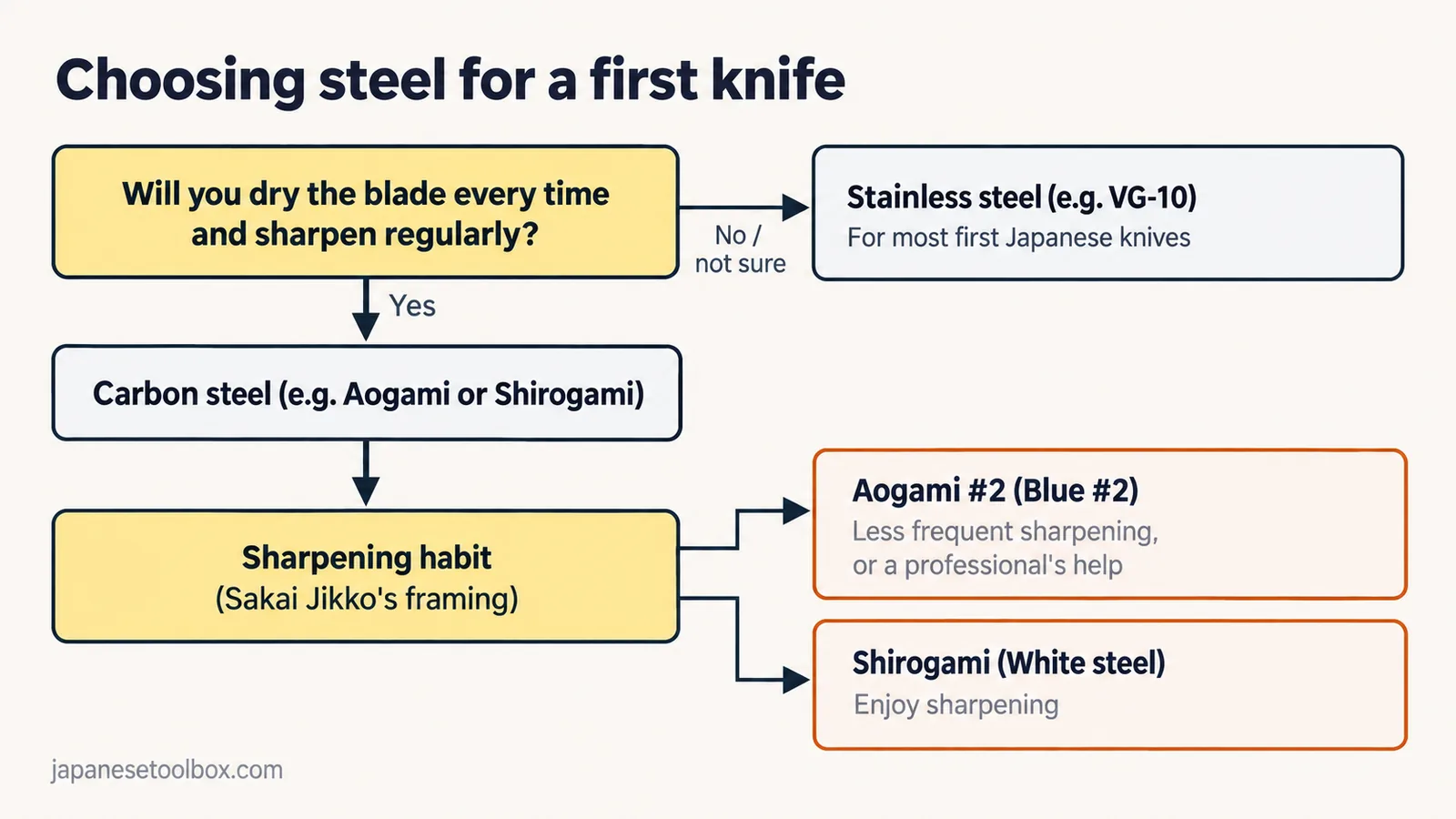
Tojiro, a knife maker based in Tsubame, Niigata Prefecture, that makes and sells kitchen knives and cooking tools, says stainless suits ordinary households because it resists rust and is easy to maintain. Sakai Jikko, a Sakai knife company that makes and sells kitchen knives, run by its fourth-generation head, Toshiyuki Jikko, says stainless is reassuring for home use and beginners.
This guide is built from Japanese makers’ and shops’ own buying guides, not hands-on testing. For rust prevention and daily care, see our Japanese knife care routine.
VG-10, Shirogami #2, or Aogami #2 at a glance
Hardness below is given in HRC — Rockwell C hardness, a common standardized measure of blade-steel hardness that Tojiro’s own guide uses; higher numbers mean a harder steel.
| VG-10 | Shirogami #2 (White #2) | Aogami #2 (Blue #2) | |
|---|---|---|---|
| Type | Stainless steel | Carbon steel (hagane) | Carbon steel (hagane) |
| Who makes the steel | Takefu Special Steel | Proterial (trademark) | Proterial (trademark) |
| How it’s described | Sakai Jikko: hard, cuts well, easy to sharpen | Sakai Jikko: high-purity carbon steel, easy to sharpen | Sakai Jikko: White steel with chromium and tungsten added, holds its edge long |
| Hardness, as stated by the maker | Takefu: as-quenched hardness “HRC60以上” (HRC 60 or higher) · Tojiro: HRC 58±1 | Tojiro: HRC 60±1 | Varies by knife; check the specific listing |
| Suits | Sakai Jikko recommends it because it is hard, cuts well, and is easy to sharpen. | Sakai Jikko: people who enjoy sharpening | Sakai Jikko: people who want to sharpen less often, or leave sharpening to a professional |
Jikko, Sakai Ichimonji Mitsuhide, and Tojiro each sell knives in the steels they describe, and Takefu makes and sells VG-10 itself. That doesn’t make their descriptions wrong — it’s useful context for weighing them.
Stainless or carbon: decide this first
Before comparing Aogami and Shirogami against each other, decide whether you want stainless or carbon steel at all — Japanese makers and shops treat this as the bigger fork in the road.
Tojiro says ordinary households do best with stainless steel, since it resists rust and is easy to maintain. Its separate steel guide adds that ordinary stainless can’t quite match carbon steel for sharpness, but its sharpness is fine for everyday home use.
Sakai Jikko’s basic rule: choose carbon steel (hagane) if sharpness matters most to you, choose stainless if convenience matters most. It also says stainless is reassuring for home use and beginners, while carbon steel rusts easily and needs regular care.
Sakai Ichimonji Mitsuhide, a knife shop in Osaka that opened in 1953 and sells knives and kitchen equipment, says carbon steel rusts but sharpens easily and offers good value. When asked for a recommendation for a first-time buyer, the shop recommends its White #2 (Shirogami #2) over cheaper steels like Yellow steel (kigami, 黄紙) — a cheaper carbon steel, also a Proterial trademark — or 8A, another steel Sakai Ichimonji Mitsuhide names in the same comparison.
These are separate guides from separate companies that describe the choice a little differently, not a single agreed rule. Our read, as a synthesis of the above: for most first-time buyers, start with stainless such as VG-10, and consider carbon steel once you’re ready to dry the blade after every use and sharpen it regularly. For how to prevent rust day to day, see our Japanese knife care routine rather than repeating that advice here.
What the steel names mean
VG-10
VG-10 (V金10号) is a stainless blade steel made by Takefu Special Steel, a steel company in Echizen, Fukui Prefecture, founded in 1954 as a material supplier to Echizen blade makers. Takefu’s own composition table lists VG-10 as 1.00% carbon, 15.00% chromium, 1.00% molybdenum, 0.25% vanadium, and 1.55% cobalt, with an as-quenched hardness of “HRC60以上” (HRC 60 or higher). Takefu says the chromium, molybdenum, and cobalt strengthen the steel’s base structure to achieve high hardness. Makers can select different finished hardness settings, so check the knife’s listing rather than assuming Takefu’s as-quenched figure applies directly.
Tojiro describes VG-10 as slightly behind carbon steel in sharpness but fairly rust-resistant. It also says VG-10’s cobalt content makes the steel’s base very hard, giving it good sharpness and wear resistance. Sakai Jikko calls VG-10 hard, good at cutting, easy to sharpen, and a steel the shop recommends.
Shirogami and Aogami
Shirogami (White steel) and Aogami (Blue steel) are registered trademarks of Proterial, a Japanese materials company that makes and sells specialty steel. Proterial was called Hitachi Metals until it changed its name in January 2023.
Sakai Jikko describes Shirogami as a high-purity carbon steel, with impurities kept to a minimum. It describes Aogami as White steel with elements like chromium and tungsten added to it. Sakai Ichimonji Mitsuhide describes White steel as pure, taking an edge easily, and Blue steel as having tenacity from its chromium and tungsten. The carbon ranges below come from Tojiro’s own steel guide.
What #1, #2, and Super mean
Tojiro publishes carbon-content ranges by grade: White #1 (Shirogami #1) 1.25–1.35%, White #2 (Shirogami #2) 1.05–1.15%, White #3 (Shirogami #3) 0.80–0.90%. Blue #1 (Aogami #1) and Blue #2 (Aogami #2) run about the same carbon range as the matching White grade, per Tojiro’s guide, and Blue Super (Aogami Super) — a Blue steel with more carbon and additives — runs 1.40–1.50%. Sakai Jikko explains the pattern behind those numbers: a lower grade number means a harder steel. Sakai Ichimonji Mitsuhide agrees that carbon content sets a steel’s maximum hardness, and orders the grades from hardest and priciest to softest: Super, then #1, then #2, then #3. A harder steel holds its edge longer but is harder to sharpen.
Clad knives
Clad material (複合材) bonds dissimilar materials by forging or rolling. Tojiro describes clad construction as combining the sharpness and easy sharpening of a carbon-steel edge with the easier maintenance of a stainless exterior. It also describes warikomi (割込), a type of clad construction, with a core of VG-10 or molybdenum vanadium steel (モリブデンバナジウム鋼) — another stainless blade steel Tojiro uses as a core — as well balanced for sharpness, durability, and ease of care. For what a damascus pattern does and doesn’t change, see are damascus knives worth it.
Shirogami #2 vs Aogami #2: how Japanese sellers describe them
| Source | Describes White #2 as | Describes Blue #2 as | Points it toward |
|---|---|---|---|
| Sakai Jikko — sells knives in both steels | White steel generally: easy to sharpen, takes a keen edge, holds it a little less long than Blue | Blue steel generally: keeps a sharp edge long, resists chipping, somewhat harder to sharpen | White: people who enjoy sharpening. Blue: people who want to sharpen less often, or leave it to a pro |
| Sakai Ichimonji Mitsuhide — sells knives in both steels | Best-balanced of the White grades; the shop’s general first-timer recommendation over cheaper steels | Adds chromium and tungsten versus White #2 | White: if you prioritize easy sharpening. Blue: if you prioritize resistance to wear and chipping |
| Tojiro — sells knives in both steels | White steel generally: harder than stainless with a sharp edge, but brittle and prone to chipping; easy to sharpen on a whetstone, with a good balance of sharpness and handling | Blue steel generally: heat treatment is less exacting, making uniform hardness easier to maintain, giving it a bit more toughness than White, so it’s a little less prone to chipping | Tojiro says White #2 is common in professional knives |
Sakai Jikko recommends Blue #2 for home cooks who want to sharpen less often, or who’d rather leave sharpening to a professional, and recommends White for people who enjoy sharpening. Sakai Ichimonji Mitsuhide puts it as a matter of priority: choose Blue if you care most about resistance to wear and chipping, choose White if you care most about easy sharpening. It adds that a pricier Blue steel isn’t automatically the better steel, and says that, citing a Hitachi Metals catalog, Blue #2 and White #2 share the same hardness. These are separate guides that describe White #2 and Blue #2 a little differently — treat the choice as one of sharpening habit and preference, not a ranking of one steel over the other.
A note on hardness (HRC) numbers
HRC, or Rockwell C hardness, is a common standardized measure of blade-steel hardness that Tojiro’s own guide uses. Higher numbers mean a harder steel.
Only a few maker-stated figures are available, each specific to its source: Takefu states VG-10’s as-quenched hardness as “HRC60以上” (HRC 60 or higher). Tojiro separately states its own VG-10 figure as HRC 58±1, its White steel as HRC 60±1, and its ordinary stainless blade steel as HRC 52±1. These are two different companies’ own figures for VG-10, stated under different conditions — Takefu’s is an as-quenched figure for the raw steel, and Tojiro’s is the hardness of Tojiro’s own finished knives. Don’t try to reconcile them into one number.
Makers can select different finished hardness settings, so check the knife’s listing rather than assuming a steel name guarantees one number.
Match the steel to how you’ll sharpen
As covered above, Sakai Jikko’s sharpening-habit framing — Blue #2 for less frequent sharpening or a professional’s help, White for people who enjoy sharpening — is a useful shortcut for choosing between the two carbon steels. Sakai Jikko separately calls VG-10 easy to sharpen.
Stone choice follows the same logic. Tojiro’s guidance that softer stones generally suit stainless knives and harder stones generally suit carbon-steel knives is already covered in our guide to which whetstone to buy first — see that guide for stone recommendations rather than repeating them here.
What to look for on a product page
- The steel name as sellers write it: “VG-10,” “Aogami #2 (Blue #2),” or “Shirogami #2 (White #2).”
- Whether the whole blade is stainless, or only the core is — on a clad or warikomi knife, a carbon-steel core still means the edge itself can rust, even though the surrounding steel resists it.
- The HRC stated for that specific knife, if the listing gives one — as shown above, the same steel name can carry different HRC figures from different sources.
- Your own willingness to dry the blade after every use and to sharpen it regularly.
Shipping rules for kitchen knives vary by country and state. Check the seller’s shipping policy and your local laws before ordering.
Glossary
- stainless steel — Steel that resists rust.
- carbon steel (hagane, 鋼) — Steel that can take a sharp edge but rusts more easily and needs regular care; how easily it sharpens varies by alloy (White steels are generally easier to sharpen than Blue steels).
- VG-10 (V金10号) — A stainless blade steel made by Takefu Special Steel. It contains cobalt and molybdenum, per the maker’s table.
- Shirogami / White steel (白紙) — A high-purity carbon steel, a Proterial trademark.
- Aogami / Blue steel (青紙) — White steel with chromium and tungsten added, a Proterial trademark.
- grade designation (#1, #2, #3, or Super) — A designation after the steel name. A lower number means more carbon and a harder steel that holds its edge longer but is harder to sharpen.
- clad / warikomi (複合材 / 割込) — Material formed by bonding dissimilar steels through forging or rolling.
- HRC — Rockwell C hardness, a common standardized measure of blade-steel hardness. Higher is harder.
FAQ
Is Blue steel better than White steel?
Not necessarily. Sakai Ichimonji Mitsuhide says a pricier Blue steel isn’t automatically the better steel — it’s a matter of preference. Sakai Jikko frames it as a matter of how often you want to sharpen: Blue #2 if you want to sharpen less, White if you enjoy sharpening.
Is VG-10 good for a first Japanese knife?
Tojiro and Sakai Jikko both describe it favorably for everyday use — Tojiro calls it fairly rust-resistant with sharpness close to carbon steel, and Sakai Jikko calls it hard, good at cutting, and easy to sharpen.
What does the #2 in Aogami #2 mean?
It refers to Tojiro’s carbon-content grading: Aogami #2 (Blue #2) runs about the same carbon range as White #2 (1.05–1.15%), per Tojiro’s guide. Sakai Jikko explains that a lower grade number means a harder steel.
Will a carbon steel knife rust?
Yes — Sakai Jikko says carbon steel rusts easily and needs regular care, and Sakai Ichimonji Mitsuhide says carbon steel rusts but is easy to sharpen and offers good value. See our Japanese knife care routine for day-to-day care.
Is White #1 better than White #2?
White #1 (Shirogami #1) raises the carbon content to increase sharpness compared with White #2, but Sakai Ichimonji Mitsuhide notes that as hardness goes up, sharpening gets harder too. The shop calls White #2 the best-balanced of the White grades.
Who makes Aogami, Shirogami, and VG-10?
Aogami and Shirogami are registered trademarks of Proterial, formerly Hitachi Metals. VG-10 is made by Takefu Special Steel.
Sources
The facts in this guide were checked against these pages (accessed October 2026). Pages marked (in Japanese) are written in Japanese.
- Sakai Jikko: 青紙・白紙どちらを選ぶ?プロが教える包丁の鋼材「ハガネ」の種類と特徴 (in Japanese)
- Tojiro: 包丁の種類と使い分け (in Japanese)
- Takefu Special Steel: V金10|武生特殊鋼材株式会社 (in Japanese)
- Sakai Ichimonji Mitsuhide: 包丁の素材「鋼」職人の技と科学が生み出す最高の切れ味 (in Japanese)
- Proterial: 高級刃物鋼 | PROTERIAL | 株式会社プロテリアル (in Japanese)
- Proterial: 会社概要 | PROTERIAL | 株式会社プロテリアル (in Japanese)
- Proterial: 沿革(ビジュアル編) (in Japanese)
- Tojiro: 会社情報 – 燕三条製包丁の藤次郎株式会社 (in Japanese)
- Sakai Jikko: 会社概要 | 包丁通販なら明治33年創業の大阪 堺の實光刃物 (じっこう) (in Japanese)
- Sakai Jikko: 實光刃物とは (in Japanese)
- Tojiro: 材料の種類 – 燕三条製包丁の藤次郎株式会社 (in Japanese)
- Sakai Jikko: 包丁の材質に使われるV金(V金1号,V金10号)とは? (in Japanese)
- Sakai Ichimonji Mitsuhide: 包丁の素材「白二鋼(白紙2号)」高い硬度でシャープな切れ味 (in Japanese)
- Sakai Ichimonji Mitsuhide: 包丁の素材「青二鋼(青紙2号)」切れ味別群で欠けにくい (in Japanese)
- Sakai Ichimonji Mitsuhide: 企業情報 | 堺一文字光秀 (in Japanese)
- Sakai Ichimonji Mitsuhide: 大阪の包丁専門店、堺一文字光秀の歴史 (in Japanese)
- Takefu Special Steel: 会社案内|武生特殊鋼材株式会社 (in Japanese)
- Takefu Special Steel: オリジナル刃物鋼 (in Japanese)
- Tojiro: 砥石の扱い方 (in Japanese)
- Tojiro: 包丁のお手入れ (in Japanese)
- Tojiro: 砥石の選び方 (in Japanese)
- Sakai Ichimonji Mitsuhide: 包丁の素材「白一鋼(白紙1号)」不純物を極限まで取り除いた逸品 (in Japanese)
Related guides
- Japanese knife care routine
- Whetstone grit for beginners
- Gyuto vs santoku: which Japanese knife to buy first
- Nakiri vs santoku: whether a nakiri is worth adding
Researched and written by the Japanese Toolbox AI editorial team and reviewed by Ken, our editor in Japan. Approved for publication by Ken on September 28, 2026. How we work · @JapaneseToolbox on X