Disclosure: This post contains affiliate links. If you buy through them, we may earn a commission at no extra cost to you. We only recommend tools our editor has handled or researched in depth. Learn more
A damascus knife is worth it if you want the look and are happy to pay for it. Every damascus knife examined in this guide is core-clad: the cutting edge is a separate core steel in the middle of the blade, and Japanese makers describe the patterned layers around it as cladding. So a core-clad damascus knife is not automatically sharper than a plain knife with the same core. This guide is built from Japanese makers’ own descriptions and dated shop listings, not hands-on testing. It covers the structure, what layer counts do and don’t mean, a same-maker price comparison, care, and how to check a listing.
What you’re looking at: core-clad construction
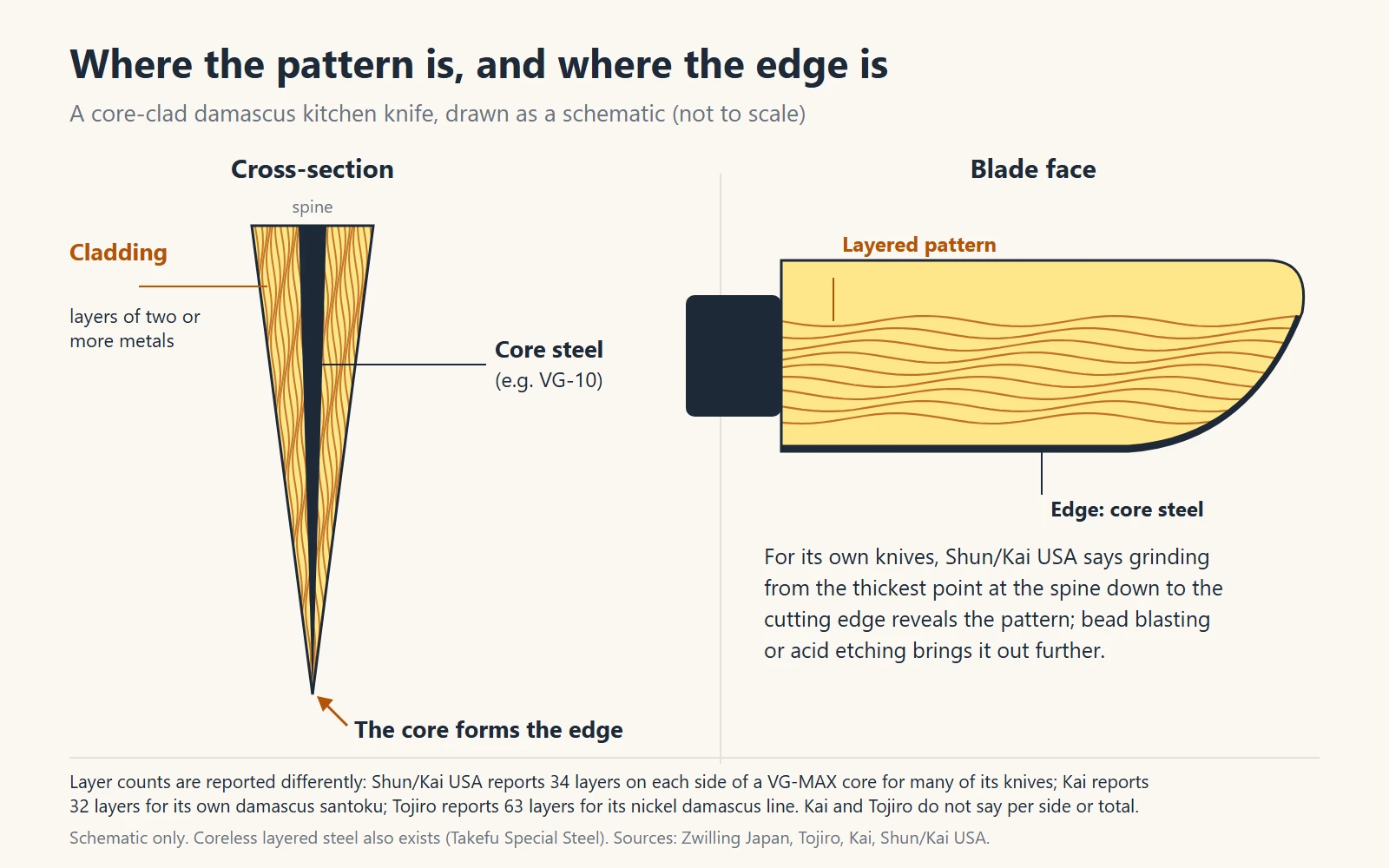
In core-clad construction, the edge is the core
Zwilling Japan’s definition describes the core-clad kind of damascus knife (ダマスカス): a blade made of two or more metals layered over a core material, with a wood-grain-like pattern. The core is a hard, sharp-edged steel, with a tougher steel layered on both sides to form the pattern.
Takefu Special Steel, the Fukui steel company that makes VG-10, also lists a coreless layered steel on its clad-metal page, made by layering two steels many times with no separate core (コアレス鋼).
Maker spec lines describe the same split. Tojiro, a knife maker in Niigata, lists its TOJIRO PRO nickel damascus line with a core (心材) of VG-10 — a stainless blade steel made by Takefu Special Steel — and a cladding (側材) of nickel damascus steel, in 63 layers.
Kai, a Japanese cutlery company, sells damascus knives in its Seki Magoroku line, a brand named after the noted Seki swordsmith Magoroku Kanemoto. It lists its Seki Magoroku damascus santoku (三徳) — Japan’s everyday all-purpose home knife for meat, fish and vegetables (“three uses”) — with a blade (刃体) of high-carbon stainless blade steel and stainless side metal (側金). For how core steels differ, see our guide to VG-10 vs Aogami vs Shirogami.
Where the pattern comes from
Across makers, the process follows a similar outline: two or more different metals are stacked and forged in many layers, then the surface is ground and finished so the layers show.
- Takefu Special Steel’s multi-layer material stacks two or more different metals and is used mainly as knife pattern material.
- Forging two stainless steels with different nickel content, in many layers, produces the ripple pattern on the nickel damascus line, and forging two stainless steels of different hardness does the same for the BASIC damascus line (Tojiro).
- Grinding each blade from its thickest point at the spine down to the cutting edge reveals the pattern, and bead blasting or acid etching brings it out further (Shun/Kai USA).
- Sandblasting is also named as a way the pattern is brought out (Zwilling Japan).
In short: grinding reveals the layered pattern, and blasting or etching can increase its contrast (Shun/Kai USA, on its own knives).
Same idea, plain version
San mai is a simpler version of the same construction: a very hard steel blade core clad with a single layer of “softer” steel on each side (Shun). Kai’s 木蓮 line uses a similar idea under a different name: a stainless three-layer steel that’s easy to re-sharpen (Kai). Clad material (複合材) bonds dissimilar materials by forging or rolling (Tojiro). Damascus cladding is a many-layer version of this same core-and-cladding construction, which some plain knives also use.
The old “Damascus steel”
The name traces to wootz steel (ウーツ鋼), the patterned steel of ancient India also called Damascus steel (Zwilling Japan). Today’s damascus kitchen knives are layered steel that recalls that old pattern, not the same material.
Does the pattern make a knife cut better?
Maker claims differ here, and each is a claim about that maker’s own knives, not a general rule:
- Zwilling Japan: the number of layers and the difference in pattern don’t affect cutting or other functions.
- Shun/Kai USA: for its own knives, the cladding supports and protects the core and adds stain resistance, and bead blasting adds surface texture that helps food release from the blade and reduces cutting drag.
- Tojiro: for its TOJIRO PRO nickel damascus line specifically, the forging process improves the core’s density and uniformity and greatly improves edge retention.
- Kai: Kai markets its Seki Magoroku damascus line as sharp, easy to sharpen, and able to keep its edge.
Our synthesis, not stated by any single source: two knives with the same core steel and the same listed hardness are worth judging on that core first. The cladding’s claimed benefits above are each maker’s own claim about its own knives, and we didn’t find a published test comparing a damascus blade with a plain blade of the same core (as of Oct 2026). See our guide to how knife sharpness is measured for how sharpness testing works.
What “33 layers” means, and doesn’t
Layer counts aren’t always reported with the same scope from maker to maker: Shun/Kai USA reports 34 layers of metal on each side of a high-performance VG-MAX cutting core, for many of its knives; Kai gives one number for its own damascus santoku, with no “per side” or “total” attached: 32 layers (32層); and Tojiro does the same for two of its own lines: 63 layers for its nickel damascus, and 37 layers for its kasumi-nagashi (霞流し) — Tojiro’s name for this rippled pattern. So the number is a label you can read on one maker’s own knife, not a spec you can compare across brands. The same would hold for any other count a listing prints, such as a “67-layer” label: it would describe how that maker counts the construction, not whether the knife cuts or lasts better than a lower-layer blade — and it’s worth checking whether the count is of total layers or layers per side.
Within one maker’s line, more layers can coincide with a higher price. At Hocho Knife (an affiliate partner), on Oct 12, 2026, Sakai Takayuki’s 17-layer VG10-core damascus santoku, 180 mm (7.1 in), was listed at about $128, and its 33-layer VG10-core version, also 180 mm, was listed at about $151. Both listings give a hardness of 60 ±1 HRC (Rockwell C hardness, a common standardized measure of blade-steel hardness; higher is harder) and a double-edged blade; the handles differ, as listed — black pakka wood with a stainless bolster on the 17-layer, pakka from mahogany on the 33-layer. Hocho Knife describes the 33-layer line as a higher grade than the 17-layer version.
Layer count doesn’t set the price across makers, either: a 33-layer VG-10-core santoku from Iseya, also 180 mm, was listed at about $122 at Hocho Knife the same day — less than Sakai Takayuki’s 33-layer version.
Layer count also doesn’t affect function (Zwilling Japan).
Same maker, with and without the pattern
A same-maker comparison narrows the variables, but it still cannot isolate the price of the pattern when the listings describe other differences.
At Kai’s online store, on Oct 12, 2026, the Seki Magoroku damascus santoku and the Seki Magoroku 木蓮 santoku, both 165 mm (6.5 in), are compared in the table below. Both listings describe knives made in Japan with laminated-wood handles (積層強化木), and both say the knives are not dishwasher-safe. The two listings name the blade steel differently, so the price gap isn’t a pattern-only comparison.
Damascus knives cost more than ordinary knives of the same grade because the layered construction requires more production steps and craftsmanship (Zwilling Japan).
At Hocho Knife, the same day, the table below adds a plain reference point to the Sakai Takayuki pair from the section above: the Kanetsune KC-170 santoku, 180 mm. The two Sakai Takayuki listings also differ in handle, as listed.
Kai, yen, tax included (Oct 12, 2026)
| Listing | Construction, as listed | Blade steel, as listed | Price |
|---|---|---|---|
| Seki Magoroku damascus santoku, 165 mm | Damascus cladding over a core | High-carbon stainless blade steel, stainless side metal | ¥16,500 |
| Seki Magoroku 木蓮 santoku, 165 mm | Stainless three-layer steel | High-carbon molybdenum-vanadium stainless blade steel, stainless outer layer | ¥9,350 |
Hocho Knife, USD — sale prices as listed (Oct 12, 2026)
| Listing | Construction, as listed | Core, as listed | HRC, as listed | Price |
|---|---|---|---|---|
| Sakai Takayuki 17-layer VG10 damascus santoku, 180 mm | 17-layer damascus hammered stainless | VG10 alloy core | 60 ±1 | about $128 |
| Sakai Takayuki 33-layer VG10 damascus santoku, 180 mm | 33-layer damascus hammered stainless | VG10 alloy core | 60 ±1 | about $151 |
| Kanetsune KC-170 santoku, 180 mm (plain reference, not damascus) | — | Stainless, as listed | 60–62 | about $111 |
A dash means the listing we used doesn’t give that line for that knife.
At Kai, the damascus santoku cost ¥7,150 more than the 木蓮 santoku on Oct 12, 2026 (¥16,500 minus ¥9,350), but the listings name different blade steels, so the gap isn’t the pattern alone.
Living with a damascus blade: rust, dishwashers, and sharpening
Wash, dry, and store it somewhere dry and airy: Zwilling Japan describes its own damascus knives as rust-resistant, while noting that, being metal, they can still rust. Stainless steel (ステンレス), as Japanese sellers describe it, resists rust but isn’t rust-proof. Neither Kai santoku listing above allows dishwasher use. For day-to-day care, see our Japanese knife care routine.
Check the core, not just the pattern: if a listing names a carbon steel (hagane, 鋼) — steel that can take a sharp edge but rusts more easily and needs regular care — as the core, the stainless cladding around it doesn’t protect the edge itself, and the edge is the part more likely to rust (Tojiro’s care page).
Sharpen it like any other knife, taking care not to grind away or scratch the pattern (Zwilling Japan). Our practical take: keep the stone on the bevel, and avoid scrubbing the flat of the blade against the stone. See our guide to whetstone grit for beginners.
The contrast on the pattern comes from bead blasting or acid etching (Shun/Kai USA, on its own knives). So, as our own cautious advice rather than a maker’s: skip abrasive pads on the face of the blade.
Is it really layered? Checking a listing
A listing cannot prove the construction by itself, but specific details give you more to verify.
The listings cited above, from Hocho Knife and Kai, each name a core or blade steel, a layer count, the maker, and an origin. Our own checklist, built from what those listings include: (1) named blade steel(s) — a core steel such as VG-10, VG10, or VG-MAX on a core-clad knife, or whichever steels a coreless listing names; (2) a maker you can look up; (3) a hardness figure; (4) an origin line. A listing that gives only “damascus” and a pattern name, with none of those four, is a reason to ask the seller before you buy. See our guide to the cheap Japanese knife that’s actually made in Japan for how to check an origin line.
Shun/Kai USA says grinding a damascus-clad blade from the spine toward the edge reveals the pattern. That’s a description of the structure, not a test you can run on a knife in your hand.
A very low price on a “damascus” knife is a reason to read the listing closely, rather than a rule you can apply by any dollar amount.
So, should you pay for damascus?
Buy it if: you want the look, for yourself or for a gift where the look matters — see our Japanese knife gift guide — and the core steel and hardness are ones you’d choose anyway.
Skip it if: you want the most knife for the money. Put the budget into the core steel, the right shape, and a #1000 whetstone instead. See our guide to the best Japanese knife for beginners.
Our picks
We chose these as a damascus option and a plain price reference because the listings identify the steel, hardness, dimensions, and maker; we haven’t used these knives.
The Sakai Takayuki 17-layer VG10-core damascus santoku, 180 mm (7.1 in), lists HRC 60 ±1, a double-edged blade, and a black pakka-wood handle with a stainless bolster, made by Aoki Hamono, as listed, at about $128 (as of Oct 12, 2026).
Sakai Takayuki 17-layer VG10 damascus santoku (180 mm) at Hocho Knife
For a plain alternative at a lower price, the Kanetsune KC-170 santoku, 180 mm, stainless as listed, HRC 60–62, was about $111 (as of Oct 12, 2026).
Kanetsune 180 mm stainless santoku at Hocho Knife
Hocho Knife’s damascus category lists knives by maker, layer count, and core steel.
Damascus knives at Hocho Knife
Shipping rules for kitchen knives vary by country and state. Check the seller’s shipping policy and your local laws before ordering.
Sources
The facts in this guide were checked against these pages (accessed Oct 12, 2026). Pages marked (in Japanese) are written in Japanese.
- Zwilling: ダマスカス包丁とは?メリット・デメリットやおすすめの包丁をご紹介 (in Japanese)
- Takefu Special Steel: クラッド材|武生特殊鋼材株式会社 (in Japanese)
- Takefu Special Steel: 会社概要|武生特殊鋼材株式会社 (in Japanese)
- Takefu Special Steel: V金10|武生特殊鋼材株式会社 (in Japanese)
- Shun/Kai USA: Damascus, Tsuchime, and San Mai Edge: Japanese Knife Blades
- Tojiro: TOJIRO PRO ニッケルダマスカス鋼シリーズ (in Japanese)
- Tojiro: 藤次郎 BASICダマスカスシリーズ (in Japanese)
- Tojiro: 材料の種類 (in Japanese)
- Tojiro: 包丁のお手入れ (in Japanese)
- Tojiro: 会社情報 – 燕三条製包丁の藤次郎株式会社 (in Japanese)
- Tojiro: 包丁の種類と使い分け (in Japanese)
- Tojiro: 三徳包丁とは?特徴や選び方 (in Japanese)
- Kai: 関孫六 ダマスカス|貝印 (in Japanese)
- Kai: 関孫六 ダマスカス 三徳包丁 165mm (in Japanese)
- Kai: 関孫六 木蓮 三徳 165mm (in Japanese)
- Kai: 関孫六 木蓮|貝印 (in Japanese)
- Kai: 会社情報
- Sakai Ichimonji Mitsuhide: 包丁の素材「鋼」職人の技と科学が生み出す最高の切れ味 (in Japanese)
- Sakai Jikko: 青紙・白紙どちらを選ぶ?プロが教える包丁の鋼材「ハガネ」の種類と特徴 (in Japanese)
- hocho-knife.com: Sakai Takayuki 17-Layer VG10 Damascus Hammered BLK Santoku Knife 180mm
- hocho-knife.com: Sakai Takayuki 33-Layer VG10 Damascus Hammered Santoku Knife 180mm
- hocho-knife.com: Sakai Takayuki 33-Layer VG10 Damascus Hammered (line page)
- hocho-knife.com: Iseya G-Series 33-Layer VG-10 Damascus Santoku Knife 180mm
- hocho-knife.com: Kanetsune KC-170 Whole AUS10 Stainless Steel Santoku Knife 180mm
- hocho-knife.com: Damascus
Related guides: VG-10 vs Aogami vs Shirogami, the cheap Japanese knife that’s actually made in Japan, Japanese knife care routine, whetstone grit for beginners, the best Japanese knife for beginners, gyuto vs. santoku, Japanese knife gift guide, how knife sharpness is measured.
Researched and written by the Japanese Toolbox AI editorial team and reviewed by Ken, our editor in Japan. Approved for publication by Ken on October 12, 2026. How we work · @JapaneseToolbox on X