Disclosure: This post contains affiliate links. If you buy through them, we may earn a commission at no extra cost to you. We only recommend tools our editor has handled or researched in depth. Learn more
For most beginners, the best first Japanese knife is a stainless, double-bevel (sharpened on both sides, like a Western knife) santoku (三徳, Japan’s everyday all-purpose home knife) of about 165–180 mm (6.5–7.1 in), or a 180–210 mm (7.1–8.3 in) stainless gyuto (a chef’s knife that came to Japan from the West, with a long blade and a curved, pointed tip) if you like slicing strokes and have board space. Plan your sharpening before you buy: a #1000 whetstone is the usual starting point. The handle type matters least.
It walks through four decisions in a fixed order: shape, steel, handle and sharpening. This guide pulls together Japanese makers’ and shops’ own buying advice and our earlier research articles, not hands-on testing.
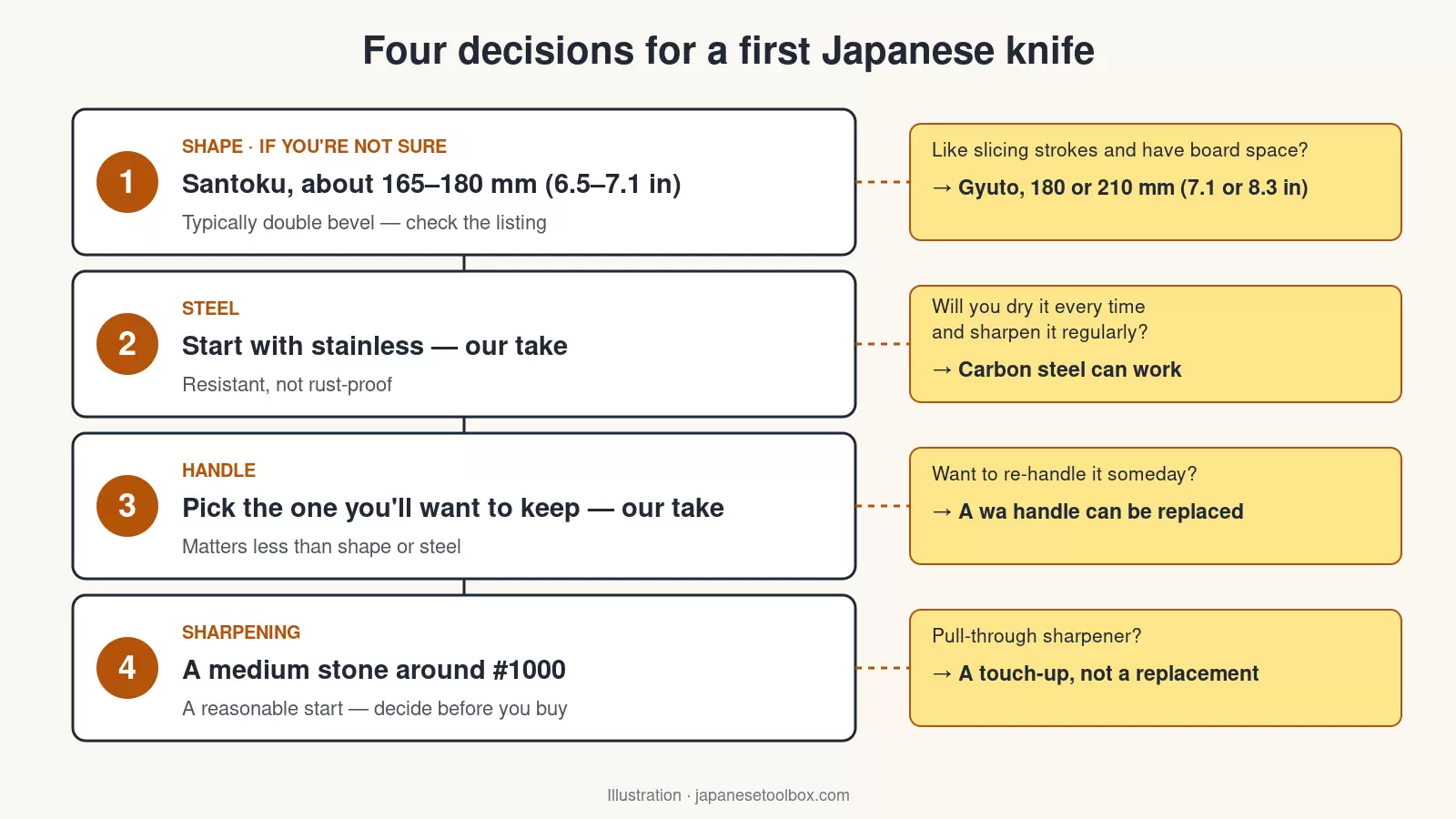
Step 1: Santoku or gyuto
If you’re not sure, a santoku
Several Japanese maker and shop guides recommend a santoku to beginners and first-time buyers. If you’re not sure, go with one:
- Tojiro, a knife maker in Niigata, advises shoppers who aren’t sure to go with a santoku in its household buying guide: 「迷ったら三徳を。」
- The shop’s sharpener at Sakai Ichimonji Mitsuhide, an Osaka knife shop, recommends it in a santoku-vs-gyuto column for people who are new to knives or buying their first.
- Zwilling’s Japanese company gives the same advice for cooking beginners and people with small kitchens.
Tojiro’s household size guide puts a santoku at about 165–180 mm (6.5–7.1 in).
If you’d rather have a gyuto, 180 or 210 mm
If you’d rather have a gyuto, Tojiro’s gyuto buying guide recommends 18 or 21 cm (180 or 210 mm) to first-time buyers, noting that 18 cm is used much like a santoku and that 21 cm is a balanced size for home kitchens. Sakai Ichimonji Mitsuhide’s column recommends a gyuto to cooking enthusiasts who are comfortable using knives, and says sliding the blade helps avoid the uncut portions that can result from santoku-style cutting. Board space is worth checking before you size up — see our guide to cutting boards for Japanese knives.
Typically double bevel — check the listing to be sure
Santoku and gyuto are typically double bevel (両刃: ground on both sides, like a Western knife, as opposed to single bevel/片刃, ground on one side only); confirm the edge grind on the specific listing. Tojiro’s guide to blade orientation calls a double-bevel knife an all-purpose choice for ordinary home cooking and notes that it’s common on Western-style knives and also used on Japanese-style knives such as the santoku, and its household buying guide adds that the Western-style knives covered there are double bevel, so they work for either hand. Sakai Jikko, a knife company in Sakai, says a double-bevel knife works for right- and left-handed cooks alike, since it’s sharpened on both sides. Single-bevel knives such as the deba (a knife for preparing fish) and yanagiba (a knife for slicing sashimi) are specialist knives worth adding later — see our guide to single bevel vs. double bevel.
For the full size comparison and more on choosing between the two, see our guide to gyuto vs. santoku. If you’re curious about a second knife to add later, see the FAQ below and our guide to types of Japanese kitchen knives.
Step 2: Stainless, unless you’ll dry it every time
Carbon steel (hagane, 鋼) can take a sharp edge; sharpening ease varies by alloy, with White steels generally easier to sharpen than Blue steels. It also rusts more easily and needs regular care. Stainless steel (ステンレス) resists rust — resistant, not rust-proof.
For ordinary households, a rust-resistant, low-maintenance stainless-type steel is the best choice, Tojiro’s buying guide says, and Sakai Jikko agrees that stainless is reassuring for home use and beginners. Sakai Ichimonji Mitsuhide takes the other side for its own knives: its guide to White #2 (Shirogami #2) steel recommends it over cheaper steels for first-time buyers. That’s a shop recommending its own carbon-steel knives, not a general rule. Our take, in line with our steel guide: start with stainless, and consider carbon steel once you know you’ll dry the blade every time and sharpen it regularly.
On the listing, look for the steel name the way the seller writes it — VG-10 (a stainless blade steel made by Takefu Special Steel), Aogami #2 (Blue #2), Shirogami #2 (White #2). On a clad knife with a carbon-type core, Tojiro’s care guide notes that the exposed core at the edge is more likely to rust than the stainless sides. For more on steel choices, see our guide to Japanese knife steel for beginners.
Step 3: Handle — pick the one you’ll want to keep
Handle type matters less than shape or steel. Our take: it comes down to whether you’d ever want to re-handle the knife down the road.
Tojiro’s guide to handle construction gives the two basic types. A wa handle (和柄) is typically an insert-style wooden handle fitted over a heated tang (nakago, 中子 — the narrow part of the blade that goes into the handle) rather than riveted, so the blade can be kept by replacing the handle. A Western (yo) handle (洋柄) is fixed with rivets, glue or one-piece molding and isn’t designed with replacement in mind, though wooden ones are sometimes replaced. For long use with a Western handle, Tojiro suggests a spine-tang or full-tang knife rather than a half tang.
The picks below list a laminated-wood handle with a stainless bolster, as the listing gives it. For more on wa vs. Western handles, see our guide to wa handle vs. Western handle.
Step 4: Decide how you’ll sharpen before you buy
Tojiro’s household buying guide says that once the edge dulls, it needs resharpening on a whetstone around #1000. For its own customers in Japan, it points to its sharpening service every few years or when the edge chips. If a service like that isn’t available where you live, a local knife-sharpening shop can serve the same purpose.
A pull-through sharpener (a handheld sharpener you pull the knife blade through, with the blade going into a V-shaped groove) is a touch-up, not a replacement. Tojiro says it roughens the edge so it bites into food again temporarily — not a substitute for resharpening on a whetstone. It recommends that sharpener users also use a whetstone or a professional sharpening shop about once or twice a month. For home use, Sakai Jikko instead gives a stone about every two to three months. One more reason to start double bevel: Kai, a Japanese cutlery company, sells a standard pull-through sharpener rated for double-bevel knives only.
For your first stone, a medium stone around #1000 is a reasonable starting point. Toishiya Ao, a whetstone shop, says a #1000 stone alone gives someone who has never sharpened on a whetstone before real sharpness. See our guides to whetstone grit for beginners and sharpener vs. whetstone — the stone pick below completes this step.
Our picks for a first Japanese knife
We chose the picks below from the listings at Hocho Knife (an affiliate partner) because their listed specs match the four steps above — we haven’t used this exact santoku, gyuto or stone.
Shipping rules for kitchen knives vary by country and state. Check the seller’s shipping policy and your local laws before ordering.
Santoku (start here)
As the listing gives it, the Kanetsune KC-170 santoku is 180 mm (7.1 in), stainless, double edged, 60–62 HRC (Rockwell C hardness, a common standardized measure of blade-steel hardness; higher is harder), with a laminated-wood handle and stainless bolster. It’s listed at $110.99 on Hocho Knife as of Oct 8, 2026. It matches the shape, steel and double-bevel defaults from Steps 1 through 3.
Kanetsune 180 mm stainless santoku at Hocho Knife
In-stock 165–180 mm stainless, double-bevel santoku at Hocho Knife started at about $50 on Oct 8, 2026.
Gyuto (if Step 1 pointed you there)
The Kanetsune KC-170 gyuto shares the same specs as listed: 210 mm (8.3 in), stainless, double edged, 60–62 HRC, and a laminated-wood handle with a stainless bolster. It’s listed at $110.99 on Hocho Knife as of Oct 8, 2026.
Kanetsune 210 mm stainless gyuto at Hocho Knife
Stainless 180–210 mm double-bevel gyuto at Hocho Knife started at about $50 on Oct 8, 2026.
The same line also comes in a 180 mm gyuto, but that listing wasn’t checked for this guide, so we’re not giving specs or a price for it.
The stone
The Naniwa Super Ceramic Waterstone with Stand [S-1000] is a #1000 stone, 210 × 70 × 20 mm (8.3 × 2.8 × 0.8 in), with a stand, made in Japan, as listed. It’s listed at $75.99 on Hocho Knife as of Oct 8, 2026. Follow the enclosed instructions; Naniwa’s guidance for Super Stone says to wet the surface rather than soak it.
Naniwa #1000 whetstone with stand at Hocho Knife
What about Tojiro?
Tojiro is the maker whose household buying guide this article leans on throughout. Chef Knives To Go, a knife retailer, calls its TOJIRO CLASSIC 210 mm gyuto (formerly called the DP) “the definitive entry-level Japanese chef knife recommendation for a reason.” By that retailer’s description, it has an even, double-bevel edge grind, a VG10 stainless core, and a full-tang handle with a bolster and rivets, so the four steps above apply to it too. Tojiro’s own care guide describes this knife’s steel differently: it calls its DP cobalt alloy steel a clad material with a carbon-type core and stainless sides, and says the carbon-type core exposed at the edge is more likely to rust than the sides.
When this path isn’t for you
- You must use the dishwasher. Tojiro’s household buying guide asks buyers to avoid it, since high heat and detergent speed up wear. A few all-stainless knives are maker-rated dishwasher-safe; see the Seki Magoroku 匠創 example in our gyuto vs. santoku guide.
- You often cut frozen food, bones or shells. Sakai Ichimonji Mitsuhide’s chipping guide names these among the common causes of a chipped edge, for kitchen knives generally. See our guides to Japanese vs. German knives for edge angles and Japanese knife care routine.
- You want carbon steel and its patina, and you’ll dry the blade every time. See Step 2 above and our guide to Japanese knife steel for beginners.
- You mainly break down fish or slice sashimi. That calls for a single-bevel deba or yanagiba as a second knife — see single bevel vs. double bevel.
- You’re buying for someone else. See our Japanese knife gift guide.
FAQ
What should my second Japanese knife be?
Tojiro’s household buying guide calls a santoku and a petty knife (ペティナイフ, a small Western-style knife that Tojiro describes as a scaled-down gyuto) a dependable pair. If you cook a lot of vegetables, see our guide to nakiri vs. santoku; for more on the petty, see petty knife vs. paring knife.
Is a Japanese knife too delicate for a beginner?
Sakai Ichimonji Mitsuhide’s chipping guide says a kitchen knife is strong against vertical force but thin at the edge and susceptible to damage from sideways force. In practice, that means cutting straight down or sliding the blade rather than twisting or prying it.
Sources
The facts in this guide were checked against these pages (accessed September 2026). Pages marked (in Japanese) are written in Japanese.
- Tojiro: 包丁の種類と使い分け (in Japanese)
- Sakai Ichimonji Mitsuhide: 包丁のプロが解説する三徳包丁と牛刀の違い。特徴と使い方とは? (in Japanese)
- Zwilling: 牛刀とは?三徳包丁との違いや用途についてわかりやすく解説!おすすめの包丁もご紹介 (in Japanese)
- Tojiro: 牛刀とは?特徴・三徳との違い・おすすめサイズの選び方【包丁メーカー解説】 (in Japanese)
- Tojiro: 刃の向きと利き手 (in Japanese)
- Sakai Jikko: 片刃包丁と両刃包丁で切れ味は変わるのか?実際に切り比べてみた (in Japanese)
- Tojiro: 和包丁の形状 (in Japanese)
- Sakai Jikko: 片刃包丁は右利き、左利き用に分かれています (in Japanese)
- Sakai Jikko: 青紙・白紙どちらを選ぶ?プロが教える包丁の鋼材「ハガネ」の種類と特徴 (in Japanese)
- Tojiro: 材料の種類 – 燕三条製包丁の藤次郎株式会社 (in Japanese)
- Sakai Ichimonji Mitsuhide: 包丁の素材「鋼」職人の技と科学が生み出す最高の切れ味 (in Japanese)
- Sakai Ichimonji Mitsuhide: 包丁の素材「白二鋼(白紙2号)」高い硬度でシャープな切れ味 (in Japanese)
- Takefu Special Steel: V金10|武生特殊鋼材株式会社 (in Japanese)
- Tojiro: 包丁のお手入れ (in Japanese)
- Tojiro: ハンドル・柄の構造 (in Japanese)
- Kai: 包丁の研ぎ方|貝印包丁サイト (in Japanese)
- Tojiro: シャープナーと砥石の違い (in Japanese)
- Sakai Jikko: 砥石とシャープナーどちらが良いですか?違いと特徴を徹底解説 (in Japanese)
- Kai: 【公式】関孫六 ダイヤモンド&セラミックシャープナー (in Japanese)
- Toishiya Ao: 砥石のおすすめは中砥#1000 (in Japanese)
- hocho-knife.com: Kanetsune KC-170 Whole AUS10 Stainless Steel Japanese Chef’s Santoku Knife 180mm
- hocho-knife.com: Santoku knife
- hocho-knife.com: Kanetsune KC-170 Whole AUS10 Stainless Steel Japanese Chef’s Gyuto Knife 210mm
- hocho-knife.com: Gyuto(Chef’s Knife)
- hocho-knife.com: Naniwa Super Ceramic Waterstone (Whetstone) with Stand [S-1000]
- naniwa-abrasive.com: How to Use Whetstones (Naniwa Super Stone instructions)
- chefknivestogo.com: TOJIRO CLASSIC Gyuto 210mm|Tojiro DP Chef Knife
- Kai: 関孫六 10000ST 三徳包丁 165mm: キッチン用品 (in Japanese)
- Sakai Ichimonji Mitsuhide: Why Do Knives Chip?
Related guides: gyuto vs. santoku, Japanese knife steel for beginners, wa handle vs. Western handle, whetstone grit for beginners, sharpener vs. whetstone, types of Japanese kitchen knives.
Researched and written by the Japanese Toolbox AI editorial team and reviewed by Ken, our editor in Japan. Approved for publication by Ken on October 8, 2026. How we work · @JapaneseToolbox on X