Disclosure: This post contains affiliate links. If you buy through them, we may earn a commission at no extra cost to you. We only recommend tools our editor has handled or researched in depth. Learn more
Yes — on a double-bevel knife, with a sharpener made for that knife, a pull-through sharpener (a handheld sharpener you pull the knife blade through: the blade goes into a V-shaped groove and is pulled toward you) works fine as a quick touch-up. Japanese makers that sell sharpeners describe them as a temporary fix, not a replacement for a whetstone: Tojiro, a knife maker based in Tsubame, Niigata Prefecture, that makes and sells kitchen knives and cooking tools, says a sharpener isn’t a substitute for resharpening on a whetstone. Standard double-bevel sharpeners — for knives with the edge ground on both sides, like a Western knife — aren’t made for single-bevel knives, with the edge ground on one side only.
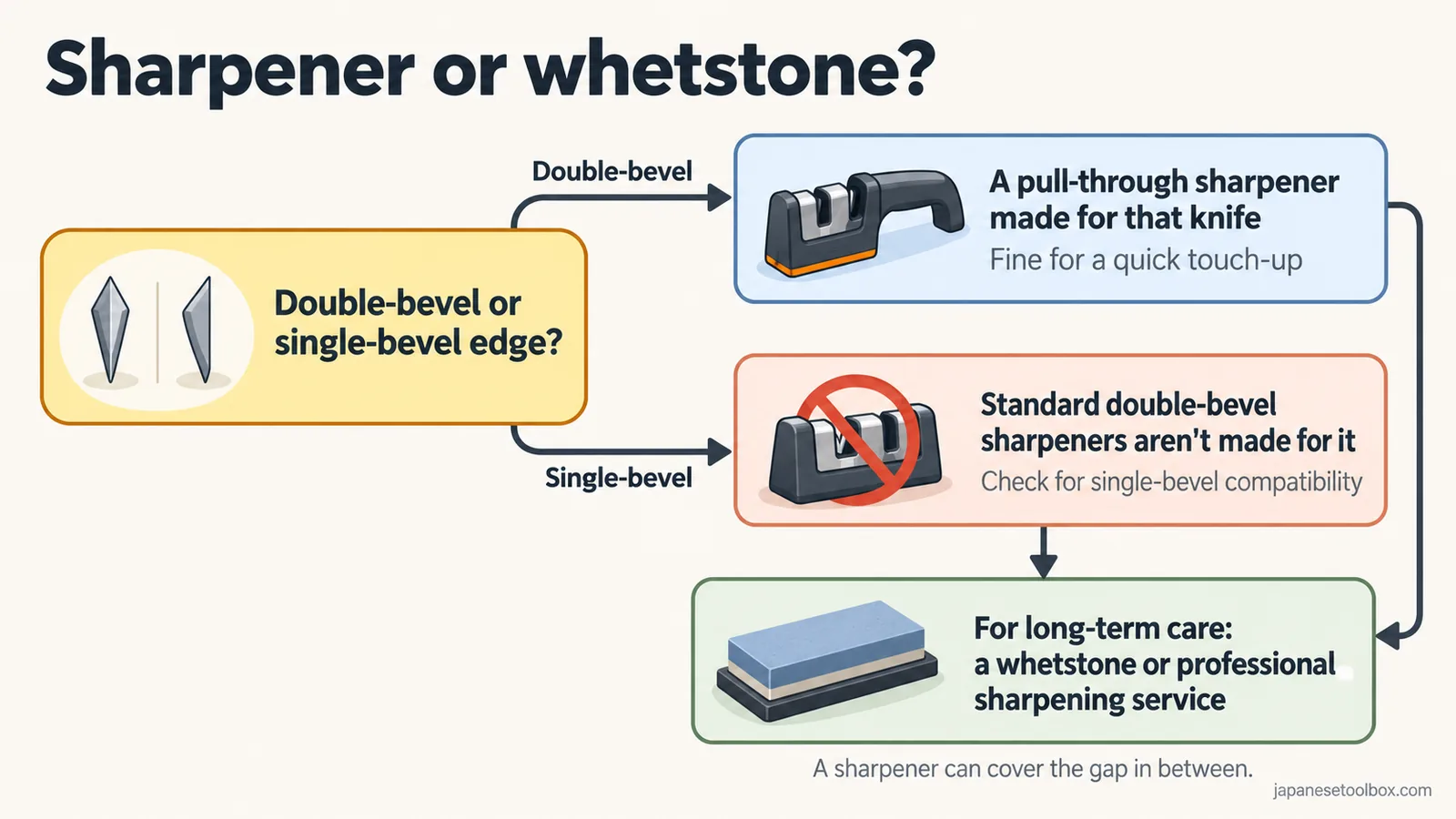
Our take: if you plan to keep the knife for years, plan on a whetstone or a professional sharpening service eventually. A sharpener can cover the gap in between.
This research draws on pages from Japanese makers’ and shops’ own sites, plus Ken’s own notes on the small sharpener used at home (see below): Tojiro; Kai, a Japanese cutlery company that began making pocket knives in 1908 and established Endo Cutlery Works in Seki in 1920 to expand pocket-knife production; Sakai Jikko (實光刃物), a Sakai knife company that makes and sells kitchen knives, run by its fourth-generation president, Toshiyuki Jikko (the fourth family head to run the business); Sakai Ichimonji Mitsuhide, a knife shop in Osaka that opened in 1953 and sells knives and kitchen equipment; Kyocera (京セラ株式会社), a company headquartered in Kyoto and founded in 1959, whose advice here comes from its official kitchen online store; and Zwilling Japan (Zwilling J.A. Henckels Japan), the Japanese company of the Zwilling knife brand, based in Seki, Gifu Prefecture. Seido, a knife retailer that also sells sharpening tools, adds its take on honing rods below.
Sharpener, honing rod, or whetstone at a glance
| Pull-through sharpener | Honing rod (steel / ceramic) | Whetstone | |
|---|---|---|---|
| What it does | Adds fine scratches to a dulled edge so it bites into food again, temporarily; Sakai Jikko calls it not strictly sharpening; Sakai Ichimonji Mitsuhide says it roughens a smooth edge into a jagged one | Zwilling Japan describes a sharpening steel (a honing rod you draw the edge along) as the European mainstream style, used when grease dulls the edge or to correct its angle; Seido recommends a ceramic rod, or a fine leather strop, over a coarse metal steel for Japanese edges | Kai describes a whetstone (角砥石) as the tool for a proper, full resharpening |
| How long the edge lasts | Sakai Ichimonji Mitsuhide says the edge wears faster and doesn’t last as long as one finely sharpened on a stone; Zwilling Japan says quick sharpeners work fast but their hold is limited; Kai says it’s difficult to keep the sharpness lasting | — | — |
| Effort | Sakai Jikko: no angle skill needed, so it suits everyday care; Sakai Ichimonji Mitsuhide: anyone can use one easily; Kyocera: short maintenance time, easy for beginners | — | — |
| Which knives | Kai’s standard model is for double-bevel knives only; Kyocera’s roll (rotary) sharpener — a sharpener with rotating stones the blade is pulled across — is for metal double-bevel knives, and its diamond roll and electric diamond sharpeners can’t take single-bevel knives; Zwilling Japan points HRC 60+ knives to its diamond-roller or V-Edge sharpeners | Seido’s honing-steel warning is about a coarse metal steel | See which whetstone grit to buy first |
| Role makers give it | Kai recommends it as a supplementary, everyday tool alongside a whetstone; Sakai Jikko: quick care when there’s no time; Kyocera: daily maintenance | — | Kai: for a proper resharpening; Sakai Jikko: regular maintenance and a full resharpening; Kyocera: every few sharpenings |
What a pull-through sharpener actually does
A pull-through sharpener (Kai’s own term for its version is 簡易砥石) is a handheld sharpener you pull the knife blade through: the blade goes into a V-shaped groove and is pulled toward you.
It roughens the edge rather than resharpening it
Tojiro says a sharpener’s real function isn’t sharpening the edge but roughening it, so it temporarily bites into food better. Sakai Jikko describes the same idea: fine scratches on the blade’s surface increase friction and temporarily improve how it cuts, without being sharpening in the strict sense. Sakai Ichimonji Mitsuhide’s sharpening column says it only turns a smooth edge into a jagged one, and doesn’t restore sharpness the way a whetstone does. Kyocera adds that because a sharpener can’t grind the sides of the blade, the edge ends up thicker, which can make food feel harder to cut. Tojiro says this basic point holds across roll (rotary), electric, and water-type sharpeners.
Why the bite fades
Sakai Ichimonji Mitsuhide’s column explains that a jagged edge has fewer, larger “teeth,” which wear down faster than a finely sharpened one, so the bite doesn’t last as long. Zwilling Japan describes quick sharpeners as fast-acting but limited in how long the effect holds. Kai says the same thing about its own pull-through sharpener: it’s hard to keep the sharpness lasting. Tojiro’s own close-up photos, described on its site, show a sharpener-roughened edge looking saw-like next to a smoother, more even edge from a medium stone (the everyday grit level) in typical home use.
If a sharpener is all you use
Tojiro says relying only on a sharpener can drop the edge’s strength and, in some cases, cause cracking or chipping. Sakai Jikko says frequent use can leave the edge an irregular shape and may shorten the knife’s working life. Zwilling Japan warns that using its quick sharpener on a knife that’s new, or still sharp, risks dulling it instead of helping it.
Which knives can go through a sharpener
Double-bevel knives include a gyuto (a chef’s knife: a Western-born, all-purpose knife with a long blade whose edge curves up to a pointed tip) or a santoku (Japan’s everyday all-purpose home knife for meat, fish, and vegetables, with a relatively straight, flatter edge). Single-bevel knives include a deba, a knife for preparing fish, or a sashimi knife. (For more on single-bevel knives like the usuba, see our nakiri vs. santoku comparison.)
Double-bevel vs. single-bevel
Kai’s standard pull-through sharpener (product 459) is for double-bevel knives only; Kai’s own listing says it can’t be used on single-bevel knives such as a deba. Kai also sells a separate sharpener labeled for single-bevel knives. Kyocera’s roll sharpener is for metal double-bevel knives; its diamond roll sharpener and electric diamond sharpener can’t be used on single-bevel knives such as a deba or a sashimi knife. To see which knives are single-bevel and what that means for left-handed cooks, see our single bevel vs double bevel guide.
Ceramic and serrated knives
Kyocera’s restrictions vary by sharpener type: its roll sharpener can’t be used on ceramic knives, its diamond roll sharpener can’t be used on ceramic knives from other makers, and its diamond roll sharpener and electric diamond sharpener aren’t made for serrated knives.
Very hard steels
Zwilling Japan points knives with a hardness of HRC (Rockwell C hardness, a common standardized measure of blade-steel hardness; higher is harder) 60 or higher toward its diamond-roller or V-Edge sharpeners. See our guide on how steel hardness affects care for more on hard steels. Our take: check the sharpener’s own listing against your knife’s steel and hardness before buying.
Where makers say a sharpener fits
Kai recommends a whetstone (角砥石) for a proper resharpening, with its pull-through sharpener as a supplementary tool for everyday care. Sakai Jikko recommends using each depending on the situation: a sharpener for quick care when there’s no time, and a whetstone for regular maintenance and a proper resharpening. Kyocera recommends a sharpener for everyday maintenance and a whetstone every few sharpenings. Sakai Ichimonji Mitsuhide recommends a sharpener for people who find a whetstone hard to use, and for when an edge dulls partway through cooking.
How often makers suggest a whetstone if you also use a sharpener
| Source | Interval | For whom / what |
|---|---|---|
| Tojiro | About once or twice a month, on a whetstone or at a professional sharpening shop | People who use a sharpener |
| Sakai Jikko | About every 2–3 months | Home use |
| Kyocera | About once a month if you cook often; every few months if you rarely cook | Whetstone frequency by how often you cook |
Separately, Tojiro says a knife’s edge in typical home use dulls to that rougher state in about a month, though it notes this depends on how the knife is used. Our Japanese knife care routine guide covers the retailer and maker sharpening intervals in more depth.
Honing rods: steel vs. ceramic
A sharpening steel (honing rod) is a rod you draw the edge along. Zwilling Japan describes it as the European mainstream sharpening style, used when grease on the edge dulls it or to correct the edge’s angle — and cautions against overdoing it, since too much use can hurt the edge’s sharpness instead.
Seido, a knife retailer, recommends a ceramic honing rod (a honing rod made of ceramic) or a fine leather strop over a coarse metal honing steel for Japanese knives, saying the abrasive surface of a standard Western honing rod can chip a Japanese edge rather than realign it.
If you buy a sharpener: follow the maker’s steps
Kai’s pull-through sharpener (Seki Magoroku, product 459)
Kai’s Seki Magoroku brand is named after the noted Seki swordsmith Magoroku Kanemoto. For this double-bevel-only sharpener, Kai’s product page describes three slots used in order: about 10 pulls toward you on the coarse diamond stone, about 10 pulls on the ceramic stone to thin and improve the edge, and about 5 pulls on the fine ceramic stone to smooth the finish. Kai says no angle adjustment is needed — just pull the blade straight toward you through the groove.
Sakai Ichimonji Mitsuhide’s water-type sharpener
The shop’s sharpening column describes these steps for its water-type sharpener: lay a wet towel on a stable surface, add water to the sharpener body, place it on the towel and hold the handle firmly, then fit the blade into the gap between the stones and move it back and forth lightly about 10 times.
Follow the instructions that come with the specific sharpener you buy — steps vary by product.
What Ken uses at home
Ken has used a small sharpener like this one for about 3 years, on a santoku and a Galaxy knife. For how often Ken reaches for it, how it’s used, and a look at the sharpener itself, see our guide to the sharpener Ken uses at home.
Which should you buy?
Our take — a few things to check before you buy:
- Your knife’s bevel. A double-bevel knife can use a double-bevel sharpener; a single-bevel knife needs a model labeled for single-bevel use, or a whetstone.
- Your knife’s material and hardness against the sharpener’s listed compatibility — Kyocera lists ceramic and serrated restrictions per sharpener type, and Zwilling Japan points HRC 60+ knives to specific sharpener types.
- Whether you want a whetstone now or later. If you’re picking one out, see which whetstone grit to buy first.
- Honing. A ceramic rod over a coarse metal steel for Japanese edges.
Our pick if you choose a whetstone: the Naniwa Super Ceramic Waterstone (Whetstone) with Stand [S-1000], #1000 grit, 210 × 70 × 20 mm, with stand, listed at $75.99 on Oct 15, 2026. We chose it because it meets the #1000-grit criterion in our whetstone guide; we haven’t used this exact stone.
Naniwa #1000 whetstone with stand at Hocho Knife
Single-grit #1000 whetstones at Hocho Knife started at about $46 on Oct 8, 2026.
Whetstones and sharpeners at Hocho Knife
Glossary
- Pull-through sharpener — a handheld sharpener you pull the knife blade through: the blade goes into a V-shaped groove and is pulled toward you.
- Whetstone — a sharpening stone used for a proper, full resharpening; see our whetstone grit guide.
- Honing rod (sharpening steel) — a rod you draw the edge along; Zwilling Japan describes it as the European mainstream sharpening style, used when grease on the edge dulls it or to correct the edge angle.
- Ceramic honing rod — a honing rod made of ceramic; Seido recommends one, or a fine leather strop, over a coarse metal honing steel for Japanese knives.
- Single bevel / double bevel — single bevel: the edge is ground on one side only; double bevel: ground on both sides, like a Western knife.
- Grit (番手) — the number describing how coarse or fine a whetstone’s surface is; low numbers are coarse, high numbers are fine.
- Medium stone — the everyday sharpening stone, generally around #1000; see our whetstone grit guide.
FAQ
Will a pull-through sharpener ruin my Japanese knife?
Tojiro and Sakai Jikko both frame the risk around how it’s used, not the tool itself: Tojiro says relying only on a sharpener can drop the edge’s strength and, in some cases, cause cracking or chipping, and Sakai Jikko says frequent use can leave the edge irregular and may shorten the knife’s working life.
Can I use a sharpener on a single-bevel knife?
Not with the standard double-bevel models: Kai’s product 459 and Kyocera’s roll, diamond roll, and electric diamond sharpeners are for double-bevel knives. Kai sells a separate sharpener labeled for single-bevel knives.
Do I need a whetstone if I have a sharpener?
Kai recommends a whetstone for a proper resharpening and its pull-through sharpener as a supplementary, everyday tool alongside it. See the frequency table above for how often other makers suggest a whetstone.
How often should I use a whetstone?
It depends on who you ask and how you use the knife — see the frequency table above for Tojiro, Sakai Jikko, and Kyocera’s separate intervals.
Ceramic rod or steel?
Seido recommends a ceramic rod, or a fine leather strop, over a coarse metal honing steel for Japanese edges. Zwilling Japan describes the steel honing rod as the European mainstream style, for grease on the edge or angle correction.
Sources
The facts in this guide were checked against these pages (accessed September 2026). Pages marked (in Japanese) are written in Japanese.
- Kai: 包丁の研ぎ方|貝印包丁サイト (in Japanese)
- Tojiro: 会社情報 – 燕三条製包丁の藤次郎株式会社 (in Japanese)
- Tojiro: シャープナーと砥石の違い (in Japanese)
- Sakai Jikko: 片刃包丁と両刃包丁で切れ味は変わるのか?実際に切り比べてみた (in Japanese)
- Tojiro: 和包丁の形状 (in Japanese)
- Kai: 【公式】関孫六 ダイヤモンド&セラミックシャープナー (in Japanese)
- Kyocera: FAQ シャープナー (in Japanese)
- Kai: 沿革 | KAIグループについて | 貝印 (in Japanese)
- Sakai Jikko: 会社概要 | 包丁通販なら明治33年創業の大阪 堺の實光刃物 (じっこう) (in Japanese)
- Sakai Jikko: 實光刃物とは (in Japanese)
- Sakai Ichimonji Mitsuhide: 企業情報 | 堺一文字光秀 (in Japanese)
- Sakai Ichimonji Mitsuhide: 大阪の包丁専門店、堺一文字光秀の歴史 (in Japanese)
- Kyocera: 会社概要 | 京セラグループについて | 京セラ (in Japanese)
- Kyocera: 特定商取引法に基づく表記 (in Japanese)
- Zwilling: プライバシーポリシー (in Japanese)
- Sakai Jikko: 砥石とシャープナーどちらが良いですか?違いと特徴を徹底解説 (in Japanese)
- Sakai Ichimonji Mitsuhide: 包丁シャープナー・簡易砥石の使い方 (in Japanese)
- Zwilling: 包丁の研ぎ方 包丁の切れ味を長持ちさせるコツ (in Japanese)
- Seido: How to Properly Maintain a Japanese Knife
- Kyocera: シャープナーを使用するメリット・デメリットとは? (in Japanese)
- Tojiro: 牛刀とは?特徴・三徳との違い・おすすめサイズの選び方【包丁メーカー解説】 (in Japanese)
- Tojiro: 三徳包丁とは?特徴・選び方・おすすめ5選 (in Japanese)
- Tojiro: 包丁の種類と使い分け (in Japanese)
- Kai: 包丁の研ぎ方|貝印包丁サイト (in Japanese)
- Tojiro: 材料の種類 – 燕三条製包丁の藤次郎株式会社 (in Japanese)
- ISO: www.iso.org/standard/84343.html
- Kai: 関孫六について (in Japanese)
- Kai: 砥⽯の種類と選び⽅を解説!プロが認める⾙印おすすめの砥⽯や、初⼼者にも易しい研ぎ器を紹介 (in Japanese)
- Tojiro: 砥石の選び方 (in Japanese)
Related guides
- Whetstone grit for beginners
- Japanese knife care routine
- Japanese knife steel for beginners
- Gyuto vs. santoku
- Single bevel vs double bevel knife: which should you buy?
Written by the Japanese Toolbox AI editorial team, using hands-on notes from Ken, our editor in Japan. Approved for publication by Ken on September 29, 2026. How we work · @JapaneseToolbox on X