Disclosure: This post contains affiliate links. If you buy through them, we may earn a commission at no extra cost to you. We only recommend tools our editor has handled or researched in depth. Learn more
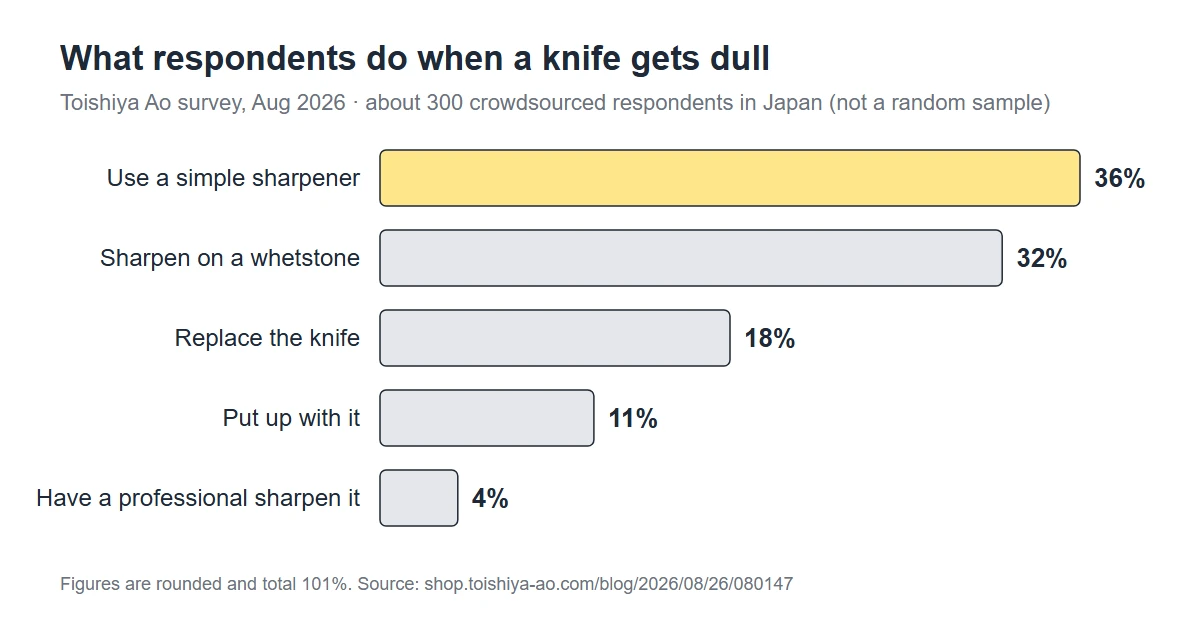
In an August 2026 crowdsourced survey of about 300 respondents in Japan, run by Toishiya Ao, a whetstone shop, a simple sharpener (36%) edged out sharpening on a whetstone (32%) as the way respondents say they deal with a dull knife. Ken’s own kitchen runs on a palm-sized MARNA sharpener that’s been in the kitchen drawer for about three years. This guide draws on Japanese survey data, makers’ own product pages and our editor’s three years with one small sharpener.
How this survey’s respondents handle a dull knife
What the 2026 survey found
Toishiya Ao asked about 300 crowdsourced respondents what they usually do once a knife’s edge has dulled. In that group, 36% said they use a simple sharpener, 32% said they sharpen on a whetstone, 18% said they replace the knife, 11% said they put up with it, and 4% said they have a professional sharpen it for them. These figures are rounded to whole numbers and together total 101%.
What stops respondents without a whetstone
A separate sub-survey asked 281 respondents from households without a whetstone about their barriers to trying one. The top answers were uncertainty about technique (36%), the hassle of it (35%), the cost of the tools (11%), not having time (9%), and not having storage space (6%); 4% said nothing in particular holds them back. Rounding again puts the total at 101%. Among these 281 respondents, technique was a much more common concern than price.
How far to trust these numbers
Toishiya Ao says its own survey is crowdsourced and isn’t a random sample representing households nationwide, and the shop itself calls the result unwelcome news. The survey also ran narrower sub-groups of households with and without a whetstone, so the dull-knife numbers above come only from the general-recruitment group, not a blend of all three sub-surveys. If you’d rather try a stone yourself, see which whetstone grit to buy first.
The sharpener on Ken’s counter
What it is
Ken’s family home used a whetstone, but for everyday life, Ken says a very small sharpener like this one is enough. The sharpener itself is MARNA’s お魚包丁とぎ (o-sakana hōchō-togi, “fish knife sharpener”), model K257. MARNA is a Tokyo housewares maker founded in 1872.
MARNA’s own store describes the K257 as a fish-shaped sharpener you sharpen with by pulling it lightly. Per that listing, it has an alumina-ceramic sharpening part, a polystyrene body, and a magnet on the back meant to let it stick to a refrigerator, in a size of about 90 × 24 × 40 mm (3.5 × 0.9 × 1.6 in), made in Japan, for ¥770 (tax-included, as of Oct 2026). Ken’s own unit is green; MARNA’s store currently lists the same product in blue. The two ceramic balls on Ken’s unit show visible scuffing after about three years of use.
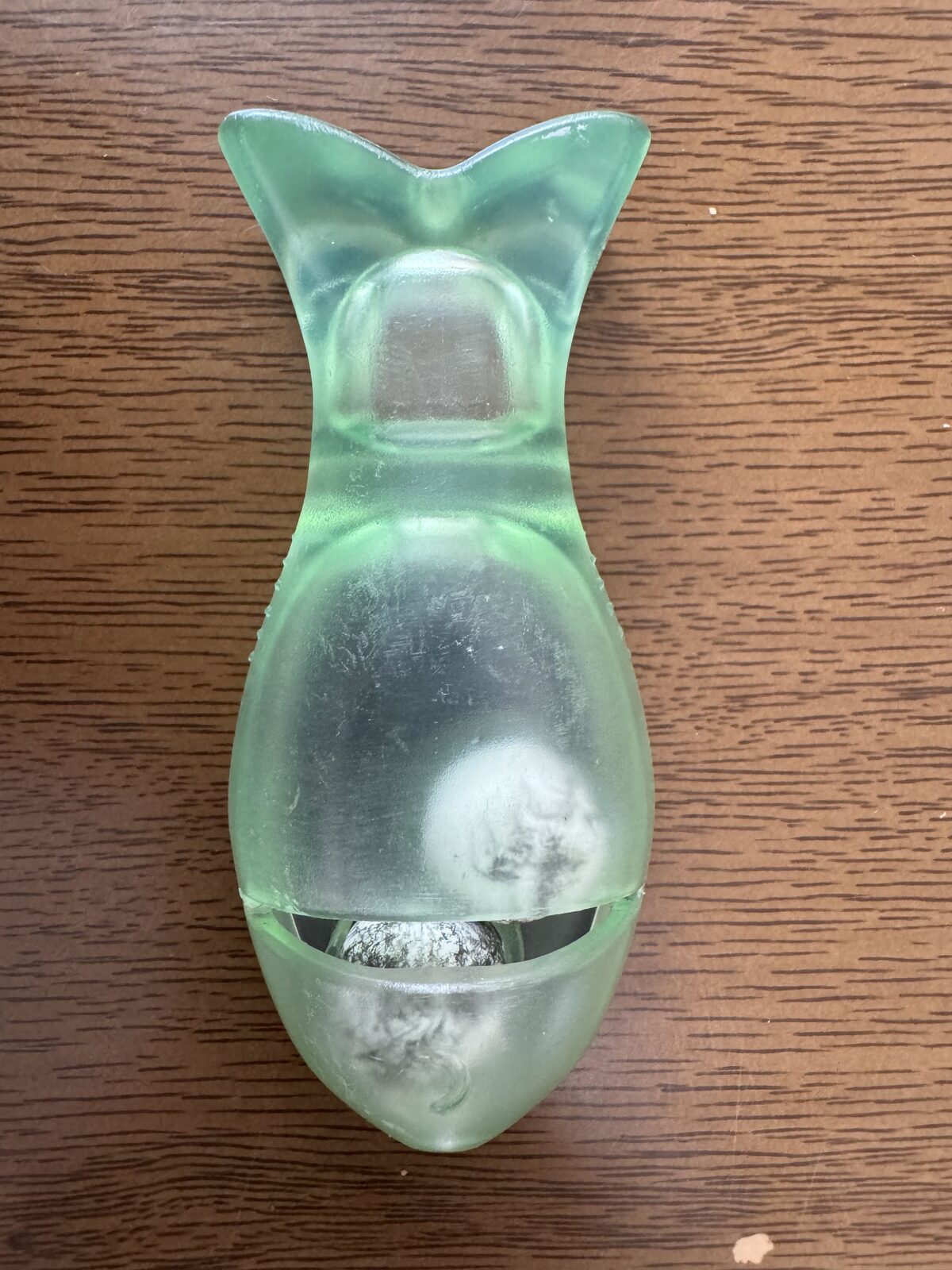
Ken remembers paying about ¥700 roughly three years ago and thinks it came from a general retailer that sold knives.
How Ken uses it
Ken has had this sharpener for about three years and uses it on a santoku (Japan’s everyday all-purpose home knife) and one other everyday knife. Ken reaches for it about once every three months — usually when slicing sashimi or feeling that raw meat isn’t cutting well. About 10 pulls restores enough sharpness, and afterward Ken rinses the knife with water and wipes it before using it (see our knife care routine).
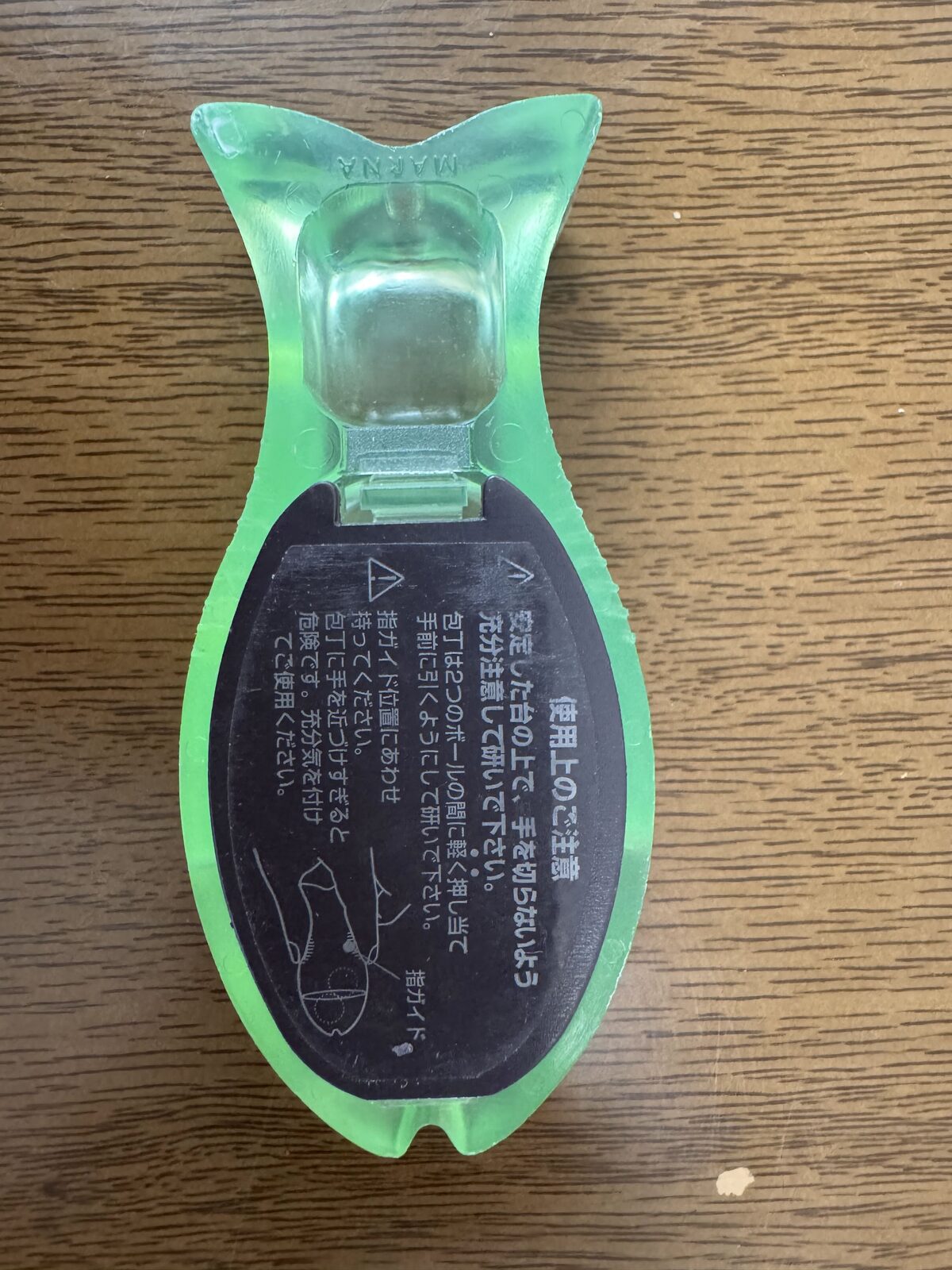
The printed instructions on the back of Ken’s unit say to use it on a stable surface, press the knife lightly between the two balls and pull it toward you, and hold the knife at the finger-guide position.
What Ken noticed
Before sharpening, a tomato’s skin wouldn’t cut; afterward, Ken says the skin cut through smoothly. Ken doesn’t press down while pulling — the knife’s own weight does the work, and the blade doesn’t catch as it goes through. No visible filings come off, but Ken rinses the knife before using it anyway, in case anything too small to see comes off. Ken cleans the sharpener itself just by rinsing it with water, without scrubbing it with detergent.
The one complaint: because it’s small, it can get lost in the kitchen drawer. As for why not a whetstone, Ken says learning a whetstone’s finer rules looked like a lot of trouble, and the sharpener is enough for everyday cooking.
Four sharpener designs from Japanese makers
Here are four sharpener designs sold by Japanese makers: a roll sharpener with rotating stones you pull the blade across, a three-slot pull-through you draw the blade through a slot, a water-type sharpener you run with water, and a small handheld tool with two ceramic balls.
| Type | Example product | How the maker describes it | Knives it’s not for | Maker-store price (as of Oct 2026) |
|---|---|---|---|---|
| Roll sharpener | Kyocera’s RS-20 | Push and pull about 10 times to do coarse and finish sharpening in one pass | Single-bevel knives and serrated knives such as bread knives | ¥2,750 |
| Three-slot pull-through | Kai’s Seki Magoroku (a Kai brand) diamond & ceramic sharpener (AP0308) | Three steps of about 10, 10, then 5 pulls each | Single-bevel knives; Kai sells a separate single-bevel model | ¥2,420 |
| Water-type | Yoshikin’s GLOBAL sharpener (GSS-02) | Running water keeps the rotating stones from clogging | Knives other than GLOBAL’s own double-bevel knives | ¥6,050 |
| Small ceramic-ball | MARNA’s お魚包丁とぎ (K257) | Press the knife lightly between two ceramic balls and pull toward you | Check your knife’s own packaging | ¥770 |
Kyocera’s official kitchen store sells the RS-20, a roll sharpener (rotating stones the blade is pulled across). Kyocera says you push and pull the blade through about 10 times to do coarse and finish sharpening in one pass. It’s labeled for metal knives only, and Kyocera says it won’t sharpen single-bevel knives (ground on one side rather than both) or serrated ones like bread knives.
Kai, a Japanese cutlery company, sells a pull-through sharpener (you pull the blade through a slot) called the Seki Magoroku diamond & ceramic sharpener (AP0308), with three slots. Kai’s own instructions call for about 10 pulls in the first slot, 10 in the second, and 5 in the third. Kai markets this model for double-bevel knives only, and sells a separate single-bevel version.
Yoshikin, the Tsubame, Niigata company that makes GLOBAL knives, sells a water-type sharpener, the GSS-02. Yoshikin says running water through the unit keeps the rotating stones from clogging as you sharpen. It’s built for GLOBAL’s own double-bevel knives only.
The MARNA K257 from the section above is the small ceramic-ball type: two ceramic balls you press the blade against and pull toward you.
Some sharpeners only work with one knife brand. Yoshikin also sells a dry version, the GSS-01, built for GLOBAL knives — and Yoshikin says not to use it on the GLOBAL-IST or GLOBAL-PRO lines. The lesson for any sharpener: read the listing for your exact knife line before buying.
Two Japanese ranking sites, not us, have their own picks. My-best, a Japanese product-ranking site, listed Kai’s AP0308 first and Kyocera’s RS-20 roll sharpener third as of September 2026. 360life, the review site of LDK, a Japanese product-testing magazine, tested sharpeners by cutting tomato and sea bream. It named Yoshikin’s GLOBAL Speed Sharpener (GSS-01) — a GLOBAL-only tool — its Best Buy in April 2026.
Picking one for your knife
Our take:
- Bevel. Kyocera’s RS-20, Kai’s AP0308, and Yoshikin’s GSS-01 and GSS-02 are labeled by their makers for double-bevel knives only. MARNA doesn’t state knife-bevel compatibility for the K257 on its product page, so check your own knife’s packaging before relying on it. If you have a single-bevel knife, look for a model labeled for single-bevel edges instead — see our single bevel vs. double bevel guide.
- Knife brand and steel. Some sharpeners are brand-locked (Yoshikin’s GLOBAL sharpeners work with GLOBAL knives only), and some are metal-only (Kyocera’s RS-20 is for metal blades). Check your knife’s brand and material against the listing before buying, and do the same for ceramic knives.
- How each one works. Yoshikin’s GSS-01 can be used dry. Kyocera’s RS-20 is pushed and pulled about ten times, combining coarse and finish sharpening; Yoshikin’s GSS-02 runs water through separate coarse and finishing stages.
- Price. On the makers’ own stores, prices run from about ¥770 for the MARNA K257 to about ¥6,050 for Yoshikin’s GSS-02 (as of Oct 2026). US prices vary by retailer.
If you want to buy one, here’s where to start:
- MARNA’s お魚包丁とぎ (K257) — this is the model Ken has used for about three years.
- Kai’s Seki Magoroku diamond & ceramic sharpener (AP0308) — Kai markets it for double-bevel knives only, so confirm your knife before ordering.
- Kyocera’s RS-20 roll sharpener — Kyocera says it’s for metal knives, not single-bevel or serrated blades.
What a small sharpener won’t do
Tojiro, a knife maker in Niigata, describes a sharpener’s effect as temporary: it roughens the edge just enough to temporarily improve how it bites into food, and Tojiro adds that relying only on a sharpener can, in some cases, lead to a chipped or cracked edge. Sakai Jikko, a knife company in Sakai, likewise describes a sharpener’s result as a temporary improvement in sharpness, made by adding fine scratches to the edge. Kyocera notes that a sharpener can’t grind the sides of the blade, so the edge gradually thickens.
If you decide to try one, a medium whetstone — a medium stone around #1000 — is the usual starting point. Our sharpener vs. whetstone guide covers when you still need a whetstone, and our whetstone grit guide covers which whetstone grit to buy first.
Sources
The facts in this guide were checked against these pages (accessed September 2026), alongside our editor's own notes and photos. Pages marked (in Japanese) are written in Japanese.
- Toishiya Ao: 包丁のお手入れ実態調査2026 (in Japanese)
- marna.jp: 【marna】会社概要 (in Japanese)
- marna.jp: 【marna】お魚包丁とぎ(ブルー): キッチン (in Japanese)
- Tojiro: 三徳包丁とは?特徴・選び方・おすすめ5選 (in Japanese)
- Kyocera: 【公式】京セラ ロールシャープナー(包丁研ぎ器)金属包丁専用 (in Japanese)
- Kai: 【公式】関孫六 ダイヤモンド&セラミックシャープナー (in Japanese)
- global.yoshikin.co.jp: GSS-02:GLOBALシャープナー (in Japanese)
- Tojiro: シャープナーと砥石の違い (in Japanese)
- Sakai Jikko: 片刃包丁と両刃包丁で切れ味は変わるのか?実際に切り比べてみた (in Japanese)
- Kai: 沿革 | KAIグループについて | 貝印 (in Japanese)
- Kai: 包丁の研ぎ方|貝印包丁サイト (in Japanese)
- Kai: 包丁の研ぎ方|貝印包丁サイト (in Japanese)
- yoshikin.co.jp: 会社概要 / 沿革 (in Japanese)
- global.yoshikin.co.jp: GSS-01:GLOBALスピードシャープナー (in Japanese)
- my-best.com: 包丁研ぎ器のおすすめ人気ランキング【2026年9月】 (in Japanese)
- 360life.shinyusha.co.jp: 【2026年】包丁研ぎ器・シャープナーのおすすめランキング15選。LDKとプロが徹底比較 (in Japanese)
- Tojiro: 会社情報 – 燕三条製包丁の藤次郎株式会社 (in Japanese)
- Sakai Jikko: 会社概要 | 包丁通販なら明治33年創業の大阪 堺の實光刃物 (じっこう) (in Japanese)
- Sakai Jikko: 砥石とシャープナーどちらが良いですか?違いと特徴を徹底解説 (in Japanese)
- Kyocera: シャープナーを使用するメリット・デメリットとは? (in Japanese)
- Tojiro: 包丁の研ぎ方 (in Japanese)
Related guides
- Sharpener vs. whetstone for Japanese knives
- Whetstone grit for beginners
- Japanese knife care routine
- Single bevel vs. double bevel
Written by the Japanese Toolbox AI editorial team and reviewed by Ken, our editor in Japan, who uses the sharpener shown in the photos. Approved for publication by Ken on October 4, 2026. How we work · @JapaneseToolbox on X