Disclosure: This post contains affiliate links. If you buy through them, we may earn a commission at no extra cost to you. We only recommend tools our editor has handled or researched in depth. Learn more
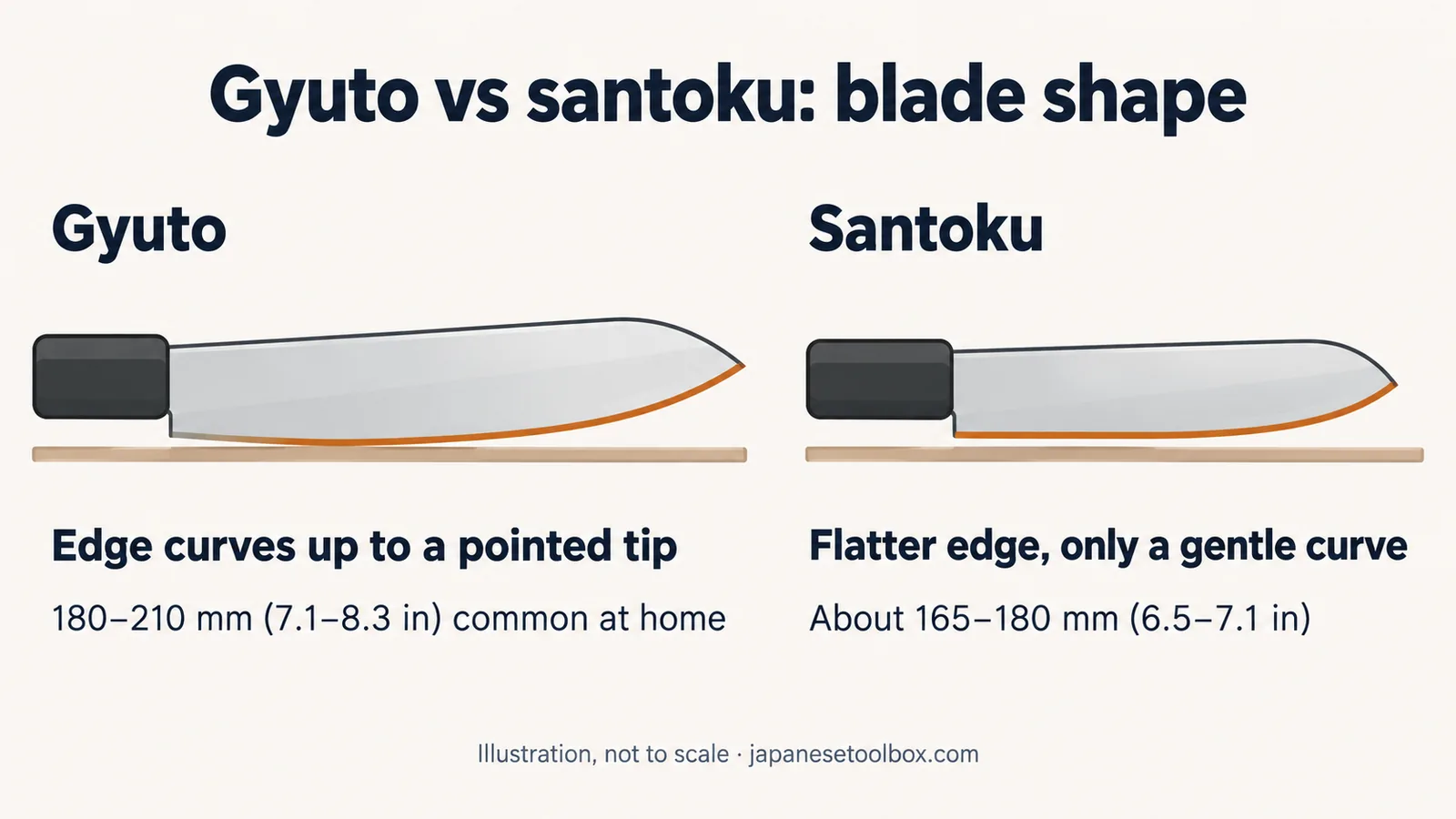
For most home cooks buying a first Japanese knife, the santoku — Japan’s everyday home knife, about 165–180 mm (6.5–7.1 in) long, with a flatter edge; the name is read as “three uses,” for meat, fish, and vegetables — is a solid starting point. Several Japanese maker and shop guides recommend a santoku to beginners and first-time buyers, and its flatter edge suits straight-down chopping. Pick a gyuto instead — a chef’s knife: a Western-born, all-purpose knife with a long blade whose edge curves up to a pointed tip; the name means “beef knife” — if you’re already comfortable with a knife and enjoy cooking, or want a longer slicing stroke. If you’re torn, a 180 mm (7.1 in) gyuto sits in between: one maker recommends it as a first gyuto because it isn’t used much differently from a santoku. This article is built from Japanese knife makers’ and shops’ own buying guides, not hands-on testing.
Gyuto vs santoku at a glance
| Gyuto | Santoku | |
|---|---|---|
| Typical length | 180–270 mm (7.1–10.6 in) overall; 180–210 mm (7.1–8.3 in) common at home | About 165–180 mm (6.5–7.1 in) (Tojiro); 160–180 mm (6.3–7.1 in) (Sakai Jikko) |
| Tip | Curves toward a point | Edge line stays close to straight, with only a gentle curve |
| Edge line | Curved; lifts away from the board toward the tip | Flatter; more of it stays parallel to the board |
| Main cutting motion | Slide and pull cuts | Push cuts, straight down |
| Who makers suggest it for | Cooking enthusiasts already comfortable with knives | First-time buyers and beginners |
Where each knife comes from
A gyuto (牛刀) is a chef’s knife. Tojiro — a knife maker based in Tsubame, Niigata Prefecture, that makes and sells kitchen knives and cooking tools — says it was imported to Japan during the Meiji era (1868–1912) and got its “beef knife” name because it was mainly used for cutting meat at the time.
A santoku, by contrast, is named for handling three foods: meat, fish, and vegetables. According to a column from Sakai Ichimonji Mitsuhide, an Osaka knife shop in Namba on the Doguyasuji kitchen-tool street that has sold knives from Sakai since 1953 and offers sharpening and repair, the santoku descends from two older knives. Sakai is a city in Osaka Prefecture known for knives; its forged knives are a nationally designated traditional craft, made by separate specialists for forging, sharpening, and handle-fitting. The santoku’s ancestors are the nakiri (a thin, double-bevel vegetable knife with a squared-off blade, once found in most Japanese homes and now largely replaced by the santoku) and the gyuto. Together they produced the bunka, an older home-knife style with a tip cut off at an angle that was an early form of the santoku. Tojiro describes this older 文化型 form as now rarely seen, while Ichimonji’s English page says bunka knives are still sold in knife shops throughout Japan. The bunka was later refined into the santoku.
Sakai Jikko — a Sakai knife company that makes and sells kitchen knives, now run by its fourth-generation president, Toshiyuki Jikko (the fourth family head to run the business) — tells a similar story on its Japanese site: the gyuto is said to have arrived in Japan alongside meat-eating culture, and the santoku’s shape is ideal for Japanese cooks who mostly cut vegetables.
How the shape changes the way you cut
The santoku’s edge meets the cutting board along more of its length, which is why push cuts — pressing the knife straight down through the food — work well; a santoku’s flat edge is good at this motion. The gyuto’s curved edge lifts away from the board toward the tip, and Tojiro says this suits Western-style pull cuts — a pull cut simply means drawing the blade back toward you as it cuts — and swinging the gyuto to use its curved tip for a smoother cut, the closest any of these maker pages come to describing a rocking-like motion. Sakai Ichimonji Mitsuhide describes sliding or slicing cuts instead, moving the blade along its length as it cuts instead of chopping straight down.
According to a column credited to Sakai Ichimonji Mitsuhide’s sharpener (研ぎ師) — a specialist who puts the final edge on a knife; in Sakai, forging, sharpening, and handle-fitting are traditionally done by different craftsmen — chopping straight down with a gyuto, the way you would with a santoku, leaves pieces uncut, so the shop recommends sliding the blade instead. Tojiro’s own santoku page makes a similar point for beginners: pressing straight down from above with a gyuto can leave food not fully cut through. This detail doesn’t appear in Ichimonji’s English version of the same column, which instead describes the gyuto as suited to “mincing and rock cutting motions” — see the note on rocking below.
A note on “rocking”
English-language knife retailers commonly describe the gyuto’s cutting motion as rocking — rocking the blade’s curved edge up and down as you cut. English-language retailers and the Japanese maker pages cited here use different words and describe different techniques: the English pages emphasize rocking, while the Japanese pages emphasize sliding and pull cuts.
Which should you buy first?
Several Japanese makers and shops give their customers similar, though not identical, advice for a first knife. If you’re unsure, Tojiro recommends the santoku since it covers meat, fish, and vegetables, and Sakai Ichimonji Mitsuhide’s column points the same way for people just starting out or considering their first knife purchase, reserving the gyuto for cooking enthusiasts already used to handling knives.
Zwilling Japan — Zwilling J.A. Henckels Japan, the Japanese company of the Zwilling knife brand, based in Seki, Gifu Prefecture, — recommends the santoku for cooking beginners and people working in small kitchens, and Sakai Jikko makes a similar case, calling it relatively light and easy to balance, with a compact shape suited to home kitchens and small workspaces.
Choose a santoku if…
- You mostly cut vegetables — Sakai Jikko calls the santoku’s shape ideal for cooks who mostly cut vegetables.
- You have a small board or a small kitchen.
- You want the easiest, most forgiving first Japanese knife.
- You want less strain on your hand, or you cook relatively infrequently.
Choose a gyuto if…
- You’re already comfortable handling a knife and enjoy cooking.
- You want a pointed tip for detail work and a longer slicing stroke.
- You regularly cut large ingredients — Sakai Jikko notes that professional cooks reach for the longer 240–270 mm (9.4–10.6 in) gyuto sizes for big cuts of meat.
See the size guide below for whether 180 mm (7.1 in) or 210 mm (8.3 in) suits you better.
Our pick: the Kanetsune KC-170 gyuto, 210 mm (8.3 in), stainless, double edged, 60–62 HRC, listed at $110.99 on Oct 8, 2026. We chose it from the shop’s listings because its listed specs match the criteria above; we haven’t used this exact knife.
Kanetsune 210 mm stainless gyuto at Hocho Knife
Stainless 180–210 mm gyuto at Hocho Knife started at about $50 on Oct 8, 2026.
Who should not start with a gyuto
Skip the gyuto, at least for now, if you only ever chop straight down — Sakai Ichimonji Mitsuhide’s sharpener notes this can leave pieces uncut with a gyuto. Also think twice about 240 mm (9.4 in) and larger sizes if you’re working with a small board or limited counter space: Tojiro’s own size guide calls 270 mm (10.6 in) gyutos professional-grade, needing a wide kitchen space.
What size gyuto: 180, 210, or 240 mm?
Makers don’t agree on one ideal home size, as the table below shows. Tojiro, Zwilling Japan, and Sakai Ichimonji Mitsuhide each point somewhere in the 180–210 mm (7.1–8.3 in) range for home cooks, while Sakai Jikko points larger: a 210–240 mm (8.3–9.4 in) gyuto for people who often cut larger vegetables, and 240–270 mm (9.4–10.6 in) for professional cooks cutting large pieces of meat. There’s no single right answer — it comes down to your hands, your kitchen, and how you cook.
| Size | Tojiro | Zwilling Japan | Sakai Ichimonji Mitsuhide | Sakai Jikko |
|---|---|---|---|---|
| 180 mm (7.1 in) | Recommended as a first gyuto; used much like a santoku; suits smaller hands and smaller kitchens | Easiest size for general home use | Commonly used for home cooking, 180–210 mm (7.1–8.3 in) | — |
| 210 mm (8.3 in) | Its most-recommended size overall | Choose this size to handle many different ingredients with one knife | Commonly used for home cooking, 180–210 mm (7.1–8.3 in) | Recommended for people who often cut larger vegetables, 210–240 mm (8.3–9.4 in) |
| 240 mm (9.4 in) | For people who frequently handle large ingredients or want to cook more seriously | For large ingredients, at 240 mm (9.4 in) or more | — | Recommended for people who often cut larger vegetables, 210–240 mm (8.3–9.4 in); also what professional cooks choose for large pieces of meat, 240–270 mm (9.4–10.6 in) |
| 270 mm (10.6 in) | Professional-grade; needs a wide kitchen space | — | — | What professional cooks choose for large pieces of meat, 240–270 mm (9.4–10.6 in) |
180 mm: the “first gyuto” bridge
Tojiro says a 180 mm (7.1 in) gyuto isn’t used much differently from a santoku, recommending it as a first gyuto for people unsure they can handle one. It also suits smaller hands and smaller kitchens.
210 mm: the balanced home size
Tojiro’s top recommendation is 210 mm (8.3 in), calling it a size that keeps the gyuto’s strengths while staying easy to handle in a home kitchen. Zwilling Japan makes a similar point: choose about 210 mm (8.3 in) if you want one knife that handles many different ingredients.
240 mm and up: for large ingredients and frequent cooking
Tojiro’s size guide suggests 240 mm (9.4 in) for people who frequently handle large ingredients or want to cook more seriously, calling 270 mm (10.6 in) professional-grade and needing a wide kitchen space. Sakai Jikko says professional cooks reach for 240–270 mm (9.4–10.6 in) gyutos specifically for cutting large pieces of meat.
No maker source gives a ratio between cutting-board size and blade length, so treat board fit as a practical judgment call. If you’re working with a compact home board, see which cutting board is safe for a Japanese knife before sizing up.
And santoku sizes?
Santoku sizing is more settled. Tojiro puts standard length at about 165–180 mm (6.5–7.1 in), and calls a 170 mm (6.7 in) santoku a shape that’s hard to go wrong with as a first knife, while a more compact size suits people who want less strain on the hand. Sakai Jikko says 160–180 mm (6.3–7.1 in) fits a standard home cutting board.
Steel and care
Tojiro recommends stainless steel for ordinary households, since it resists rust and is easier to maintain. For how stainless steel, VG-10, Aogami, and Shirogami compare, see our guide to Japanese knife steels. For the full routine — washing, drying, storage, and sharpening — see our Japanese knife care routine, and which cutting board is safe for a Japanese knife for what to cut on.
What about the dishwasher?
Our care guide’s default holds here too: hand wash. Tojiro advises hand washing, asking buyers to avoid the dishwasher since high heat and detergent wear a blade down faster.
One documented example is Kai’s Seki Magoroku 匠創 line (we’ll use the reading “Shoso” here for readability). Kai — a Japanese cutlery company that began making pocket knives in 1908 and established Endo Cutlery Works in Seki, Gifu Prefecture, in 1920 to expand pocket-knife production — makes Seki Magoroku, one of its kitchen-knife brands, named after Magoroku, a famous swordsmith of Seki. The cited 匠創 santoku and 180 mm chef’s-knife models are one-piece, all-stainless knives. The santoku’s product page marks it safe for the dishwasher and dish dryer, and even for boiling-water sterilization. The 180 mm chef’s-knife page marks it dishwasher-safe only; it doesn’t state dish-dryer or boiling-water compatibility.
Kai’s FAQ limits this to knives with stainless blades and stainless or heat-resistant plastic handles — carbon-steel blades, clad blades with a carbon-steel core, and wooden handles are excluded — and tells buyers to check the package for the dishwasher/dryer marking. Even Kai’s own product page for these dishwasher-rated knives still says to remove dirt and moisture promptly after use.
A few all-stainless Japanese knives, such as Kai’s Seki Magoroku 匠創 line, are rated dishwasher-safe by their maker. Unless the maker says so for your exact knife, hand wash it — see our Japanese knife care routine for the full steps.
Our picks: santoku and gyuto options
Shipping rules for kitchen knives vary by country and state. Check the seller’s shipping policy and your local laws before ordering.
For a santoku, look for a blade in the santoku range covered above (roughly 165–180 mm / 6.5–7.1 in).
Our pick: the Kanetsune KC-170 santoku, 180 mm (7.1 in), stainless, double edged, 60–62 HRC, listed at $110.99 on Oct 8, 2026. We chose it from the shop’s listings because its listed specs match the criteria above; we haven’t used this exact knife.
Kanetsune 180 mm stainless santoku at Hocho Knife
In-stock 165–180 mm santoku at Hocho Knife started at about $50 on Oct 8, 2026.
For a gyuto, match the length to the size section above: 180 mm (7.1 in) as a first-gyuto bridge, 210 mm (8.3 in) as an all-around home size, or 240 mm (9.4 in) if you cut large ingredients often and have the counter space for it.
Glossary
- gyuto — A chef’s knife: a Western-born, all-purpose knife with a long blade whose edge curves up to a pointed tip. The name means “beef knife.”
- santoku — Japan’s everyday home knife, about 165–180 mm (6.5–7.1 in) long, with a flatter edge. The name is read as “three uses” (meat, fish, and vegetables).
- nakiri — A thin, double-bevel Japanese vegetable knife with a squared-off blade. It was once found in most Japanese homes and has largely been replaced by the santoku.
- bunka — An older home knife style with a tip cut off at an angle. It was an early form of the santoku.
- push cut — Pressing the knife straight down through the food. A santoku’s flat edge is good at it.
- pull cut — Drawing the blade back toward you as it cuts.
- sliding (slicing) cut — Moving the blade along its length as it cuts, instead of chopping straight down.
- Sakai — A city in Osaka Prefecture known for knives. Its forged knives are a nationally designated traditional craft, made by separate specialists for forging, sharpening, and handle-fitting.
FAQ
Is a gyuto good for vegetables?
Yes. Sakai Ichimonji Mitsuhide describes the gyuto as an all-purpose Western knife usable for meat, fish, and vegetables.
Is a santoku enough for meat and fish?
Yes, for ordinary cooking. The name itself reflects being suited to three foods — meat, fish, and vegetables — and Zwilling Japan says a santoku is enough for ordinary, everyday cooking.
Is a 180 mm gyuto just a long santoku?
Not quite, but close. Tojiro says a 180 mm (7.1 in) gyuto isn’t used much differently from a santoku, recommending it as a first gyuto.
What’s the difference from a bunka?
Mainly lineage. Sakai Ichimonji Mitsuhide says the nakiri combined with the gyuto produced the bunka, which was later refined into the santoku.
Sources
The facts in this guide were checked against these pages (accessed September 2026). Pages marked (in Japanese) are written in Japanese.
- Tojiro: 三徳包丁とは?特徴・選び方・おすすめ5選 (in Japanese)
- Zwilling: 牛刀とは?三徳包丁との違いや用途についてわかりやすく解説!おすすめの包丁もご紹介 (in Japanese)
- Tojiro: 包丁の種類と使い分け (in Japanese)
- Sakai Ichimonji Mitsuhide: 包丁のプロが解説する三徳包丁と牛刀の違い。特徴と使い方とは? (in Japanese)
- Tojiro: 牛刀とは?特徴・三徳との違い・おすすめサイズの選び方【包丁メーカー解説】 (in Japanese)
- Sakai Jikko: 三徳包丁 vs. 牛刀:包丁のプロが解説する違いと使い分けのコツ (in Japanese)
- Tojiro: 会社情報 – 燕三条製包丁の藤次郎株式会社 (in Japanese)
- National Astronomical Observatory of Japan: 暦Wiki/歴史/元号 (in Japanese)
- National Diet Library (Japan): 明治に改元したのは何月何日か (in Japanese)
- Sakai Ichimonji Mitsuhide: 企業情報 | 堺一文字光秀 (in Japanese)
- Sakai Ichimonji Mitsuhide: 大阪の包丁専門店、堺一文字光秀の歴史 (in Japanese)
- Sakai City: 堺打刃物 堺市 (in Japanese)
- Sakai Jikko: 實光刃物とは (in Japanese)
- Tojiro: 和包丁の形状 (in Japanese)
- Sakai Ichimonji Mitsuhide: Santoku Vs. Gyuto: What's the Difference?
- Sakai Jikko: 会社概要 | 包丁通販なら明治33年創業の大阪 堺の實光刃物 (じっこう) (in Japanese)
- Sakai Jikko: Santoku vs. Gyuto: Choosing the Best Japanese All-Purpose Knife
- Zwilling: プライバシーポリシー (in Japanese)
- Kai: 沿革 | KAIグループについて | 貝印 (in Japanese)
- hocho-knife.com: Kanetsune KC-170 Whole AUS10 Stainless Steel Japanese Chef's Gyuto Knife 210mm
- hocho-knife.com: Gyuto(Chef's Knife)
- Kai: 関孫六について (in Japanese)
- Kai: 【公式】関孫六 匠創 三徳包丁 165mm (in Japanese)
- Kai: 関孫六 匠創 シェフナイフ 180mm (in Japanese)
- Kai: 食器洗浄機や食器乾燥機に包丁を入れてもよいのでしょうか? (in Japanese)
- Kai: 包丁を食洗器で洗ってもいいですか? (in Japanese)
- hocho-knife.com: Kanetsune KC-170 Whole AUS10 Stainless Steel Japanese Chef's Santoku Knife 180mm
- hocho-knife.com: Santoku knife
Related guides
- Nakiri vs santoku: do you need a vegetable knife?
- Japanese knife care routine
- Cutting boards for Japanese knives
- VG-10 vs Aogami vs Shirogami: steel for a first knife
- Whetstone grit for beginners: which stone to buy first
Researched and written by the Japanese Toolbox AI editorial team and reviewed by Ken, our editor in Japan. Approved for publication by Ken on September 27, 2026. How we work · @JapaneseToolbox on X