Disclosure: This post contains affiliate links. If you buy through them, we may earn a commission at no extra cost to you. We only recommend tools our editor has handled or researched in depth. Learn more
A bunka and a santoku are close relatives, and the clearest difference is the tip. In the descriptions from Tojiro, a knife maker in Niigata, the bunka type’s tip is cut off at an angle, while a santoku’s tip curves gently. Japan-side sources also describe “bunka” in two ways, as an older form and as a knife still sold, so look at the tip, not the label.
This guide draws on Japanese makers’ and knife shops’ own descriptions and dated shop listings, not hands-on testing. Several Japanese maker and shop guides recommend a santoku to beginners and first-time buyers, so the beginner section below explains where a bunka fits. For the wider family of knives, see our guide to Japanese kitchen knife types.
The difference you can see: the tip
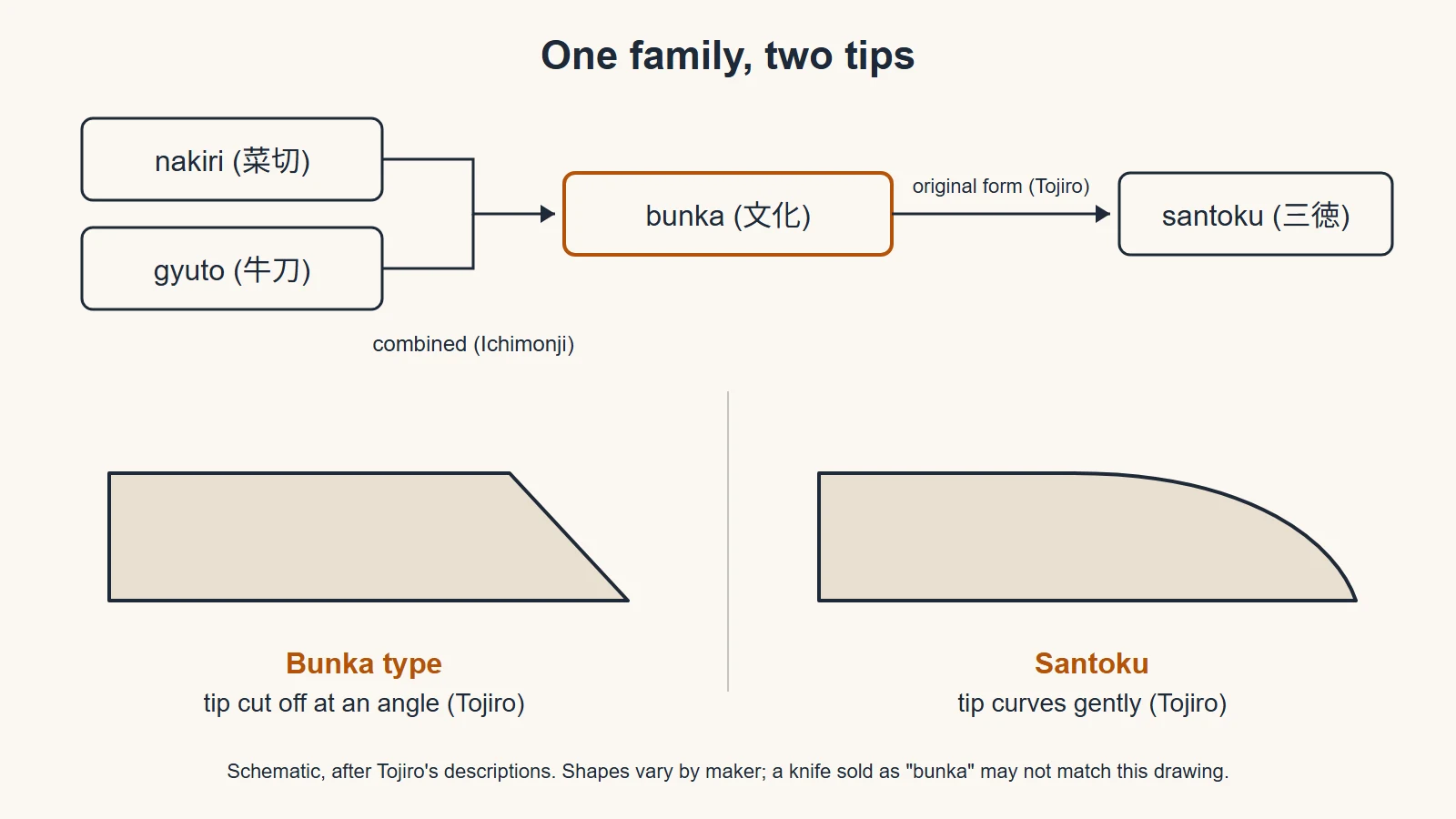
Tojiro’s traditional-shapes page describes the bunka type (文化型, bunka-gata) as the original form of the santoku, with its tip cut off at an angle. Its santoku page describes the santoku as about 170 mm (6.7 in) long, with a wide blade and a gently curving tip.
The santoku (三徳, “three uses”) is Japan’s everyday all-purpose home knife for meat, fish and vegetables, with a relatively straight edge that, Tojiro says, is good for push-cutting. Tojiro gives its typical length as about 165–180 mm (6.5–7.1 in), and Sakai Jikko, a knife company in Sakai, gives 160–180 mm (6.3–7.1 in). If you want to know how a straighter edge changes the cut, our gyuto vs santoku guide covers it.
Our reading, not stated by any single source: in these descriptions the edge and the blade width put both knives in one family, and the front corner is where they differ.
For the bunka, no maker in our sources gives a typical length. The bunka listings checked on Oct 24, 2026 were 170–180 mm (6.7–7.1 in): Zwilling’s Japanese company lists a MIYABI 文化包丁 (bunka bocho, “bunka knife”) at 17 cm, and Hocho Knife (an affiliate partner) lists bunka knives at 170 mm and 180 mm.
Two Japan-side sources trace the santoku’s tip to different ancestors. Tojiro credits the tip shape of the gyuto (牛刀, a chef’s knife: a Western-born, all-purpose knife whose edge curves up to a pointed tip), which came to Japan in the Meiji era (1868–1912). Sakai Ichimonji Mitsuhide, an Osaka knife shop, says on its English page that the bunka “was then paired with the traditional deba’s curvature near the tip” to create the santoku. The deba (出刃) is a knife for preparing fish.
Older form or another name? How Japan-side sources describe the bunka
Lineage and meaning. Ichimonji’s English page says the nakiri (菜切, a thin, double-bevel household vegetable knife with a rectangular blade and no pointed tip) and the gyuto were combined to make the bunka, glossing the word as “meaning cultured or modern knife”. Separately, Tojiro says the santoku took its straight edge from the nakiri. For how the nakiri compares with the santoku, see our nakiri vs santoku guide.
Tojiro, Ichimonji, Hocho Knife and Zwilling Japan describe the bunka in two ways: as an older form that is now rarely seen, and as a knife still sold.
Rarely seen now: – Tojiro says the older 文化型 form it describes is now rarely seen.
Still sold: – Ichimonji’s English page says “both the nakiri and bunka are available in knife stores throughout Japan”. – As of Oct 24, 2026, Hocho Knife’s santoku category says the santoku is sometimes called a “Bunka” Bocho, and lists two knives with “Bunka” in their titles. – On the same date, Zwilling Japan’s store listed a MIYABI HIBANA 文化包丁 at 17 cm, with Japan as the country of origin. MIYABI is a Zwilling group knife brand made in Seki, Japan.
Our reading, not stated by any source: the name covers both a historical form and a current product label, so two knives sold as “bunka” may not share one exact shape. Ichimonji’s English page adds a caution about a related name: it says bunka and kiritsuke-santoku (a related knife name) “are often used interchangably”, yet “they are not the same knife as they have different blade geometry”. The page also says “some manufacturers” call the gyuto and kiritsuke-gyuto (another related name) kengata (sword-type), and that “sometimes” bunka and kiritsuke-santoku knives are classified as kengata too, so “double check whenever you see that name”.
Bunka or santoku for a beginner?
Those guides are Tojiro’s (「迷ったら三徳を。」), Sakai Jikko’s (relatively light and well balanced, and easy for beginners to use) and Zwilling Japan’s (for cooking beginners and small kitchens).
Tojiro’s santoku page says the santoku is the knife it gets the most enquiries and sales for, as a shape that is hard to go wrong with as a first knife, and suggests a compact size for people who want less strain on the hand. The Japanese guides cited here give first-knife advice for the santoku, not the bunka.
Our framing: if you like the look of the angled tip, a bunka is a santoku-family knife you choose by its shape. If you have no preference, the santoku is the knife these guides recommend first. For more options, see our best Japanese knife for beginners guide.
What a “bunka” label tells you on a listing
On Oct 24, 2026, the two bunka knives in Hocho Knife’s santoku category were about $342 (Kei Kobayashi, R2 steel, 170 mm) and about $357 (Sakai Takayuki, Shirogami #2 (White #2) steel, 180 mm), both sale prices. Shirogami #2 is a high-purity carbon steel. The santoku picks below start at about $44 (as of Oct 24, 2026), so these two bunka listings were priced higher than the picks. So the label alone is not a reason to pay more or less; the tip, length and steel in the listing are what you can compare.
Three things to check, in our view:
- The tip in the photos. Is it an angled corner or a gentle curve? The name may not tell you; see Ichimonji’s caution above.
- The blade length as listed. Compare it with the 165–180 mm santoku range above.
- The steel and bevel as listed. Our steel guide for beginners explains the common names.
Once you own one, our knife care routine covers the basics.
Santoku picks at Hocho Knife, with prices on Oct 24, 2026
These picks come from Hocho Knife’s listings, and we haven’t used them. None is labeled “bunka”; they are santoku listings, so if the angled corner matters to you, look at the tip in each photo. Prices are as of Oct 24, 2026 and may change.
Entry: Kanetsune KC-950 santoku, 165 mm (6.5 in), about $51. The listing gives a DSR-1K6 stainless core with soft stainless sides, a double-edged (ground on both sides) blade, 120 g, and made in Japan.
Kanetsune KC-950 165 mm santoku at Hocho Knife
Compact all-stainless: Shimomura PRO-Grade santoku, 155 mm (6.1 in), about $44. It uses molybdenum-vanadium stainless, a hollow all-stainless handle, 110 g, and made in Japan. At 155 mm it is below the 165–180 mm santoku range, so it suits a reader who wants a compact knife.
Shimomura 155 mm all-stainless santoku at Hocho Knife
180 mm: Kanetsune KC-170 santoku, 180 mm (7.1 in), about $111. Per the listing, it is double edged, HRC 60–62, and made in Japan. The listing’s steel details conflict, so we can only call it stainless. HRC is a steel-hardness scale; Tojiro uses it and lists harder carbon steels at higher HRC values.
Kanetsune 180 mm stainless santoku at Hocho Knife
Damascus look: Sakai Takayuki 17-layer VG10 damascus santoku, 180 mm (7.1 in), about $128. Per the listing, it has a VG-10 core, HRC 60±1, 170 g, and is made in Japan by Aoki Hamono. VG-10 is a blade steel made by Takefu Special Steel, with 15% chromium. Zwilling Japan describes a damascus knife as one with two or more different metals layered over the blade’s core material, giving a distinctive pattern like tree rings. Our damascus knife guide covers whether the look is worth it.
Sakai Takayuki 17-layer VG10 damascus santoku (180 mm) at Hocho Knife
Hocho Knife’s santoku category also includes the two bunka-labeled knives mentioned above, so you can compare tips side by side.
Shipping rules for kitchen knives vary by country and state. Check the seller’s shipping policy and your local laws before ordering.
Related guides
- Gyuto vs santoku
- Nakiri vs santoku
- Types of Japanese kitchen knives
- Best Japanese knife for beginners
- Japanese knife steel for beginners
- Japanese knife care routine
Sources
- Tojiro: traditional knife shapes, santoku guide, household knife guide, chef’s knife (gyuto) guide, nakiri guide, steel and hardness
- Sakai Ichimonji Mitsuhide: English article, Time Out Japan shop listing
- Sakai Jikko: santoku vs gyuto, carbon steel
- Zwilling Japan: chef’s knife guide, MIYABI listing, damascus guide
- Hocho Knife: santoku category and the product pages for the four picks, read Oct 24, 2026
- Takefu Special Steel: VG-10
Researched and written by the Japanese Toolbox AI editorial team and reviewed by Ken, our editor in Japan. Approved for publication by Ken on October 25, 2026. How we work · @JapaneseToolbox on X