Disclosure: This post contains affiliate links. If you buy through them, we may earn a commission at no extra cost to you. We only recommend tools our editor has handled or researched in depth. Learn more
A santoku is Japan’s everyday all-purpose home knife, about 165–180 mm (6.5–7.1 in), whose name refers to its three uses of meat, fish, and vegetables. If you already own one, a nakiri — a Japanese vegetable knife with a straight, flat edge — is a reasonable second knife if you cook a lot of vegetables. It is not a santoku replacement. Tojiro, a Japanese knife maker, is explicit about this: 「三徳の代わりではなく、料理を楽にする」 — not a replacement for the santoku, but something that makes cooking easier. If you’re choosing your first Japanese knife, start with the santoku (see gyuto vs santoku: which to buy first), because a nakiri has no pointed tip and is built specifically for vegetables. This article is built from Japanese knife makers’ and knife shops’ own guides, not hands-on testing.
Nakiri vs santoku at a glance
| Nakiri | Santoku | |
|---|---|---|
| Edge line | Straight, flat edge | Gentle curve |
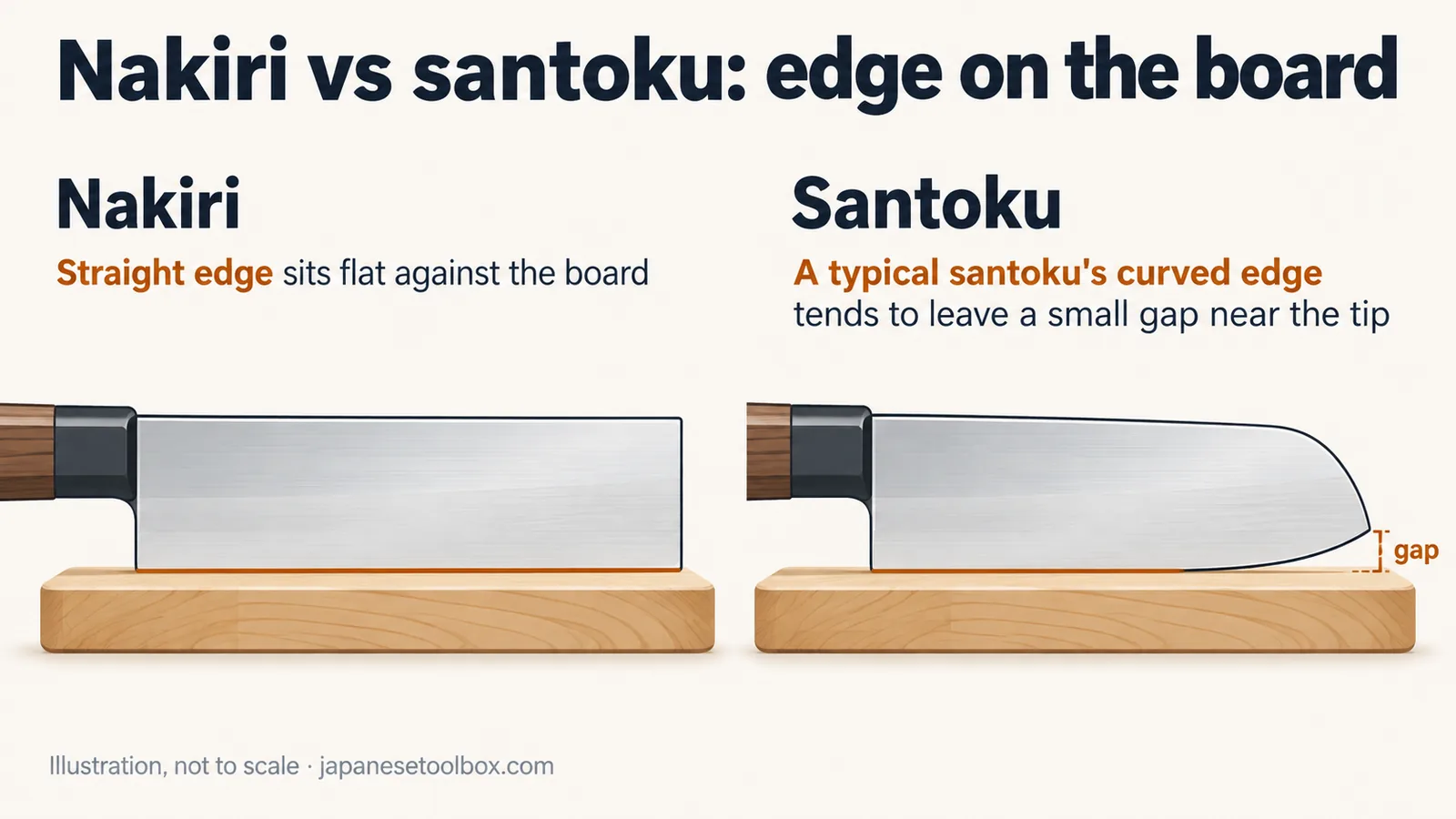
| Board contact | Sits flat against the board | A gap tends to form near the tip |
| Blade shape | Rectangular, square-cornered | Triangular |
| Tip | No pointed tip | Has a tip; the edge curves more and the tip is rounded |
| Main use | Vegetables | All-purpose (meat, fish, vegetables) |
| Typical length | About 165 mm (6.5 in) | 165–180 mm (6.5–7.1 in) |
| Bevel | Double-bevel | Double-bevel |
What a nakiri is, and why Japan had one
A nakiri is a Japanese knife made for cutting vegetables. Tojiro describes it as a home vegetable knife with a very thin, double-bevel blade, and Sakai Ichimonji Mitsuhide — an Osaka knife shop in Namba on the Doguyasuji kitchen-tool street that has sold Sakai knives since 1953 — calls it a home knife that has long been used in Japan. The blade is straight-edged, wide, and thin.
Japanese home cooking involves a lot of fine vegetable chopping, and Japan developed separate knives for different jobs: the deba (a knife for breaking down fish), the yanagiba (a knife for slicing sashimi), and the nakiri, for vegetables.
How the santoku took its place
Tojiro says the santoku combined the strong points of the nakiri and the gyuto — a Western-born all-purpose knife (see gyuto vs santoku: which to buy first) — and that the nakiri has largely been replaced by it in Japanese homes. Sakai Ichimonji Mitsuhide’s column on the santoku and gyuto describes a lineage: the nakiri combined with the Western-born gyuto produced the bunka, an older home-knife style, which was later refined into the santoku. The same column notes that the santoku still keeps a trace of the nakiri in its straighter edge line. Neither maker dates this transition.
Why a flat edge matters for vegetables
Tojiro explains the mechanics behind a common complaint: julienned vegetables that stay joined at one end after cutting. A typical santoku’s edge has a gentle curve, so the tip lifts slightly off the board, leaving a small gap — and that gap is what keeps julienne strips connected. A nakiri’s edge is straight, so it sits flat against the board: 「刃が直線のため、まな板にぴったり密着し」 — because the edge is straight, it sits flush against the board — and cuts all the way through. Sakai Ichimonji Mitsuhide makes the same point: because the edge line is straight, it meets the board horizontally with less of a gap, leaving fewer uncut pieces. Sakai Jikko describes the nakiri’s square blade shape as designed to meet the board in parallel.
The basic nakiri motion is straight-down chopping — 「トントン切り」 — rather than moving the blade back and forth. For board options, see our cutting board guide.
The wide blade doubles as a scraper
Because the nakiri’s blade is wide and rectangular, both Tojiro pages describe it as also working as a scraper for moving chopped food off the board.
What a nakiri can’t do (who should not buy one)
Tojiro’s own “honest review” section of its nakiri guide is blunt about the tradeoffs. With no pointed tip, a nakiri is awkward for separating broccoli into florets or opening packaging. Sakai Jikko makes a related point: without a tip, a nakiri can’t make incisions, which makes it a little harder to use than a gyuto for that kind of work. Tojiro also says a nakiri isn’t suited to cutting through bone-in meat or frozen food straight from the freezer.
A nakiri is mostly a vegetable knife. Tojiro’s FAQ notes one exception: it also suits skin-on ingredients like chicken thighs.
Based on those points, a nakiri is not a good choice as your only knife if you regularly cut meat and fish, or need a pointed tip for detail work — that’s our reading of the sources above, not a maker’s own summary.
Nakiri vs usuba: not the same knife
A nakiri and an usuba both cut vegetables, but they are not the same knife. The nakiri is double-bevel, ground on both sides like a Western knife. The usuba is single-bevel — ground on one side only — and is used in Japanese cuisine for peeling, hollowing out vegetables, and other delicate vegetable work. Sakai Jikko describes the usuba as specialized for katsuramuki and delicate chopping.
Sakai Ichimonji Mitsuhide draws a broader line: single-bevel knives are mainly for washoku (Japanese cuisine), while double-bevel knives cover other cooking, including home cooking. It also describes the double-bevel nakiri as the popular choice in home kitchens.
For a home cook who wants a vegetable knife for everyday cooking, these sources describe the nakiri, not the usuba, as the home knife. The usuba is single-bevel and specialized for peeling and detail work. For how single-bevel and double-bevel knives differ, including left-handed versions, see our single bevel vs double bevel guide.
Is a nakiri worth it? Who each knife suits
Add a nakiri if…
Tojiro’s own list of who a nakiri suits: you cook a lot of vegetable dishes, you cut a lot of julienne or thin rounds, you already own a santoku, and you enjoy cooking. Tojiro’s FAQ adds that it’s easy for beginners too, since the straight edge just needs to meet the board to cut cleanly.
Stick with your santoku (or gyuto) if…
You want one knife that handles meat, fish, and vegetables; you need a pointed tip for detail work; or you rarely do fine vegetable prep. None of the sources above frame the nakiri as a fit for those needs, so a santoku or gyuto remains the better single-knife choice.
Your first Japanese knife
If you’re buying your first Japanese knife, start with a santoku, then add a nakiri later if you find yourself doing a lot of vegetable prep. See gyuto vs santoku: which to buy first for the santoku vs gyuto decision.
Steel and care
Sakai Ichimonji Mitsuhide notes that vegetable juices and moisture make a blade prone to discoloring and rust, and recommends rust-resistant stainless steel if you’re not used to handling knives. Tojiro likewise recommends stainless steel for ordinary households. For how stainless steel, VG-10, Aogami, and Shirogami compare, see our guide to Japanese knife steels. For washing, drying, storage, and sharpening, see our Japanese knife care routine. None of the sources here say a nakiri is dishwasher-safe.
What to look for in a nakiri
Based on the guidance above, a few selection criteria for a first nakiri. Shipping rules for kitchen knives vary by country and state, so check the seller’s shipping policy and your local laws before ordering.
- Stainless steel, especially if you’re not yet used to caring for knives.
- About 165 mm (6.5 in) for home use.
- Double bevel — that’s the home nakiri described throughout this guide, not the single-bevel usuba.
Our pick: the Kanetsune KC-150 nakiri, 165 mm (6.5 in), Swedish stainless steel, double edged, 60–61 HRC, listed at about $114 on Oct 15, 2026. We chose it from the shop’s listings because its listed specs match the criteria above; we haven’t used this exact knife.
Kanetsune 165 mm stainless nakiri at Hocho Knife
Stainless 160–180 mm nakiri at Hocho Knife started at about $50 on Oct 8, 2026.
Glossary
- nakiri — A thin, double-bevel Japanese vegetable knife with a rectangular blade and a straight edge, once the standard vegetable knife in Japanese homes.
- santoku — Japan’s everyday all-purpose home knife, about 165–180 mm (6.5–7.1 in), whose name refers to its three uses: meat, fish, and vegetables.
- usuba — A single-bevel Japanese vegetable knife used in Japanese cuisine for peeling, hollowing, and other delicate vegetable work.
- single bevel / double bevel — Single bevel: the edge is ground on one side only. Double bevel: ground on both sides, like a Western knife.
- gyuto — A chef’s knife: a Western-born, all-purpose knife with a long blade that curves up to a pointed tip.
- bunka — An older home-knife style with the tip cut off at an angle, an early form of the santoku.
- straight-down chopping — Bringing the knife straight down onto the board, rather than moving it back and forth.
FAQ
Is a nakiri only for vegetables?
Mostly. Tojiro’s FAQ says a nakiri is mainly for vegetables, though it also suits skin-on ingredients like chicken thighs; it isn’t meant for bone-in cuts or frozen food.
Is a nakiri good for beginners?
Tojiro’s FAQ says yes — the straight edge just needs to meet the board to cut cleanly, which makes it easy to handle.
Is a nakiri the same as an usuba?
No. The nakiri is double-bevel; the usuba is single-bevel.
Can a nakiri replace my santoku?
No — Tojiro positions the nakiri as a second knife that makes cooking easier, not a santoku replacement.
Sources
The facts in this guide were checked against these pages (accessed October 2026). Pages marked (in Japanese) are written in Japanese.
- Tojiro: 包丁の種類と使い分け (in Japanese)
- Tojiro: 菜切包丁(なきり包丁)とは? プロが教える特徴・使い方・三徳との違い【もっと千切りしたくなる野菜用包丁】 (in Japanese)
- Sakai Jikko: 菜切包丁のメリットとデメリット:科学が解明する切れ味の秘密 (in Japanese)
- Tojiro: 和包丁の形状 (in Japanese)
- Sakai Ichimonji Mitsuhide: 企業情報 | 堺一文字光秀 (in Japanese)
- Sakai Ichimonji Mitsuhide: 大阪の包丁専門店、堺一文字光秀の歴史 (in Japanese)
- Sakai Ichimonji Mitsuhide: プロがおすすめする菜切り包丁の選び方と通販 (in Japanese)
- Tojiro: 牛刀とは?特徴・三徳との違い・おすすめサイズの選び方【包丁メーカー解説】 (in Japanese)
- Sakai Ichimonji Mitsuhide: 包丁のプロが解説する三徳包丁と牛刀の違い。特徴と使い方とは? (in Japanese)
- Sakai Jikko: 片刃包丁と両刃包丁で切れ味は変わるのか?実際に切り比べてみた (in Japanese)
Related guides
- Gyuto vs santoku: which to buy first
- Japanese knife care routine
- Cutting boards for Japanese knives
- VG-10 vs Aogami vs Shirogami: steel for a first knife
- Whetstone grit for beginners: which stone to buy first
- Single bevel vs double bevel knife: which should you buy?
Researched and written by the Japanese Toolbox AI editorial team and reviewed by Ken, our editor in Japan. Approved for publication by Ken on September 28, 2026. How we work · @JapaneseToolbox on X