Disclosure: This post contains affiliate links. If you buy through them, we may earn a commission at no extra cost to you. We only recommend tools our editor has handled or researched in depth. Learn more
Start with a medium stone — the everyday whetstone used for regular sharpening — around #1000. That’s the number the Japanese knife makers and whetstone shop covered in this guide keep landing on. This is a pattern across separate guides, not a stated consensus. They recommend different finer-grit options and place different emphasis on adding one; for a first purchase, treat the finer side as optional. All of them point to flattening (restoring a worn stone’s surface back to flat) as something you’ll eventually have to deal with.
This guide is built from those makers’ and that shop’s own Japanese-language buying guides, not hands-on testing. It covers choosing a first whetstone — the grit (the numbered coarseness rating printed on the stone), whether a combination stone is worth it, and what else to buy with it — not how to sharpen a knife. A future hands-on guide will cover technique.
What Japanese makers recommend for a first stone
Here’s what each source says about the grits relevant to a first stone, read in its own language:
| Source | First-stone advice | Finer side | Sells stones? |
|---|---|---|---|
| Tojiro — a knife maker based in Tsubame, Niigata Prefecture, that makes and sells kitchen knives and cooking tools | For general resharpening, its guide says it tells buyers that one medium stone (#600–#2000) covers most needs. | Not addressed separately from the medium-stone recommendation above. | Yes — Tojiro’s guide links to its own stone products and store categories. |
| Kai — a Japanese cutlery company that began making pocket knives in 1908 and established Endo Cutlery Works in Seki, Gifu Prefecture, in 1920 to expand pocket-knife production | Recommends a #1000–#2000 medium stone for buyers getting just one stone. | Kai’s own combination stone (one stone with a different grit bonded to each side) pairs #1000 with #4000. | Yes — Kai’s own combination stone. |
| Sakai Jikko — a Sakai knife company that makes and sells kitchen knives, run by its fourth-generation president, Toshiyuki Jikko (the fourth family head to run the business) | #1000 is used for basic sharpening, shaping the edge while increasing smoothness. | A #1000/#6000 combination stone is ideal for keeping one or two home knives in shape. | Yes — this page is a guide to stones Jikko sells. |
| Toishiya Ao — a whetstone specialty shop that is the official direct store of the Japanese whetstone brand ALTSTONE | The first stone should be a medium #1000; #1000 alone gives a first-timer real sharpness. | A combination stone (for example #1000/#3000) is convenient. | Yes — Toishiya Ao is ALTSTONE’s direct store. |
Kai recommends its own combination stone, and Toishiya Ao’s first-stone pick is its own ALTSTONE #1000 — it’s the direct store of the ALTSTONE brand. Sakai Jikko’s page is also a guide to the stones it sells. None of that makes the advice wrong; it’s useful context for weighing it.
What grit numbers mean
Grit (番手), which Kai writes with 番 or #, is the number that describes how coarse or fine a whetstone’s surface is. Lower numbers are coarser stones that remove more metal; higher numbers are finer stones used for polishing the edge, as the range tables below show.
Grit ranges by maker
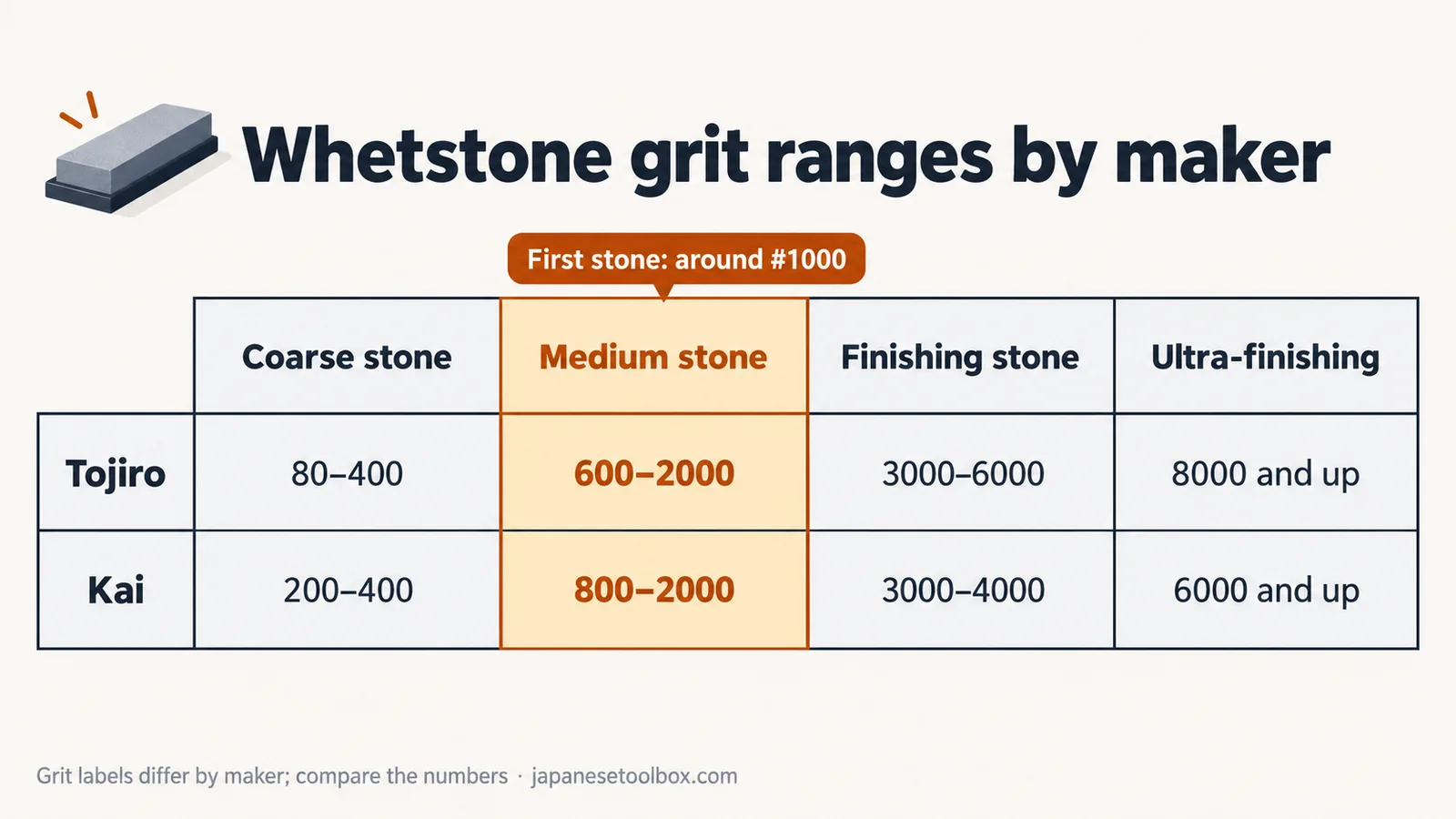
Tojiro and Kai each sort stones into four categories, but their number ranges don’t line up exactly.
| Category | Tojiro | Kai |
|---|---|---|
| Coarse stone (荒砥石) — a low-grit stone for fixing chips or reshaping an edge | #80–#400 | 200–400 |
| Medium stone (中砥石) — the everyday sharpening stone | #600–#2000 | 800–2000 |
| Finishing stone (仕上げ砥石) — a fine stone used after the medium stone to refine the edge | #3000–#6000 | 3000–4000 |
| Ultra-finishing stone (超仕上げ砥石) — Kai’s and Tojiro’s label for the finest grits | #8000 and up | 6000 and up |
Sakai Jikko doesn’t sort its stones into the same four categories. Instead, it describes what each specific grit is for:
- #240 and #400 (coarse stone): fixing chips or reshaping an edge.
- #1000 (medium stone): basic sharpening, shaping the edge while increasing smoothness.
- #3000: a medium stone that removes less metal than #1000.
- #6000 (finishing stone): used after sharpening with #1000 or #3000.
Notice the mismatch: #3000 is a medium stone for Jikko but sits in Tojiro’s and Kai’s finishing range. #6000 is a finishing grit for Tojiro and Jikko, but sits in Kai’s ultra-finishing category. A stone’s “medium” or “finishing” label means something different depending on which maker wrote it — compare the number, not the label.
Your first stone: a medium stone around #1000
A medium stone around #1000 is where the four sources in the table above converge.
The practical takeaway is to shop by the number, not the label. As the mismatch described above shows, a “medium” stone means a different exact range depending on which maker wrote it, but #1000 itself sits inside every source’s medium range — so look for that number on the box, and treat the wider range each source lists around it as flexible rather than exact.
Do you need a 6000 grit stone?
See the “Finer side” column in the table above for each maker’s specific number on the finer, finishing side.
Our synthesis, not stated by any single source: a finishing side looks optional for a first stone. If you want one anyway, a combination stone is the simple way to get it — #3000, #4000, and #6000 all show up as the finer side, depending on which maker’s combination stone you buy.
Combination stone vs two single stones
A combination stone (両面砥石) is one stone with a different grit bonded to each side, so you can sharpen on one side and refine the edge on the other. Sakai Jikko’s version has #1000 and #6000 grits on its two faces. Toishiya Ao describes the same idea: two grits bonded back to back, with one stone covering medium sharpening and finishing.
These pages do not provide a general durability or thickness comparison; prices are product-specific, so that call is left to you.
Soaking stones vs splash-and-go
Whether a stone needs soaking depends on the specific stone, not a universal rule. For the stone it describes, Sakai Jikko says to soak it in water until bubbles stop rising before use, while some stones need a good soak before use and others are sold as needing none at all, per Toishiya Ao.
Here, “splash-and-go” means a stone sold as not requiring soaking. Follow the instructions on the specific stone you buy rather than assuming either way.
Softer or harder stone? Match your knife’s steel
Tojiro connects stone hardness to the knife’s steel: softer stones generally suit stainless knives, and harder stones generally suit carbon-steel knives.
For a first-time buyer, Tojiro points to what it calls a home stone — a stone meant for home use — that tends to be on the softer side and can sharpen many kinds of knives.
Japanese maker guidance, covered in our guide to choosing between a gyuto and a santoku, points most households toward stainless steel for easier maintenance. If your first knife is stainless, a softer home stone is the more likely fit.
Don’t forget a flattening stone
A whetstone’s surface doesn’t stay flat. Toishiya Ao says the center wears hollow with use. Flattening it regularly — grinding the worn stone flat again, using either a dedicated flattening stone or a diamond plate — is something Sakai Jikko recommends. Kai warns that an uneven stone makes a knife harder to sharpen and can leave the edge uneven or the sharpening incorrect, and calls a flattening stone a maintenance item you need if you keep sharpening over time.
This guide doesn’t walk through the flattening steps themselves — that’s outside what it covers.
Whetstone or pull-through sharpener?
Kai draws a line between the two: a whetstone gives a knife a proper, full sharpening, while a pull-through sharpener — a handheld sharpener you pull the knife blade through — restores cutting performance more simply. Kai’s article presents sharpeners as beginner-friendly, and its product text says simple operation restores cutting performance.
For the fuller picture on care and where sharpening fits in, see our Japanese knife care routine, whose sharpening section points to a whetstone, a professional sharpening service, or honing; a hands-on sharpening guide covering technique is planned for later.
What to look for when buying a first stone
Based on everything above, here’s what to check before buying:
- A medium grit around #1000.
- Optional: a combination stone, if you want a finer side too.
- Whether the label says to soak the stone before use, or not.
- A way to flatten it — a dedicated flattening stone or a diamond plate.
- If your knife is stainless, consider a softer “home” stone, per Tojiro’s guidance above.
Our pick: the Naniwa Super Ceramic Waterstone (Whetstone) with Stand [S-1000], #1000 grit, 210 × 70 × 20 mm, with stand, listed at $75.99 on Oct 8, 2026. We chose it because it meets our core #1000-grit criterion; we haven’t used this exact stone.
Naniwa #1000 whetstone with stand at Hocho Knife
Single-grit #1000 whetstones at Hocho Knife started at about $46 on Oct 8, 2026.
Glossary
- grit (番手) — The number describing how coarse or fine a whetstone’s surface is. Low numbers are coarse; high numbers are fine.
- medium stone — The everyday sharpening stone, generally around #1000.
- finishing stone — A fine stone used after the medium stone to refine the edge.
- combination stone — One stone with a different grit bonded to each side.
- flattening stone — A stone (or diamond plate) used to grind a worn whetstone back to flat.
- soaking stone / splash-and-go — A soaking stone is left in water before use; here, splash-and-go means a stone sold as not needing a soak.
- pull-through sharpener — A handheld sharpener you pull the knife blade through, rather than sharpening on a stone.
FAQ
Is a 1000 grit whetstone enough?
For everyday upkeep, likely yes — see “Your first stone: a medium stone around #1000” above for what the four sources say a medium stone covers.
Do I need a 6000 grit stone?
Sources recommend different options — see “Do you need a 6000 grit stone?” above for how each maker’s combination stone differs.
What’s the difference between 3000 and 6000?
It depends on the maker — see “Grit ranges by maker” above for how the category boundaries shift from source to source.
Do I need to soak my whetstone?
Check the label on the stone you buy — see “Soaking stones vs splash-and-go” above for what Sakai Jikko and Toishiya Ao each say.
Do I really need a flattening stone?
Eventually, yes — see “Don’t forget a flattening stone” above for what each source says about why.
Whetstone or pull-through sharpener?
Kai frames them as different tools — see “Whetstone or pull-through sharpener?” above for the distinction it draws.
Sources
The facts in this guide were checked against these pages (accessed September 2026). Pages marked (in Japanese) are written in Japanese.
- Tojiro: 砥石の選び方 (in Japanese)
- Kai: 砥⽯の種類と選び⽅を解説!プロが認める⾙印おすすめの砥⽯や、初⼼者にも易しい研ぎ器を紹介 (in Japanese)
- Sakai Jikko: 砥石の種類と選び方:實光刃物おすすめ砥石徹底ガイド (in Japanese)
- Toishiya Ao: 砥石のおすすめは中砥#1000 (in Japanese)
- Tojiro: 会社情報 – 燕三条製包丁の藤次郎株式会社 (in Japanese)
- Kai: 沿革 | KAIグループについて | 貝印 (in Japanese)
- Sakai Jikko: 会社概要 | 包丁通販なら明治33年創業の大阪 堺の實光刃物 (じっこう) (in Japanese)
- Sakai Jikko: 實光刃物とは (in Japanese)
- Toishiya Ao: ABOUT | 砥石専門店 といし屋「碧」 (in Japanese)
- Tojiro: 包丁の種類と使い分け (in Japanese)
- Kai: 包丁の研ぎ方|貝印包丁サイト (in Japanese)
- hocho-knife.com: Naniwa Super Ceramic Waterstone (Whetstone) with Stand [S-1000]
- hocho-knife.com: Accessories
Related guides
- Japanese knife care routine
- Gyuto vs santoku: which Japanese knife to buy first
- Nakiri vs santoku: whether a nakiri is worth adding
A hands-on sharpening guide covering technique is planned for later.
Researched and written by the Japanese Toolbox AI editorial team and reviewed by Ken, our editor in Japan. Approved for publication by Ken on September 28, 2026. How we work · @JapaneseToolbox on X