A common way Japanese makers and labs measure knife sharpness is to press a weighted stack of thin paper strips against the edge, run the blade or the stack back and forth, and count how many sheets were cut through. It’s called the Honda-type (本多式, Honda-shiki) test, and a 2014 report from Gifu Prefecture’s industrial research institute (now the Gifu Prefectural Industrial Technology Center), in central Japan, calls it widely used in Japan to evaluate knife sharpness.
There’s a catch: the test has never been standardized, so every lab and maker that owns a tester runs it under its own settings.
This explainer draws on a Gifu Prefecture research report, a knife maker’s published test settings and a UK testing body’s pages, not hands-on testing.
Can you put a number on “sharp”?
Masahiro is a knife maker in Seki, a city in Gifu Prefecture it calls 「刃物の町」 (“a knife town”). It puts the idea of sharpness simply: a sharp knife is one that “cuts with little force.”
An edge that looks like a single pointed line is, Masahiro says, actually 0.002–0.005 mm wide.
The tests below turn that idea into a number: they count or measure how much of a specified test material a blade cuts through under a fixed set of conditions.
How the paper-stack test works
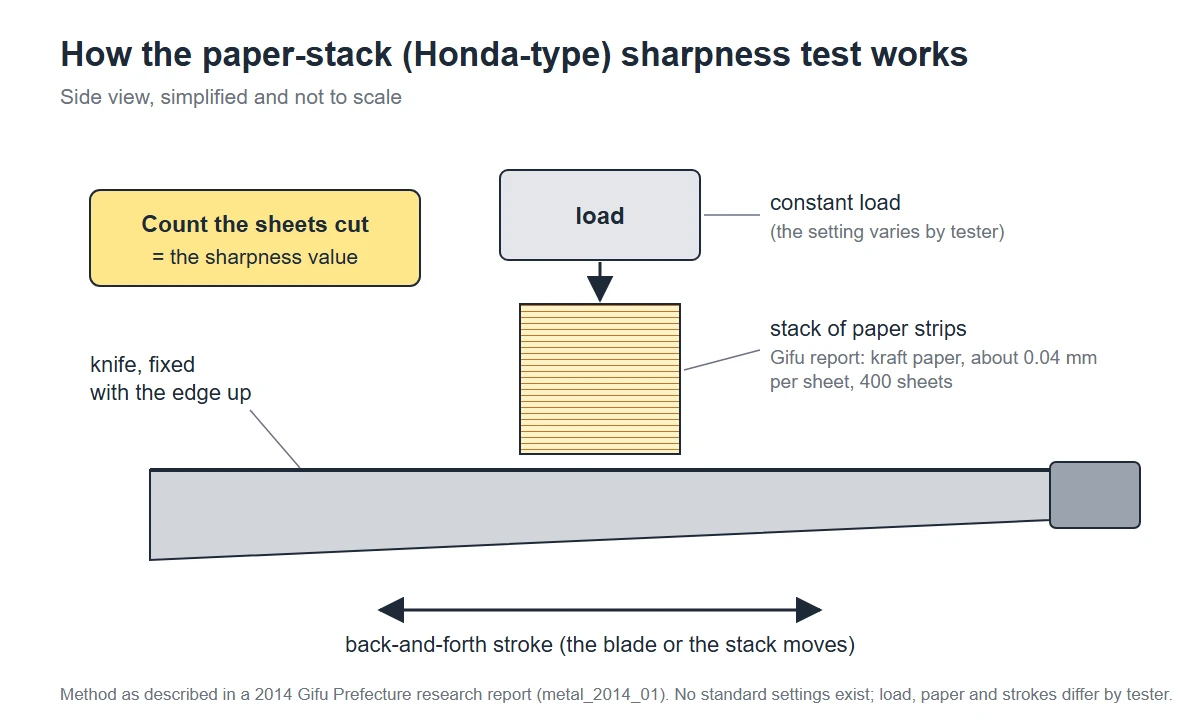
A 2014 Gifu Prefecture research report describes the Honda-type method this way: strips of washi (Japanese paper) or kraft paper are stacked to make the test material. The knife and the paper stack are pressed together at a constant load, and either the blade or the stack is moved back and forth. The number of sheets the blade cuts through is counted and used as the sharpness value.
The same report says that most of the Honda-type testers now in use automate the motor-driven stroke and the cycle count, though the operator still removes the paper stack after each stroke and counts the cut sheets.
The report’s Table 1 lists the paper’s specs: kraft paper with no filler, 30 g/m², about 0.04 mm (0.0016 in) per sheet, stacked about 16 mm (0.6 in) deep (400 sheets), cut into strips 8 mm (0.3 in) wide.
Where the test comes from
The test is named after Honda (本多). The accounts of where it came from, though, describe it differently.
A 2014 Gifu Prefecture research report dates the method to around 1920.
Touken World, a Japanese sword website, credits the tester to the metallurgist Kōtarō Honda.
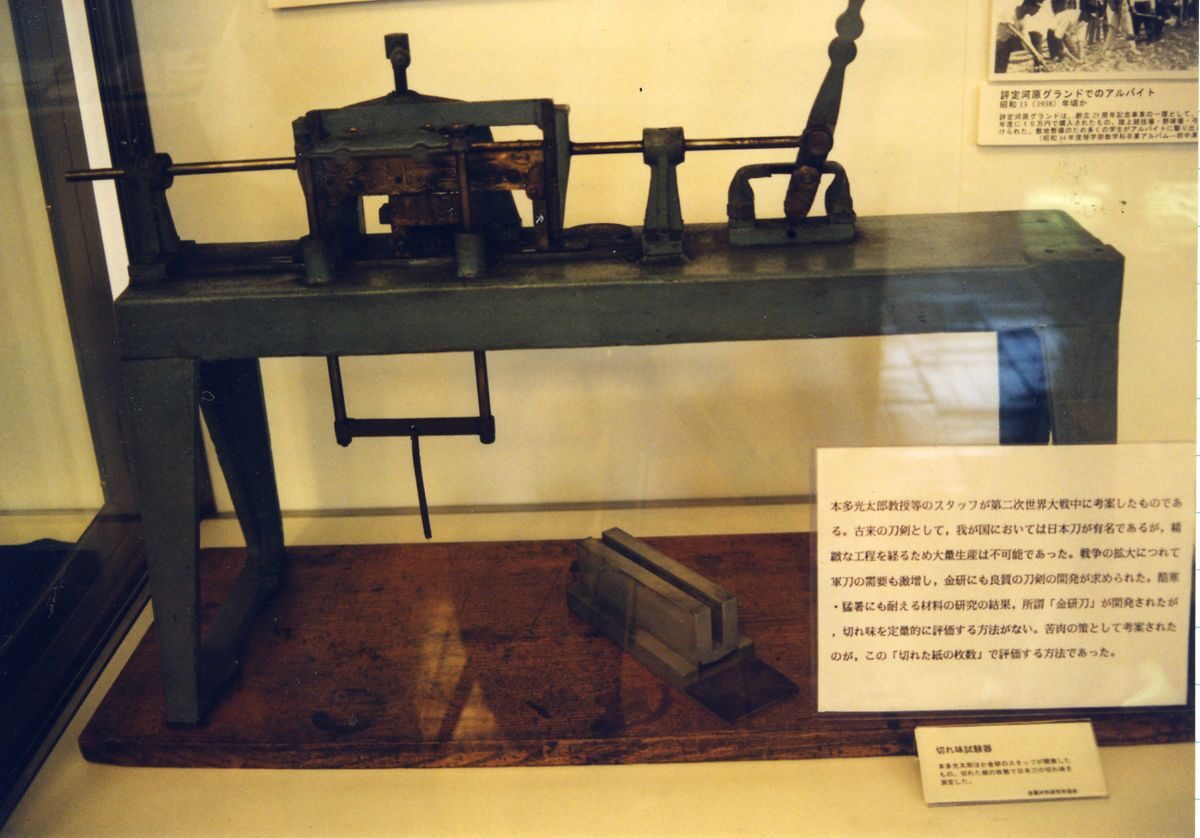
Photo: Tohoku University Archives (東北大学史料館), CC BY 4.0
The display panel next to the tester, shown in that photo, gives a third account, and its date doesn’t match the 2014 report’s “around 1920.” It says Professor Kōtarō Honda and other staff at Tohoku University’s Institute for Materials Research (Kinken, for short) devised the tester during World War II. The institute had developed a sword from research on materials that withstand severe cold and heat — what the panel calls 「金研刀」 (“Kinken-tō”) — but had no way to measure its sharpness in numbers. As a stopgap, the panel says, staff devised the method of counting how many sheets of paper the blade cut.
Tohoku University’s archive catalogs the photo itself as 「本多式刃物の切れ味試験器」, in its Institute for Materials Research collection, under a CC BY 4.0 license.
Separately, Kōtarō Honda headed Tohoku Imperial University’s iron and steel research institute — the predecessor of today’s Institute for Materials Research — from 1919 to 1933, and invented KS magnet steel.
One name, many setups: why sheet counts don’t compare
The 2014 Gifu report’s central point is that the Honda-type test has never been standardized since it was devised around 1920: each organization that owns a tester evaluates knives its own way, and no unified way of scoring knife performance is defined for the method.
Two published setups show what that means in practice. Masahiro runs its test with a 350 g (12.3 oz) load, one back-and-forth stroke over 80 mm (3.1 in) taking about 6 seconds, on paper about 0.038 mm (0.0015 in) thick, 400 sheets, 8 mm (0.3 in) (as Masahiro lists it under thickness and width).
According to the 2014 report, the institute’s own tester uses a load of about 7.4 N (750 g) and repeats the stroke anywhere from 20 to a few hundred times, depending on the performance the knife needs to demonstrate.
| Setup (source) | Paper | Sheet thickness | Stack / sheets | Strip width | Load | Strokes |
|---|---|---|---|---|---|---|
| Honda-type, Gifu Prefecture institute (2014 report) | kraft paper, no filler, 30 g/m² | about 0.04 mm | about 16 mm (400 sheets) | 8 mm | about 7.4 N (750 g) | 20 to a few hundred, depending on the performance required |
| Honda-type, Masahiro’s published settings | paper | about 0.038 mm | 400 sheets | “8 mm”* | 350 g | one back-and-forth, 80 mm, about 6 s |
| ISO 8442-5 (per the 2014 Gifu report) | chemical-pulp paper with silica, 200±10 g/m² | 0.31±0.02 mm | 50 mm (about 160 sheets) | 10±0.1 mm | 50 N (about 5.1 kg) | — |
*Masahiro lists “8 mm” together with the paper’s thickness, under one heading on its page (使用紙厚み、幅, “paper thickness, width”).
Each row is that source’s own description. The Honda-type test has no standard settings, per the 2014 Gifu report, so a sheet count only means something next to the load, paper and stroke count it was measured under.
How the Gifu center is updating its tester
The center lists a paper-stack sharpness tester made by Marutomi Seiko.
The center’s equipment page says the tester has a maximum cutting stroke of 50 mm (2.0 in) and a theoretical measuring precision of 7.5 µm, measures automatically, and is used to quantify sharpness and evaluate how long it lasts, for knives and cutter blades.
Marutomi Seiko, which says it took part as a development partner from the start of the tester’s design, describes it as cutting test time to a third or less of the “conventional method” (its own estimate), while measuring in about 7.5 µm units against about 40 µm before.
The international version: CATRA and ISO 8442-5
The 2014 Gifu report calls ISO 8442-5 the international standard for this kind of test, and notes that compliant equipment is sold by CATRA in the UK.
CATRA, a cutlery research and testing association founded in Sheffield, England, in 1952 to support the local cutlery industry, is now also a testing service and a maker of test equipment and knife sharpeners.
On CATRA’s own edge testers, the blade is mounted vertically and a pack of specially developed synthetic card is lowered onto it; the blade moves back and forth, and the depth of the cut is the measure of sharpness. CATRA says its AET and SAET testers “conform fully” to the International Cutting Test Standard, BS EN ISO 8442-5:2004.
The Gifu report describes the ISO method as also using paper, but specialized for durability evaluation, with a different cutting motion and evaluation from the Honda-type test.
The center’s equipment page also lists a CATRA SAET added in fiscal year 2022 (令和4年度), used to evaluate initial cutting performance and edge durability, with ISO 8442-5 and ISO 8442-9 listed as related standards.
The ISO paper, load and strip-width numbers are in the table above. Separately, Edge On Up, a sharpness-tester maker, says its PT50-series testers let you “numerically quantify that sharpness level.”
What a sharpness number won’t tell you
Tojiro, a knife maker in Niigata, takes a different stance: it calls sharpness a 「味」 (a feel) that can’t be expressed in numbers, saying it comes from hardness, grinding structure and edge angle working together, and that it chooses not to print hardness on its knives, while Masahiro publishes its test settings (see what HRC hardness means).
Masahiro, for its part, lists four factors that lower cutting resistance: an acute edge angle, a thin blade, low friction between the blade and the food, and a fine surface finish.
If a listing ever quotes a sheet count on its own, treat it with caution: without knowing the load, the paper and the number of strokes behind it, there’s no way to tell how it would compare with a number from a different setup.
If you’d rather keep your own knife’s edge sharp than chase a number, see which whetstone grit to start with or the small sharpeners Japanese home cooks use. At home, America’s Test Kitchen suggests drawing the blade through a sheet of printer paper; it says a sharp knife will “glide through the paper and require only minimal pushing.”
Sources
The facts in this guide were checked against these pages (accessed September 2026). Pages marked (in Japanese) are written in Japanese.
- gitec.rd.pref.gifu.lg.jp: 刃物ブランドの維持・向上に資する計測・評価装置の開発研究(第1報) (in Japanese)
- masahiro-hamono.com: 世界品質のものづくり。岐阜県関市の包丁専門メーカー。株式会社マサヒロ (in Japanese)
- masahiro-hamono.com: 切れ味について (in Japanese)
- touken-hiroba.jp: 日本刀の切れ味を測る機械/ホームメイト (in Japanese)
- touda.tohoku.ac.jp: 本多式刃物の切れ味試験器 (in Japanese)
- jstage.jst.go.jp: 数物学会誌の紹介 第3回 数物学会誌と本多光太郎 (in Japanese)
- gitec.rd.pref.gifu.lg.jp: 試験研究機器:岐阜県産業技術総合センター (in Japanese)
- mono.ipros.com: 刃物切れ味試験機 丸富精工 (in Japanese)
- catra.org: About Us
- catra.org: Automatic Edge Tester
- edgeonup.com: Edge Lab
- Tojiro: 切れ味と硬度 (in Japanese)
- americastestkitchen.com: Testing Knife Sharpness
Related guides
- Japanese knife steel for beginners
- Whetstone grit for beginners
- Sharpener vs. whetstone for Japanese knives
- The Japanese knife sharpener buying guide
Researched and written by the Japanese Toolbox AI editorial team and reviewed by Ken, our editor in Japan. Approved for publication by Ken on October 4, 2026. How we work · @JapaneseToolbox on X