Disclosure: This post contains affiliate links. If you buy through them, we may earn a commission at no extra cost to you. We only recommend tools our editor has handled or researched in depth. Learn more
For a first bread knife, Kai (a Japanese cutlery company) points to a wavy (serrated) edge, and Zwilling Japan says a wavy edge handles everything from shokupan (Japanese-style loaf or sandwich bread) to crusty hard breads. Make it about 20 cm (7.9 in) or longer, so the blade is longer than the loaf is wide.
The trade-off: a straight edge suits soft bread, drops fewer crumbs, and is easier to sharpen, but it is somewhat unsuited to hard breads. This guide draws on Japanese makers’ own bread-knife guides and dated shop listings, not hands-on testing.
Tojiro, a knife maker in Niigata, describes a bread knife as one for slicing bread, ham, and the like, with a serrated (wavy) edge. For where it sits among other blades, see types of Japanese kitchen knives. If you bake crusty loaves such as baguettes or pain de campagne, the Japanese guides’ advice for hard breads (ハード系, crusty breads such as French bread) is the part that applies. Buying for someone else? The Japanese knife gift guide covers that.
Wavy, straight, or both: the three edges in Japanese makers’ guides
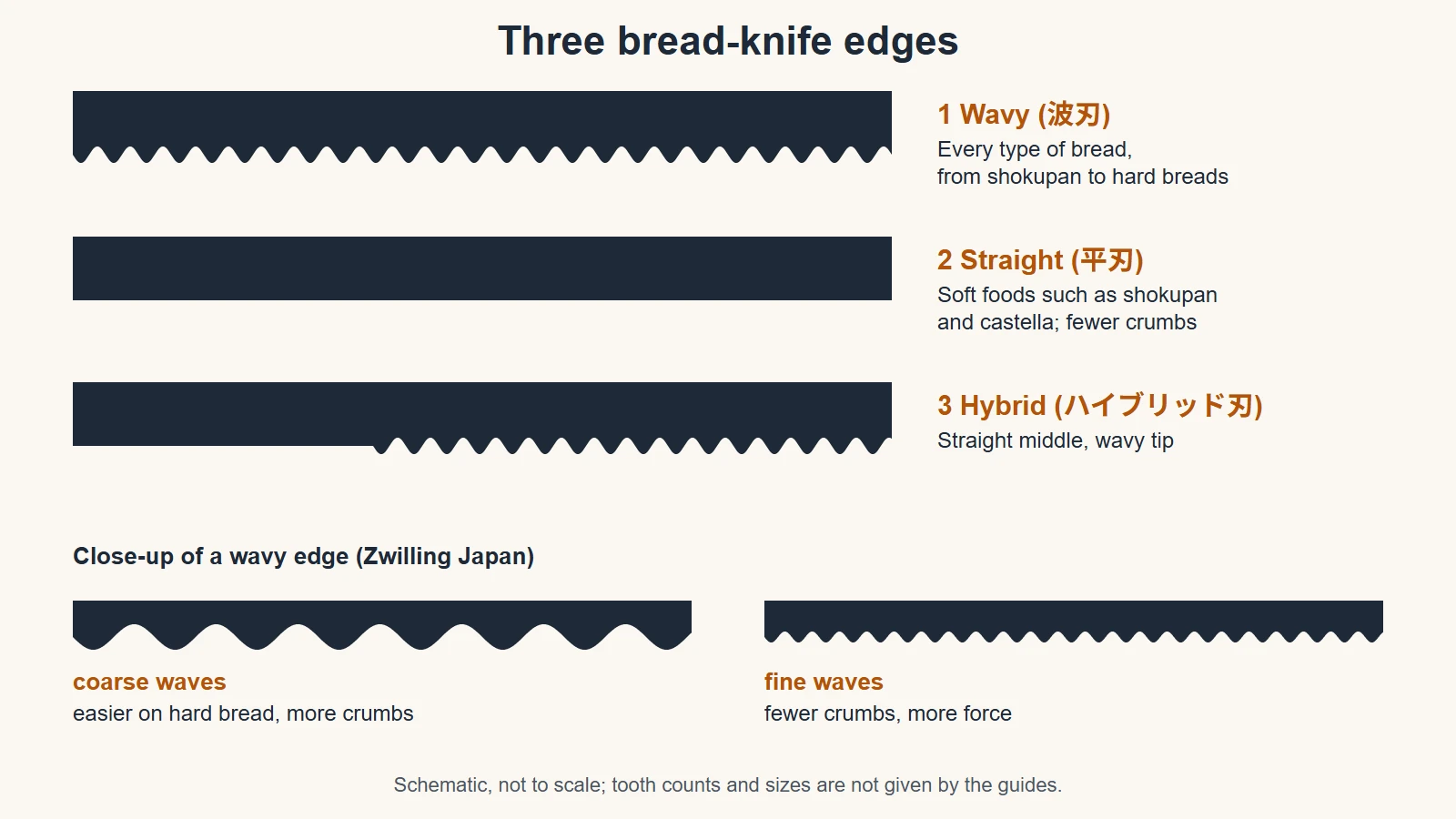
Zwilling Japan’s bread-knife guide sorts edges three ways, and Kai’s guide describes the first two plus a mix.
| Edge | What it looks like | Breads it suits, per the guides | Crumbs | Sharpening, per the guides |
|---|---|---|---|---|
| Wavy (波刃, a serrated, wave-shaped edge) | Waves along the blade | Every type of bread, from shokupan to hard breads | Depends on the waves: coarse waves cut hard bread more easily but drop more crumbs; fine waves drop fewer crumbs but take more force | The maker services checked here don’t accept it (next section) |
| Straight (平刃, a plain, non-serrated edge) | Plain edge | Soft foods such as shokupan and castella; somewhat unsuited to hard breads. Kai says soft breads like shokupan and sponge cake, and that some hard breads can be hard to cut | Fewer crumbs | Easier to sharpen |
| Hybrid (ハイブリッド刃) | Straight middle, wavy tip | n/a | n/a | n/a |
Which one to start with? Kai’s guide says to choose the wavy type for a first purchase. Our framing, not a maker’s: choose a straight edge only if you mostly cut soft bread such as shokupan, and you value fewer crumbs and easier sharpening over performance on hard crusts.
Is a Japanese bread knife different from the serrated knife you know? Tojiro notes that bread knives without a wavy edge are also used. Our reading: the Japanese guides here describe all three edges, so “Japanese” on a listing tells you less than the edge type and length do.
The catch with serrated knives: who will sharpen them
Resharpening is a buying factor here. Two maker services were checked on Oct 21, 2026:
- Tojiro’s sharpening and repair service doesn’t accept knives with a wavy edge.
- Zwilling Japan’s sharpening service doesn’t accept wavy edges such as bread knives, and its notes list bread knives (パンナイフ) and frozen-food knives as special edge shapes it can’t take.
Two sharpeners from our sharpener guide have the same limit for their own products. Kyocera’s official kitchen store says its RS-20 roll sharpener can’t sharpen wavy-edged knives such as bread knives. Yoshikin, the Tsubame, Niigata company that makes GLOBAL knives, says its GSS-01 can’t be used on wavy or single-bevel knives (the edge is ground on one side only), bread knives included.
Our takeaway: if being able to have the knife sharpened matters to you, that argues for a straight edge. If you choose a wavy edge, buy it expecting that the maker services checked here won’t sharpen it. For sharpening in general, see sharpener vs whetstone.
How long should a bread knife be?
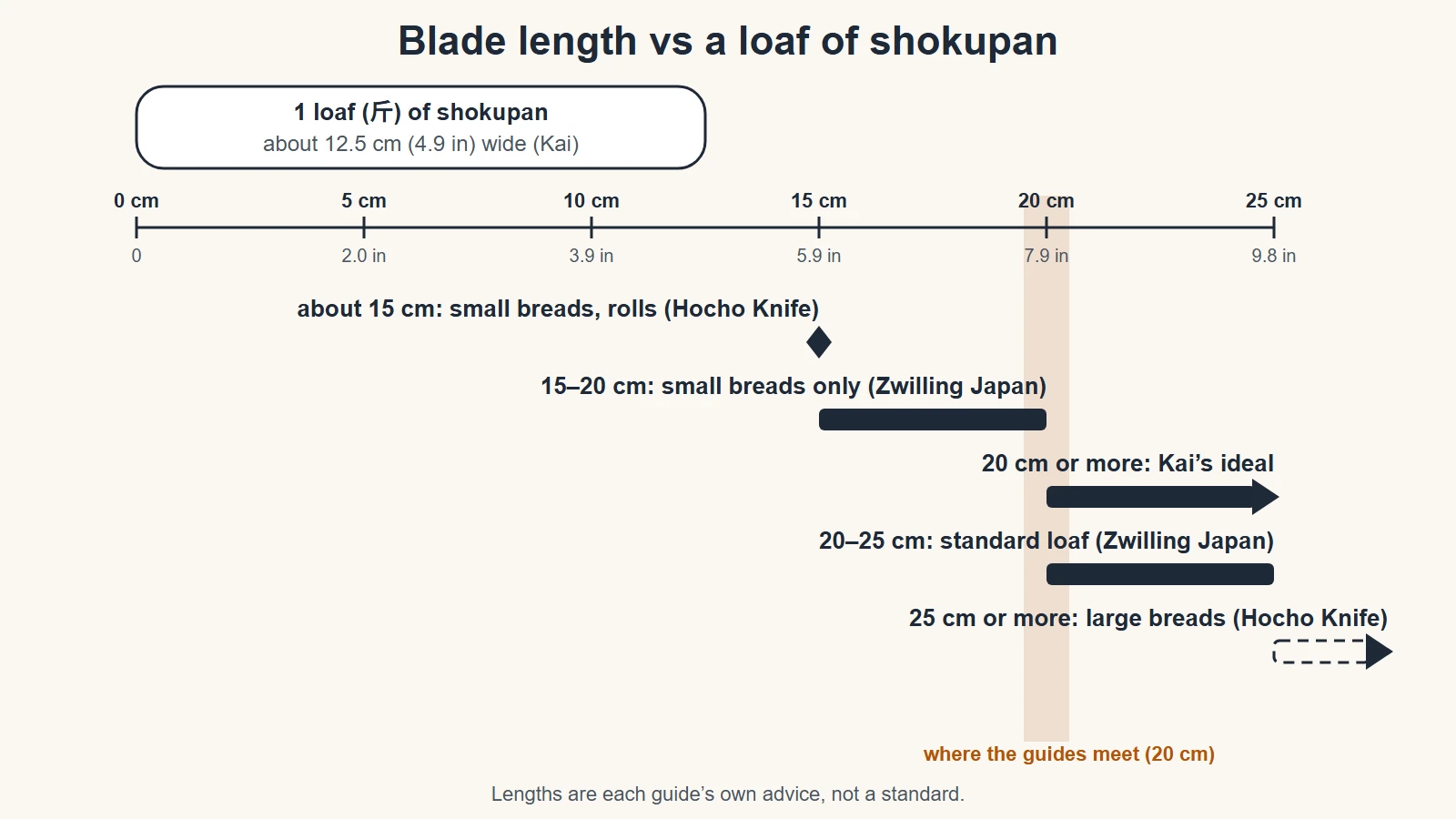
The guides cited here land on about 20 cm (7.9 in) for an everyday loaf. Kai and Zwilling Japan both start a standard-loaf bread knife at 20 cm.
- Kai: the ideal is 20 cm or more. Because a bread knife works with a push-forward, pull-back motion, choose a blade with room to spare beyond the width of one 斤 (kin, Japan’s unit for a loaf of shokupan), about 12.5 cm (4.9 in). For larger breads such as pain de campagne (a French country loaf) or sponge cake, go longer. A long knife may not fit your cupboard or kitchen storage.
- Zwilling Japan: 20–25 cm (7.9–9.8 in) for a standard loaf, and 15–20 cm (5.9–7.9 in) is enough if you only cut small breads.
- Hocho Knife (an affiliate partner): a retailer’s guide gives about 20 cm for standard loaves, 25 cm (9.8 in) or more for larger breads, and about 15 cm (5.9 in) for small breads or rolls.
Blade height matters too: for tall breads such as shokupan or campagne, Zwilling Japan recommends a blade at least 3 cm (1.2 in) tall.
The shokupan yardstick
Kai’s length advice uses one loaf of shokupan as its yardstick. Our bridge, not Kai’s: measure the widest loaf you usually cut and add room for the stroke, which is the logic behind Kai’s 12.5 cm example.
If you bake large crusty loaves, Kai’s “go longer” for pain de campagne and Hocho Knife’s “25 cm or more” for large breads are the lines to note.
Slicing and storing it
The motion varies by guide: Tojiro describes a saw-like back-and-forth, Kai has you repeat a push forward and a pull back, and Zwilling Japan says to finish in one pull if you can.
What not to cut: Tojiro says a bread knife is basically not suited to frozen food. Kai’s listing for its Bready ONE adds a warning against frozen food, meat on the bone, and hard foods like pumpkin; that applies to that product.
Care: Zwilling Japan says to wash with detergent promptly after use and wipe off the water, and to store the knife so the blade doesn’t hit other things; a dedicated knife case is one option. Check your knife’s listing before using a dishwasher. More in our knife care routine and cutting board guide.
Bread knives at Hocho Knife, with prices on Oct 21, 2026
These are picks from the shop’s listings by length, steel, and origin, and we haven’t used them. Of the three, only the Sakai Takayuki Grand Chef names its edge type in its listing (“Wave Knife”). For the other two, look at the product photos to see whether the edge is wavy or straight before you buy. These are approximate shop prices and may change.
Tamahagane Bamboo 3-layer stainless bread slicer, 230 mm (9.1 in). The closest pick to the guides’ length. Listed as double-edged, made in Japan, by Kataoka, about $108 (as of Oct 21, 2026).
a 230 mm stainless bread knife
Brieto-M11PRO bread slicer, 260 mm (10.2 in). Listed with high-carbon molybdenum-vanadium stainless steel, an all-stainless handle, Japanese origin, and a price of about $85 (as of Oct 21, 2026).
a 260 mm stainless bread knife
Sakai Takayuki Grand Chef Wave Knife, 300 mm (11.8 in). High-carbon stainless (as listed), HRC 61–62 as listed (HRC is Rockwell C hardness; higher is harder), 140 g (4.9 oz), made in Japan, about $100 (as of Oct 21, 2026). At 300 mm it is longer than the 20–25 cm the guides give for a standard loaf, so this pick is for large loaves.
a 300 mm wave-edge bread knife
The shop’s bread-slicer category also lists cake knives up to 450 mm, so filter by length first.
Shipping rules for kitchen knives vary by country and state. Check the seller’s shipping policy and your local laws before ordering.
FAQ
Can I use a bread knife on tomatoes?
Kai’s listing for its Seki Magoroku Wakatake says that knife can also cut soft foods such as tomatoes.
Is a bread knife worth it if I already own other kitchen knives?
Tojiro’s household guide lists a bread knife as an add-on, depending on use. More in the Japanese knife set guide.
Sources
The facts in this guide were checked against these pages (accessed September 2026). Pages marked (in Japanese) are written in Japanese.
- Kai: パン切り包丁のおすすめ11選 (in Japanese)
- Zwilling: パン切り包丁の必要性とは?選び方やお手入れ方法などを徹底解説 (in Japanese)
- Tojiro: 洋包丁の形状 (in Japanese)
- Tojiro: 研ぎ直し・修理 (in Japanese)
- Zwilling: ツヴィリング シャープニングサービス| ツヴィリング公式オンラインショップ (in Japanese)
- Kyocera: 【公式】京セラ ロールシャープナー(包丁研ぎ器)金属包丁専用 (in Japanese)
- global.yoshikin.co.jp: GSS-01:GLOBALスピードシャープナー (in Japanese)
- yoshikin.co.jp: 会社概要 / 沿革 (in Japanese)
- Sakai Jikko: 片刃包丁と両刃包丁で切れ味は変わるのか?実際に切り比べてみた (in Japanese)
- Zwilling: パン切包丁(ブレッドナイフ)の通販 (in Japanese)
- hocho-knife.com: Bread Slicer(Cake)
- hocho-knife.com: Tamahagane Bamboo 3-Layer Stainless Japanese Chef’s Bread Slicer 230mm
- hocho-knife.com: Brieto-M11PRO MV Stainless Japanese Chef’s Bread Slicer 260mm
- hocho-knife.com: Sakai Takayuki Grand Chef Japanese Chef’s Wave Knife 300mm
- Tojiro: 材料の種類 – 燕三条製包丁の藤次郎株式会社 (in Japanese)
- Tojiro: 包丁の種類と使い分け (in Japanese)
Related guides
- Types of Japanese kitchen knives
- Japanese knife set
- Japanese knife sharpener
- Sharpener vs whetstone
- Japanese knife care routine
- Cutting board for Japanese knives
- Japanese knife gift guide
Researched and written by the Japanese Toolbox AI editorial team and reviewed by Ken, our editor in Japan. Approved for publication by Ken on October 21, 2026. How we work · @JapaneseToolbox on X