Yes: Japan’s official list of restricted items, published by MLIT (the transport and tourism ministry), puts knives in checked baggage, not in the cabin. If you buy one tax-free on or after November 1, 2026, you pay the tax at the shop and get it back only after a check at the airport, and that check has to happen before you check your bags.
This guide draws on official Japanese government pages, an airport operator’s release, and Japan Post’s own rules, checked on Nov 3, 2026, not on our own trip. It covers the plane, the tax refund, getting the knife to the airport, shipping, and your own country’s rules. If you are still choosing what to buy, start with our guide to the best Japanese knife for beginners.
Checked bag only: what Japan’s list says
MLIT’s “Examples of Dangerous Goods by Air Transportation” (updated April 24, 2026) marks “Knives” as not allowed in carry-on baggage and allowed in checked baggage. The only carry-on exception it gives is for “round-bladed and non-dangerous knives like butter knives.” The same list adds two cautions. Airlines may have additional rules, so it recommends asking your airline whether your item counts as a dangerous good. It also says other countries may have their own rules on dangerous goods on international flights.
If your trip continues through a US airport, TSA’s knives page says sharp objects in checked bags “should be sheathed or securely wrapped” to protect baggage handlers and inspectors. That is TSA’s rule at US checkpoints, not Japan’s.
Buying tax-free after November 1, 2026
Japan’s tax-free system changes by purchase date. For purchases made on or after November 1, 2026, Japan has transitioned to a Refund Method (リファンド方式): you pay the tax-inclusive price at the shop and get the consumption tax back after a customs check when you leave. The rules below are as of Nov 3, 2026, from the pages for travelers published by the Japan Tourism Agency, part of MLIT.
- Within 90 days of purchase, you present your passport at a tax-free procedure terminal (a passport-reading kiosk in the international departure lobby) when you leave.
- You must take the purchased goods out of Japan.
- Purchases of ¥5,000 or more before tax, per store per day, are eligible. JNTO (the Japan National Tourism Organization) gives the same minimum.
- The refund is paid by the shop or its refund provider. Methods include bank transfer, credit card, and app-based refunds. Ask the shop how it refunds before you pay: MLIT says refund methods vary by shop and tells you to contact the tax-free shop.
Under the old system, consumption tax was exempted at the time of purchase, according to a joint release by Japan Airport Terminal and Glory. If you bought tax-free before Nov 1, ask the shop what you need to do when you leave.
The receipt rule
MLIT’s Japanese FAQ says that if any one item from a single receipt is missing at the check, customs can’t confirm the other tax-free goods on that receipt either, and the consumption tax for that receipt isn’t refunded. Our reading: if you buy a knife together with other things on one receipt, keep them all with you for the airport check.
Departure day, in order
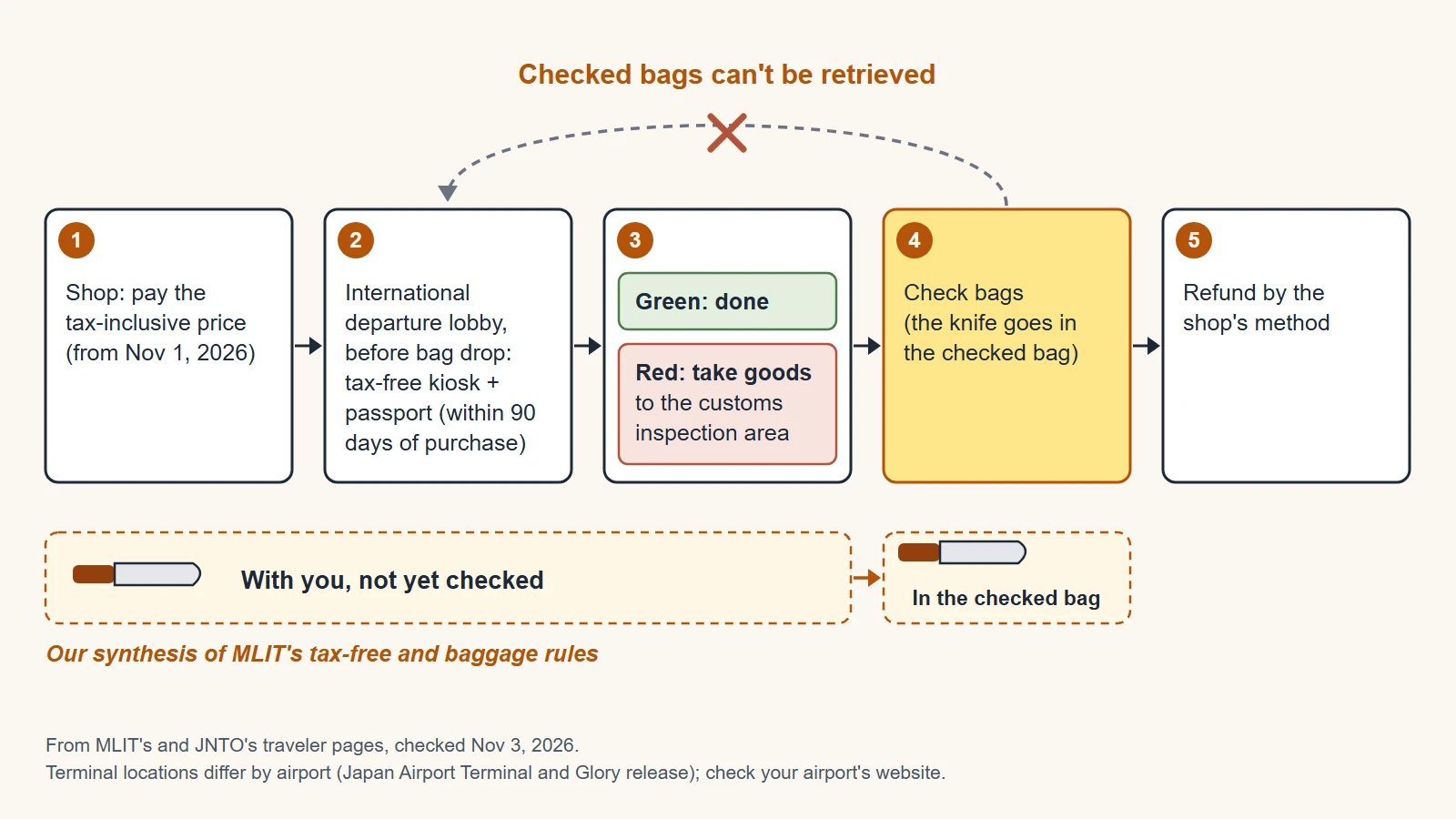
- Go to a tax-free procedure terminal in the international departure lobby, before you check your bags. JNTO also puts the kiosk step “before baggage check-in.”
- Present your passport. A Green result means the customs confirmation procedure is complete. A Red result means your tax-free goods are checked at the customs inspection area.
- Then check your bags, with the knife in the checked bag. MLIT and JNTO both warn that a bag can’t be retrieved once it has been checked in, so the procedure can’t be done afterward. Put together, these rules mean the knife should stay somewhere you can show it until the tax-free step is done, and go into your checked bag after that. This is our synthesis of MLIT’s tax-free and baggage rules, not something MLIT states.
- The refund arrives by the method the shop offers.
MLIT’s FAQ also asks you to arrive early at the airport or seaport and complete the procedures in advance.
If you connect from a domestic flight to an international one, the procedure is done at the airport where you leave Japan. Our caution: a bag checked on the domestic flight can’t be pulled back for the procedure, so think about where the knife is before that first flight.
At seven major airports (Narita, Haneda, Kansai, Chubu, Fukuoka, New Chitose, and Naha), you can also do the first step online through Visit Japan Web, using the dedicated Wi-Fi in designated areas of the international departure lobby, before the security checkpoint.
Cash refund kiosks and airport differences
The same joint release says that from Nov 1, 2026, “Self Tax Refund” kiosks at Haneda, Narita, and Naha pay the refund in cash (yen). That applies to purchases at participating shops where you chose a cash refund. In the release’s Haneda example, the tax-free check is done before bag drop in the pre-departure area, and the cash is collected afterward in the post-departure area. The release adds that terminal locations differ by airport and asks you to check your airport’s website beforehand.
From the shop to the airport
Taking a newly bought knife home is an example Kagoshima Prefectural Police give of a legitimate reason to carry one. Their summary of Japanese law: a blade longer than 6 cm (2.4 in) may not be carried except for work or another legitimate reason. The example is about taking the knife home, so don’t read it as covering anything beyond that.
On trains, MLIT’s railway guideline (December 2018) covers kitchen knives and other knives. A knife with a blade over 6 cm brought onto a train must be packed so it can’t be taken out and used right away. It gives two examples:
- a sheath or case, or cardboard over the edge, with the whole knife wrapped in newspaper and kept in a sturdy bag or box;
- the shop’s packaging, kept as it was when you bought the knife.
Our tip: keep the shop’s wrapping on until you pack for the flight.
Shipping it home instead
Overseas shipping depends on the shop, so ask. The old 別送 method of mailing tax-free goods home yourself as a tax-free export was abolished on March 31, 2025, according to MLIT’s FAQ.
If you mail a knife yourself, Japan Post’s international mail FAQ sets the packing. Protect the edge with something sturdy, such as a sheath or case, or a strong wooden or plastic cover. Wrap the whole item in cushioning so it can’t move, then put it in a sturdy box with the gaps filled with cushioning. Japan Post adds that the packaging the knife came in from the shop isn’t enough on its own for mail. Japan Post says it will not accept parcels that don’t meet these conditions.
Before you land: check your own country’s rules
None of this is legal advice. Rules in Japan and at home change and depend on the exact item, so check the official pages linked here before you travel.
- United States: check U.S. Customs and Border Protection’s page on prohibited and restricted items.
- United Kingdom: GOV.UK’s import-controls page lists the blade types the UK restricts at the border.
- Australia: check the Australian Border Force’s prohibited-goods page before you fly.
- Canada: check the Canada Border Services Agency’s border requirements page.
If you live elsewhere, check your own customs agency’s website before you travel.
Related guides
- Best Japanese knife for beginners
- Types of Japanese kitchen knives
- Japanese knife gift guide
- Japanese knife care routine
Sources
- MLIT, Examples of Dangerous Goods by Air Transportation (updated April 24, 2026)
- Japan Tourism Agency (MLIT), tax-free pages for travelers: English page, English FAQ, Japanese FAQ
- JNTO, Everything You Need to Know: Japan’s New Tax-Free Shopping System
- Japan Airport Terminal and Glory, joint release on Self Tax Refund (October 21, 2026, Japanese)
- TSA, Knives
- Kagoshima Prefectural Police, carrying blades (Japanese)
- MLIT Railway Bureau, guideline on packing blades for trains (December 2018, Japanese)
- Japan Post, international mail FAQ on packing blades (Japanese)
- Border pages: CBP, GOV.UK, CBSA
Researched and written by the Japanese Toolbox AI editorial team and reviewed by Ken, our editor in Japan. Approved for publication by Ken on November 3, 2026. How we work · @JapaneseToolbox on X