Disclosure: This post contains affiliate links. If you buy through them, we may earn a commission at no extra cost to you. We only recommend tools our editor has handled or researched in depth. Learn more
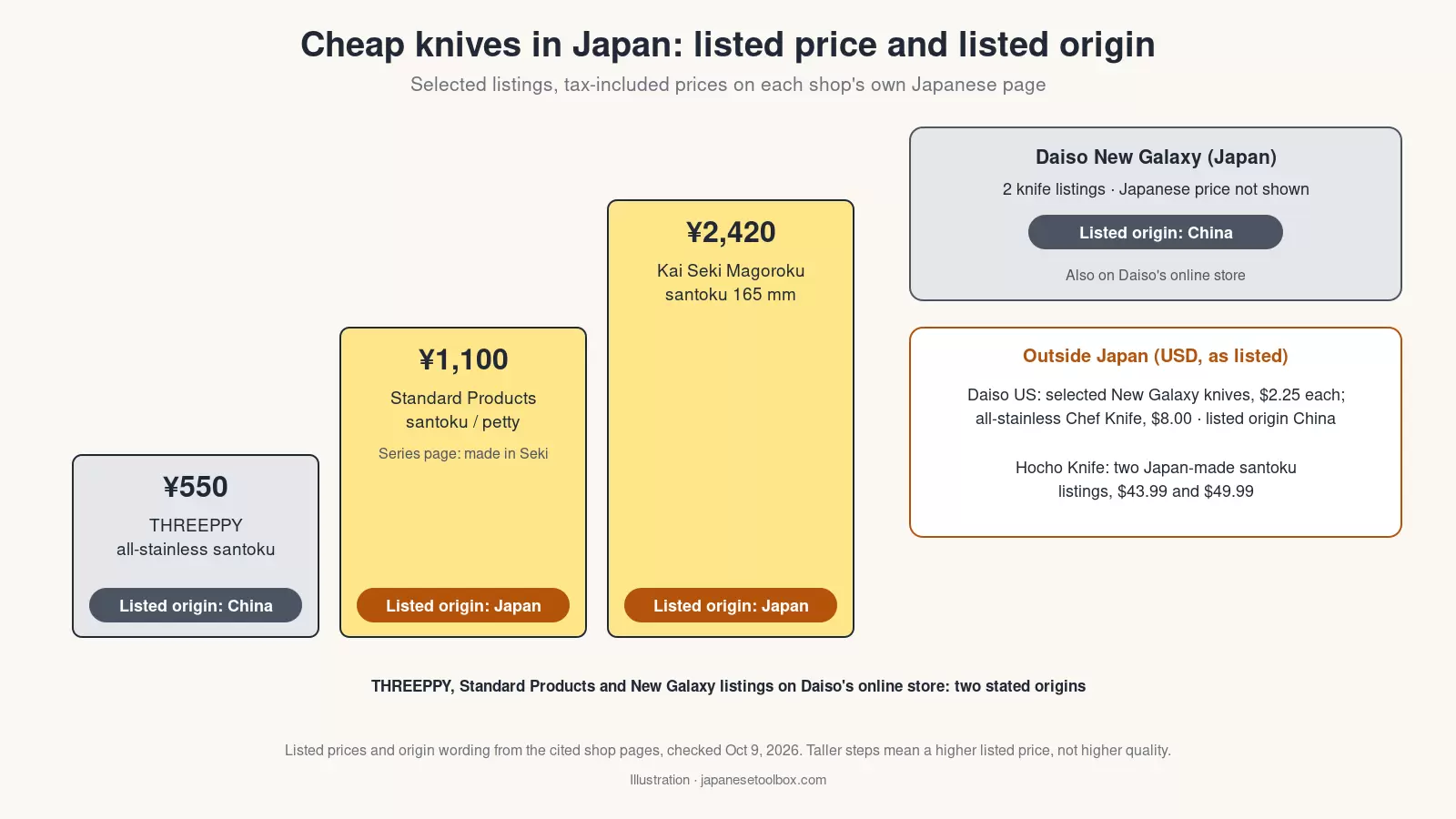
Yes. Daiso, the Japanese 100-yen-shop chain, runs Standard Products, a chain selling simple, longer-lasting basics. Its santoku (三徳), Japan’s everyday all-purpose home knife, and its petty knife (ペティナイフ), a small Western-style utility knife, are each listed at ¥1,100 including tax on Daiso’s online store as of Oct 9, 2026. Both carry an origin line reading 原産国:日本 (Japan).
Kai, a Japanese cutlery company, lists the わかたけ santoku in its Seki Magoroku line — a brand named after the noted Seki swordsmith Magoroku Kanemoto — the same way: origin 日本, at ¥2,420 including tax, as of Oct 9, 2026. Other lower-priced Daiso listings — the New Galaxy knives and THREEPPY’s all-stainless santoku — carry an origin line reading China. The origin line on the listing tells you more than the brand does.
For readers outside Japan, two Japan-made santoku selected from Hocho Knife’s listings (an affiliate partner), with prices checked on Oct 9, 2026: the Shimomura PRO-Grade santoku at $43.99 and the Kanetsune KC-950 at $49.99.
This guide is built from Japanese shop and maker pages read in October 2026, not hands-on testing.
What a cheap knife costs in a Japanese store
Here’s what people in Japan can buy at the low end of a knife shelf, and where each one is listed as made.
The 100-yen shop
Daiso’s own New Galaxy line is listed with 原産国(地域):中国 (origin China) and a stainless blade (刃部 ステンレス刃物鋼) — stainless steel resists rust but isn’t rust-proof — in the store’s product data for its sashimi knife and its perforated kitchen knife. The handle on those listings is ABS resin. THREEPPY, another Daiso-run chain, lists an all-stainless santoku — blade and handle both stainless steel — at ¥550 including tax, with its own origin line also reading China. These are facts from each listing, not a judgment on how any of these knives cut or hold up.
¥1,100 and made in Seki
Standard Products’ santoku and petty knife are each priced at ¥1,100 including tax, with an origin line reading 原産国:日本. Daiso’s series page for these knives is titled 「世界三大刃物産地 岐阜県関市でつくるこだわりの包丁」. Seki (関) is a knife-making city in Gifu Prefecture. Daiso’s series page also says it’s one of the world’s three major knife-making areas, with the knives made there in what it calls more than 20 steps including pressing, quenching, grinding, spine grinding and edge sharpening (プレス、焼入れ、研磨、背研ぎ、刃付けなど). The santoku’s handle is wood and nylon over a stainless blade, with no dishwasher or dish dryer; the petty knife’s handle is natural cherry wood.
About ¥2,400: a maker’s entry line
Kai’s わかたけ line page calls it 「関孫六ブランドのエントリーシリーズ」, the Seki Magoroku brand’s entry series. The 165 mm (6.5 in) santoku in that line is listed at ¥2,420 including tax, origin 日本, dishwasher-safe, with a stainless blade and resin handle, on Kai’s store as of Oct 9, 2026. A smaller, 145 mm (5.7 in) santoku in the same line was listed at ¥2,200 in Kai’s santoku category on the same date.
These are prices and origin lines from each shop’s own pages on one date, not a survey of what households in Japan actually spend.
One brand, two countries
On Daiso’s own online store, the Standard Products santoku’s origin line reads Japan, while the New Galaxy knives and the THREEPPY santoku read China — all sold by the same company. In the US, Daiso’s own pages for the Sashimi Knife, the Petit Knife and the Broad-bladed Fish Knife in the New Galaxy line, and for the all-stainless Chef Knife, all read “Country of Origin: China.”
The same split shows up on two of Kai’s own products: the わかたけ santoku’s origin line reads Japan on its consumer store, while the Pop Star santoku’s 生産地 (production area) reads China on Kai’s business-to-business store. That’s two products, not a count of how many Kai knives are made where.
The takeaway: check the product’s own origin line, not the brand name. This is about knowing what you’re buying, not about which country makes better knives.
How to check where a knife was made
Find the origin line
In Japan, 原産国 (country of origin) means the country where the product’s substantial change took place — the definition in Japan’s Consumer Affairs Agency’s origin-labeling rule. On the Japanese shop pages above, it shows up as 原産国 or 生産地; on Daiso US pages the same line appears in English, as “Country of Origin.” In the United States, imported articles generally must be marked to show the ultimate purchaser the English name of the country of origin, though the marking can sometimes be on the container rather than the item itself, and there are exceptions. Check the box as well as the blade — the origin line on a listing, or on the package, is where to look.
What “Seki” can and can’t tell you
関の刃物 (Seki no Hamono) is a regional collective trademark held by a Gifu knife-industry cooperative, covering kitchen knives whose main production steps take place in Seki and the surrounding area. Seki Magoroku’s brand name isn’t an origin label on its own: for わかたけ, it’s the separate origin line that says Japan, not the brand name. When a listing mentions “Seki,” look for the maker’s name and an origin line on the same page, rather than treating “Seki” on its own as proof of where a specific knife was made.
“Japanese steel” describes the material, not where the knife was made
Two English-language budget-knife lists — one with ten picks, one with twelve — describe several picks with phrases like “high-carbon Japanese steel core” and “five layers of Japanese steel.” Steel origin and knife origin are different facts — where the steel comes from, and where the knife itself was made, can be two different things — so it’s worth looking for both on a listing.
Buying a Japan-made cheap knife outside Japan
Daiso US
Daiso US lists New Galaxy knives online at $2.25 each, and an all-stainless Chef Knife at $8.00, as of Oct 9, 2026, each with “Country of Origin: China.” If price is the point, that’s fine — just know what the origin line on the page says.
Standard Products in the US
Daiso’s first US store carrying the Standard Products line opened in Oswego, Illinois, in February 2025, and a Centennial, Colorado, store followed in April 2025. Standard Products also has stores in Japan, Singapore and Taiwan, with Australia added as a fourth market in November 2024. If you shop at a Standard Products store in the US, look for 原産国 or “Made in Japan” on the box.
Online from Japan
Here are two Japan-made santoku selected from Hocho Knife’s listings, with prices checked on Oct 9, 2026. Shimomura, a knife maker in Sanjo, Niigata, lists its PRO-Grade santoku as “Made in Japan,” at $43.99 on Oct 9, 2026. The blade is 155 mm (6.1 in), molybdenum vanadium stainless steel. It’s double edged (両刃: ground on both sides, like a Western knife), with an all-stainless handle.
Shimomura 155 mm all-stainless santoku at Hocho Knife
The Kanetsune KC-950 santoku is listed as made in Japan, at $49.99 on Oct 9, 2026. Its blade is 165 mm (6.5 in), DSR-1K6 stainless steel, double edged. It has a plywood handle and plastic bolster.
Kanetsune KC-950 165 mm santoku at Hocho Knife
These are listings-based selections based on price and stated origin, not hands-on recommendations.
The step up
For a knife in the site’s usual $80–$300 beginner range, see our guide to the best Japanese knife for beginners, including the existing Kanetsune stainless santoku pick, 180 mm (7.1 in), listed at $110.99 on Oct 8, 2026.
Kanetsune 180 mm stainless santoku at Hocho Knife
Shipping rules for kitchen knives vary by country and state. Check the seller’s shipping policy and your local laws before ordering.
What a low price doesn’t tell you
Hardness
A low price doesn’t tell you how hard the steel is; if hardness matters to you, look for an HRC figure on the listing. For what hardness means for everyday cutting, see our guide to the best Japanese knife for beginners.
Care differs by product
The わかたけ santoku is listed as dishwasher-safe, while the Standard Products santoku’s page says no dishwasher or dish dryer, and Daiso US’s Chef Knife page gives the same no-dishwasher instruction, adds that its stainless “is not rust-proof,” and says the knife isn’t meant for frozen or hard foods. For day-to-day care, see our Japanese knife care routine.
Sharpening still matters at any price
A cheap knife dulls with use like any other, and the same choices apply for keeping it sharp: a pull-through sharpener, a honing rod, or a whetstone. See our guides to sharpener vs. whetstone, choosing a Japanese knife sharpener and whetstone grit for beginners.
Shape
Most of the cheap, Japan-made knives in this guide are santoku. See our guide to gyuto vs. santoku if you’d rather compare shapes.
Related guides
Best Japanese knife for beginners, gyuto vs. santoku, Japanese knife care routine, sharpener vs. whetstone, choosing a Japanese knife sharpener, whetstone grit for beginners.
Sources
The facts in this guide were checked against these pages (accessed October 2026). Pages marked (in Japanese) are written in Japanese.
- Daiso: company profile (in Japanese)
- Standard Products: about (in Japanese)
- Daiso online store: New Galaxy sashimi knife (in Japanese)
- Daiso online store: New Galaxy perforated knife (in Japanese)
- Daiso online store: THREEPPY all-stainless santoku (in Japanese)
- Daiso online store: Standard Products santoku (in Japanese)
- Daiso online store: Standard Products petty knife (in Japanese)
- Daiso online store: Standard Products knife series page (in Japanese)
- Kai: わかたけ santoku 165mm (in Japanese)
- Kai: santoku category (in Japanese)
- Kai: わかたけ line page (in Japanese)
- Kai: Seki Magoroku brand page (in Japanese)
- Kai: company history
- Kai business store: Pop Star santoku (in Japanese)
- Daiso US: Sashimi Knife -New Galaxy-
- Daiso US: Petit Knife -New Galaxy-
- Daiso US: Broad-bladed Fish Knife -New Galaxy-
- Daiso US: Chef Knife -All Stainless Steel-
- Shaw Local: grand opening of Daiso store in Oswego
- Redmond Spokesman (Daiso press release): Daiso opens Centennial store
- Daiso Australia: Standard Products launching in Australia
- Consumer Affairs Agency (Japan): origin-labeling rule (in Japanese)
- Cornell LII: 19 U.S.C. § 1304
- Japan Patent Office: 関の刃物 regional collective trademark (in Japanese)
- Zwilling: MIYABI, Seki (in Japanese)
- Tojiro: 三徳包丁とは (in Japanese)
- Tojiro: 包丁の種類と使い分け (in Japanese)
- Tojiro: ペティナイフとは (in Japanese)
- Tojiro: 和包丁の形状 (in Japanese)
- Sakai Jikko: 片刃包丁と両刃包丁で切れ味は変わるのか (in Japanese)
- Shimomura Industrial: company site (in Japanese)
- Chowhound: 10 Best Japanese Chef Knives Under $50 On Amazon
- Faucetfam: 12 Best Budget Japanese Chef Knives for 2026
- hocho-knife.com: Shimomura PRO-Grade All Stainless Santoku Knife 155mm
- hocho-knife.com: Kanetsune KC-950 Santoku Knife 165mm
- hocho-knife.com: Kanetsune KC-170 Santoku Knife 180mm
Researched and written by the Japanese Toolbox AI editorial team and reviewed by Ken, our editor in Japan. Approved for publication by Ken on October 9, 2026. How we work · @JapaneseToolbox on X