Disclosure: This post contains affiliate links. If you buy through them, we may earn a commission at no extra cost to you. We only recommend tools our editor has handled or researched in depth. Learn more
If you’re deciding between a German and a Japanese chef’s knife, the makers’ spec sheets below show real differences, but a less tidy pattern than a simple country split implies. On the makers’ own spec pages for the knives below, the main listed edge angles run from about 9.5° to 16° per side — Shun lists 22° per side on the Classic Western Cook’s Knife, as an exception to the rest of the Classic line’s 16°. Listed hardness runs from 55 to 62 HRC, measured in Rockwell C hardness, a standard hardness scale for blade steel. The listed hardness figures overlap across brands; the listed edge angles do not. These spec sheets suggest it’s worth looking at what you cut, whether the knife goes in the dishwasher, and whether you reach for a honing steel or a whetstone, rather than relying on which country’s flag is on the box.
Zwilling, whose Professional S 20 cm chef’s knife below is made in Germany, also owns MIYABI, a Zwilling group knife brand made in Seki, Japan. Seki is a knife-making city in Gifu Prefecture. Comparing two of the group’s own 20 cm (8 in) chef’s knives is a clean way to see what a “German” edge and a “Japanese” edge actually look like on paper.
This guide uses knife makers’ own spec pages, not hands-on testing.
Same maker, two chef’s knives: Zwilling’s German and Seki-made lines
What actually differs between a German and a Japanese chef’s knife? Zwilling’s own spec tables for two 20 cm (8 in) chef’s knives from its own lineup show the classic contrast.
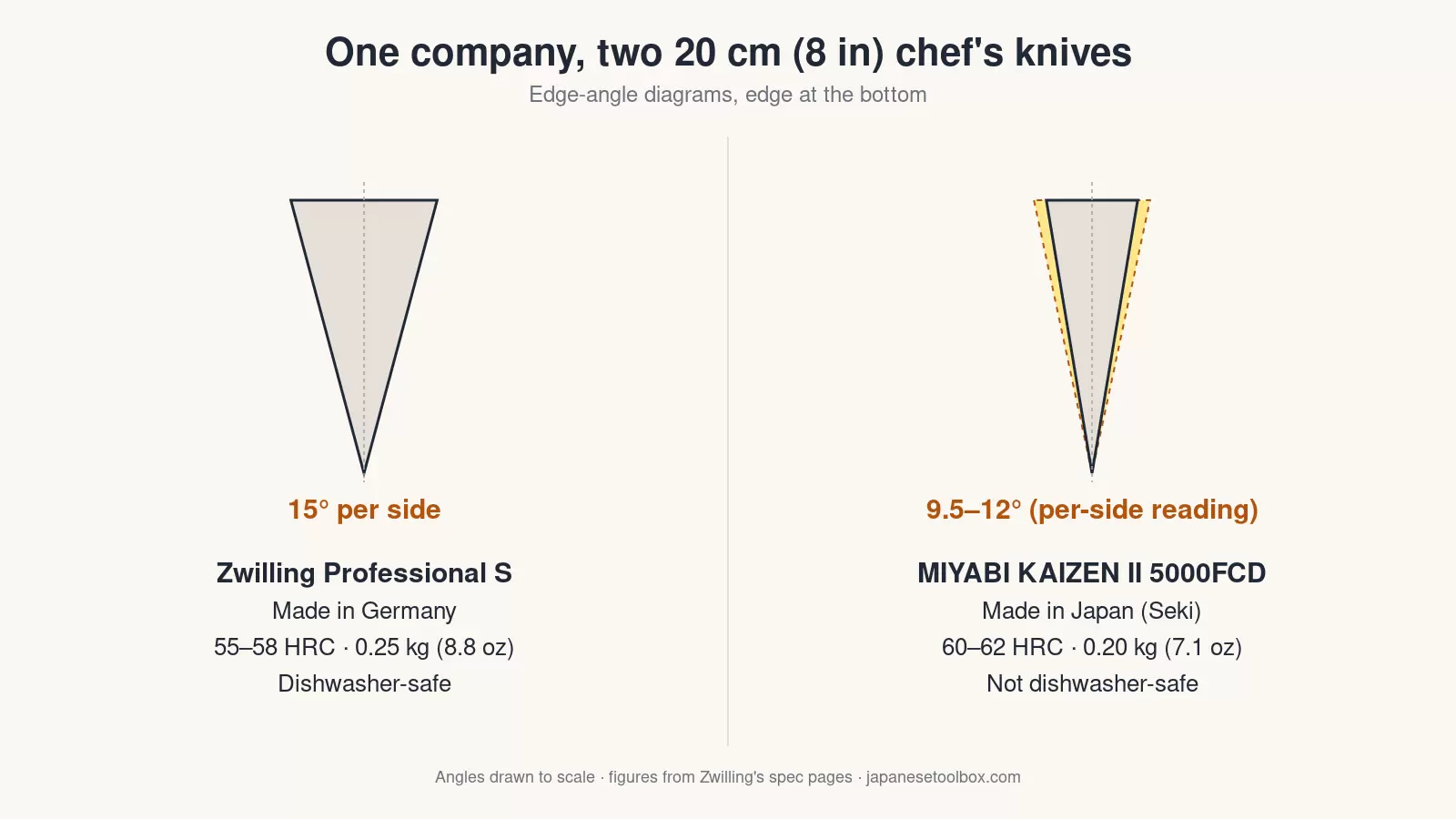
Zwilling’s Professional S chef’s knife is made in Germany. Its spec page lists a 15° edge angle per side and a hardness of 55–58 HRC, with a blade thickness listed as 0.2 cm (0.08 in); Zwilling doesn’t state where on the blade it takes that measurement. The same knife’s Japanese spec table gives a weight of 0.25 kg (8.8 oz) and dishwasher-safe status (「食洗機」「使用可能」).
MIYABI’s KAIZEN II 5000FCD chef’s knife is listed at a 9.5–12° edge angle and a hardness of 60–62 HRC, hand-honed using what Zwilling calls the honbazuke method; a separate MIYABI listing, for the 4500 FCD nakiri, defines that same numeric range as 19–24° total. Zwilling’s Japanese page for this 20 cm model lists it as made in Japan, not dishwasher-safe (「食洗機使用不可」), with a weight of 0.20 kg (7.1 oz). That page’s own spec table doesn’t include a blade-thickness row; the 24 cm KAIZEN II listing gives 0.10 cm (0.04 in) as listed for that size.
These are the classic differences people associate with “German vs Japanese” — but they’re measured on one pair of knives from one company. The next section checks whether the pattern holds once you look across brands.
Five spec sheets that don’t split neatly
Are Japanese knives always thinner-edged and harder than German ones? Line up five examples from five brands, as each lists its own specs, and the pattern gets messier.
| Knife (model, length) | Made in (as listed) | Edge angle (as listed) | Hardness | Source page |
|---|---|---|---|---|
| Zwilling Professional S chef’s knife, 20 cm (8 in) | Germany | 15° per side | 55–58 HRC | zwilling.com/ca |
| Wüsthof Classic chef’s knife, 20 cm (8 in) | Solingen, Germany | 14° per side (Wüsthof’s angle “for standard blades”) | 58 HRC | wusthof.de/en-dk |
| MIYABI KAIZEN II 5000FCD chef’s knife, 20 cm (8 in) | Seki, Japan | 9.5–12° | 60–62 HRC | zwilling.com/us and /jp |
| Shun Classic line (not the Western Cook’s Knife) | — (Western Cook’s Knife: Japan) | 16° per side (22° per side on the Classic 8-in Western Cook’s Knife) | — | shun.kaiusa.com |
| Tojiro VG-10 (materials guide, no specific model) | — (Tojiro is Niigata-based) | — | 58±1 HRC | tojiro.net/reading/7359/ and tojiro.net/company/ |
Each figure applies to the named model, line, or materials guide. A dash means the page we used doesn’t give it.
What “edge angle” and “HRC” mean on a listing
“Edge angle” on most of these listings is given per side — the angle each side of the edge is ground at. Double it for the total: Zwilling’s own page for the MIYABI 4500 FCD nakiri, a different model included here only to show the relationship, gives “9.5- 12 angle (19-24 total)”. This article gives per-side figures throughout unless noted.
HRC stands for Rockwell C hardness, a standard hardness scale for blade steel. For more on how blade sharpness itself gets measured, see how knife sharpness is measured.
Where the overlap is
Shun’s Classic Western Cook’s Knife is made in Japan, and the same page lists the rest of the Shun Classic line at a 16° edge angle per side. That’s wider than Wüsthof’s Classic chef’s knife, at 14° per side.
Tojiro, a knife maker in Niigata, lists VG-10 — a stainless blade steel made by Takefu Special Steel, a Fukui steel company — at HRC 58±1 in its materials guide. That overlaps Wüsthof Classic’s own 58 HRC figure. Takefu Special Steel separately gives an as-quenched hardness of “HRC60以上” for the steel itself.
Which fits how you cook
Do you cut winter squash, bones or frozen food?
Shun’s own Classic 8-in Western Cook’s Knife, made in Japan, is ground at a 22° edge angle per side instead of the rest of the Shun Classic line’s 16°. Shun says this less-acute 22° edge “provides additional strength” for tasks like winter squash or large heads of cabbage. That comparison is Shun’s own, between its two edges, not a claim about German knives.
Sakai Ichimonji Mitsuhide, an Osaka knife shop, lists fish bones, shells, and tough root vegetables among common causes of chipping on kitchen knives generally, along with frozen food, which can make a blade bend during cutting, and separately warns that twisting or prying can apply damaging horizontal force to a thin edge. If you regularly cut those foods, it’s worth considering a dedicated tool made for hard or frozen food. A wider-angle edge — like Shun’s 22° example above — is this guide’s inference from that one model, not a separately sourced recommendation. For more on keeping an edge in good shape day to day, see our knife care routine.
Does your knife go in the dishwasher?
Zwilling’s own Japanese spec tables mark its Professional S chef’s knife dishwasher-safe (「使用可能」) and the MIYABI KAIZEN II chef’s knife not dishwasher-safe (「食洗機使用不可」).
Kai, a Japanese cutlery company, lists its own knives with a carbon-steel blade, a carbon-steel core, or a wooden handle as not compatible with a dishwasher or dish dryer. See our knife care routine for more on day-to-day care.
Do you reach for a honing steel or a whetstone?
Zwilling Japan, Zwilling’s Japanese company, describes the sharpening steel — a rod you draw the edge along — as the mainstream style in Europe, and cautions against overusing it. Seido recommends a ceramic honing rod, or a fine leather strop, over a coarse metal honing steel for Japanese knives.
If you do sharpen on a stone, Wüsthof’s own resharpening angle for its standard blades is 14° per side. Zwilling Japan’s own whetstone guide uses a 15° lift from the stone — about the thickness of two or three 10-yen coins — as its general guide. See sharpener vs whetstone for Japanese knives and whetstone grit for beginners for how to choose between the two.
If you plan to sharpen at home, Tojiro recommends a medium whetstone of about #1000 as a starting point; see our whetstone grit guide.
Our pick: the Naniwa Super Ceramic Waterstone (Whetstone) with Stand [S-1000], #1000 grit, 210 × 70 × 20 mm, with stand, listed at $75.99 on Oct 8, 2026. We chose it from the shop’s listings because its listed specs match the criteria above; we haven’t used this exact stone.
Naniwa #1000 whetstone with stand at Hocho Knife
Single-grit #1000 whetstones at Hocho Knife started at about $46 on Oct 8, 2026.
How much does each knife weigh?
Zwilling’s own spec tables give a weight of 0.25 kg (8.8 oz) for the Professional S chef’s knife and 0.20 kg (7.1 oz) for the MIYABI KAIZEN II chef’s knife, both 20 cm (8 in) — a 50 g difference between the two listed weights. For how blade shape affects cutting style more broadly, see gyuto vs santoku.
“German” and “Japanese” are styles, and the label isn’t the factory
Is MIYABI a Japanese knife or a German one? Zwilling’s group brand page describes MIYABI as “Handcrafted in Seki, Japan”. Zwilling Japan — based in Seki — states on its own MIYABI page 「MADE IN JAPAN (岐阜県関市)」.
Wüsthof’s Classic chef’s knife, by contrast, is made in Germany. Zwilling’s own Professional S is, in its words, “Manufactured in Germany”.
The gyuto (a chef’s knife) is itself a Western-born shape. Tojiro says it came to Japan in the Meiji era (1868–1912). So a Japanese gyuto like the MIYABI KAIZEN II is itself a Western shape, made in Japan. Handle style is another “Western vs Japanese” split that runs separately from where a knife is made; see wa handle vs Western handle.
If you’re buying your first Japanese knife
When you shop by spec sheet rather than by flag, three numbers on any knife’s listing are worth checking before you buy: the HRC figure, the stated edge angle if the listing gives one, and the dishwasher line.
Tojiro recommends a santoku — Japan’s everyday all-purpose home knife for meat, fish, and vegetables, with a relatively straight, flatter edge — to beginners and first-time buyers.
Our pick: the Kanetsune KC-170 santoku, 180 mm (7.1 in), stainless, double edged, 60–62 HRC, listed at $110.99 on Oct 8, 2026. We chose it from the shop’s listings because its listed specs match the criteria above; we haven’t used this exact knife.
Kanetsune 180 mm stainless santoku at Hocho Knife
In-stock 165–180 mm santoku at Hocho Knife started at about $50 on Oct 8, 2026.
A gyuto (a chef’s knife) is another option for beginners. Stainless steel, which resists rust but isn’t rust-proof, is a reasonable starting material for either shape if you’d rather not dry and oil a carbon-steel blade after every use.
Our pick: the Kanetsune KC-170 gyuto, 210 mm (8.3 in), stainless, double edged, 60–62 HRC, listed at $110.99 on Oct 8, 2026. We chose it from the shop’s listings because its listed specs match the criteria above; we haven’t used this exact knife.
Kanetsune 210 mm stainless gyuto at Hocho Knife
Stainless 180–210 mm gyuto at Hocho Knife started at about $50 on Oct 8, 2026.
Shipping rules for kitchen knives vary by country and state. Check the seller’s shipping policy and your local laws before ordering.
For more on steel choices, see Japanese knife steel for beginners. If you’re shopping for someone else, our gift guide covers that separately.
Sources
The facts in this guide were checked against these pages (accessed September 2026). Pages marked (in Japanese) are written in Japanese.
- Shun (Kai USA): Western Cook's Kitchen Knife
- ISO: ISO 6508-1:2023
- Zwilling: Buy ZWILLING Professional S 8-inch, Chef's knife
- Henckels: Our Family of Brands
- Zwilling: MIYABIをお買い求めなら| MIYABI公式通販 (in Japanese)
- Zwilling: ツヴィリング Professional S シェフナイフ 20 cm (in Japanese)
- Zwilling: Buy MIYABI KAIZEN II 5000FCD 8-inch, Chef's Knife
- Zwilling: Buy MIYABI MIKOTO 4500FCD 7-inch, Nakiri
- Zwilling: MIYABI KAIZEN II 5000FCD 牛刀 20 cm (in Japanese)
- Zwilling: MIYABI KAIZEN II 5000FCD 牛刀 24 cm (in Japanese)
- wusthof.de: WÜSTHOF Classic Chef's Knife 20 cm
- Tojiro: 材料の種類 – 燕三条製包丁の藤次郎株式会社 (in Japanese)
- Tojiro: 会社情報 – 燕三条製包丁の藤次郎株式会社 (in Japanese)
- Takefu Special Steel: V金10|武生特殊鋼材株式会社 (in Japanese)
- Takefu Special Steel: 会社案内|武生特殊鋼材株式会社 (in Japanese)
- Sakai Ichimonji Mitsuhide: 企業情報 | 堺一文字光秀 (in Japanese)
- Sakai Ichimonji Mitsuhide: Why Do Knives Chip?
- Kai: 沿革 | KAIグループについて | 貝印 (in Japanese)
- Kai: 食器洗浄機や食器乾燥機に包丁を入れてもよいのでしょうか? (in Japanese)
- Zwilling: プライバシーポリシー (in Japanese)
- Zwilling: 包丁の研ぎ方 包丁の切れ味を長持ちさせるコツ (in Japanese)
- Seido: How to Properly Maintain a Japanese Knife
- Tojiro: 包丁の研ぎ方 (in Japanese)
- hocho-knife.com: Naniwa Super Ceramic Waterstone (Whetstone) with Stand [S-1000]
- hocho-knife.com: Accessories
- Tojiro: 牛刀とは?特徴・三徳との違い・おすすめサイズの選び方【包丁メーカー解説】 (in Japanese)
- National Astronomical Observatory of Japan: 暦Wiki/歴史/元号 (in Japanese)
- Tojiro: 三徳包丁とは?特徴・選び方・おすすめ5選 (in Japanese)
- Tojiro: 包丁の種類と使い分け (in Japanese)
- hocho-knife.com: Kanetsune KC-170 Whole AUS10 Stainless Steel Japanese Chef's Santoku Knife 180mm
- hocho-knife.com: Santoku knife
- Sakai Jikko: 青紙・白紙どちらを選ぶ?プロが教える包丁の鋼材「ハガネ」の種類と特徴 (in Japanese)
- Kai: 包丁が錆びてしまいました。なぜでしょうか?お手入れはどうしたらよいのでしょうか? (in Japanese)
- hocho-knife.com: Kanetsune KC-170 Whole AUS10 Stainless Steel Japanese Chef's Gyuto Knife 210mm
- hocho-knife.com: Gyuto(Chef's Knife)
Related guides
- Japanese knife steel for beginners
- Gyuto vs santoku
- Sharpener vs whetstone for Japanese knives
- Japanese knife care routine
- How knife sharpness is measured
Researched and written by the Japanese Toolbox AI editorial team and reviewed by Ken, our editor in Japan. Approved for publication by Ken on October 7, 2026. How we work · @JapaneseToolbox on X