Disclosure: This post contains affiliate links. If you buy through them, we may earn a commission at no extra cost to you. We only recommend tools our editor has handled or researched in depth. Learn more
A sujihiki (筋引) is a long, narrow Japanese carving knife; Tojiro’s household models have a double bevel (an edge ground on both sides). If you carve a turkey or roast only occasionally, a sharp 210 mm gyuto (a chef’s knife) can do the job. A 240 mm stainless sujihiki earns its drawer space if you slice big roasts, hams, or brisket more regularly — our own rule of thumb. It’s one of several types of Japanese kitchen knives.
This guide draws on Japanese makers’ own size guides and dated shop listings, not hands-on testing. Below, we put a 210 mm gyuto, a 240 mm sujihiki, and an 8-inch German carving knife side by side, then cover length, steel for a knife that may sit in a drawer most of the year, and our picks.
Should you buy a slicer at all?
The job here is slicing cooked meat in long, even strokes: the longer and narrower the blade, the fewer strokes each slice takes (Zwilling’s Japanese company).
Sakai Jikko, a knife company in Sakai, lists a 240 mm home sujihiki, one 30 mm (1.2 in) step longer than its 210 mm home gyuto; Tojiro, a knife maker in Niigata, gives overlapping household ranges of 210–240 mm and 150–210 mm, respectively.
- Skip it if: you carve only occasionally and your gyuto or chef’s knife is sharp — a sharp knife you already own beats a new knife you’ll rarely use. If your only knife is a santoku (a shorter, all-purpose Japanese knife), a slicer may help more; see our gyuto vs. santoku guide.
- Buy a sujihiki if: you slice large roasts, ham, brisket, or sides of salmon several times a year, or you want thinner slices than your current knife gives you.
- Buy a Western carving set if: you want a matching fork and a German-style knife. In the products checked here, the fork steadies the meat, while care varies: the Zwilling Professional S is dishwasher safe with hand washing recommended; the Wüsthof Classic requires hand washing and immediate towel-drying. So a German carving knife isn’t automatically dishwasher-friendly — check the listing.
Three knives for the same roast
Here’s the same roast, three ways: a 210 mm gyuto you may already own, a 240 mm sujihiki from Hocho Knife (an affiliate partner), and an 8-inch German carving knife, with their length, shape, bevel, listed HRC (Rockwell C hardness; higher numbers mean harder steel), care line, and price side by side.
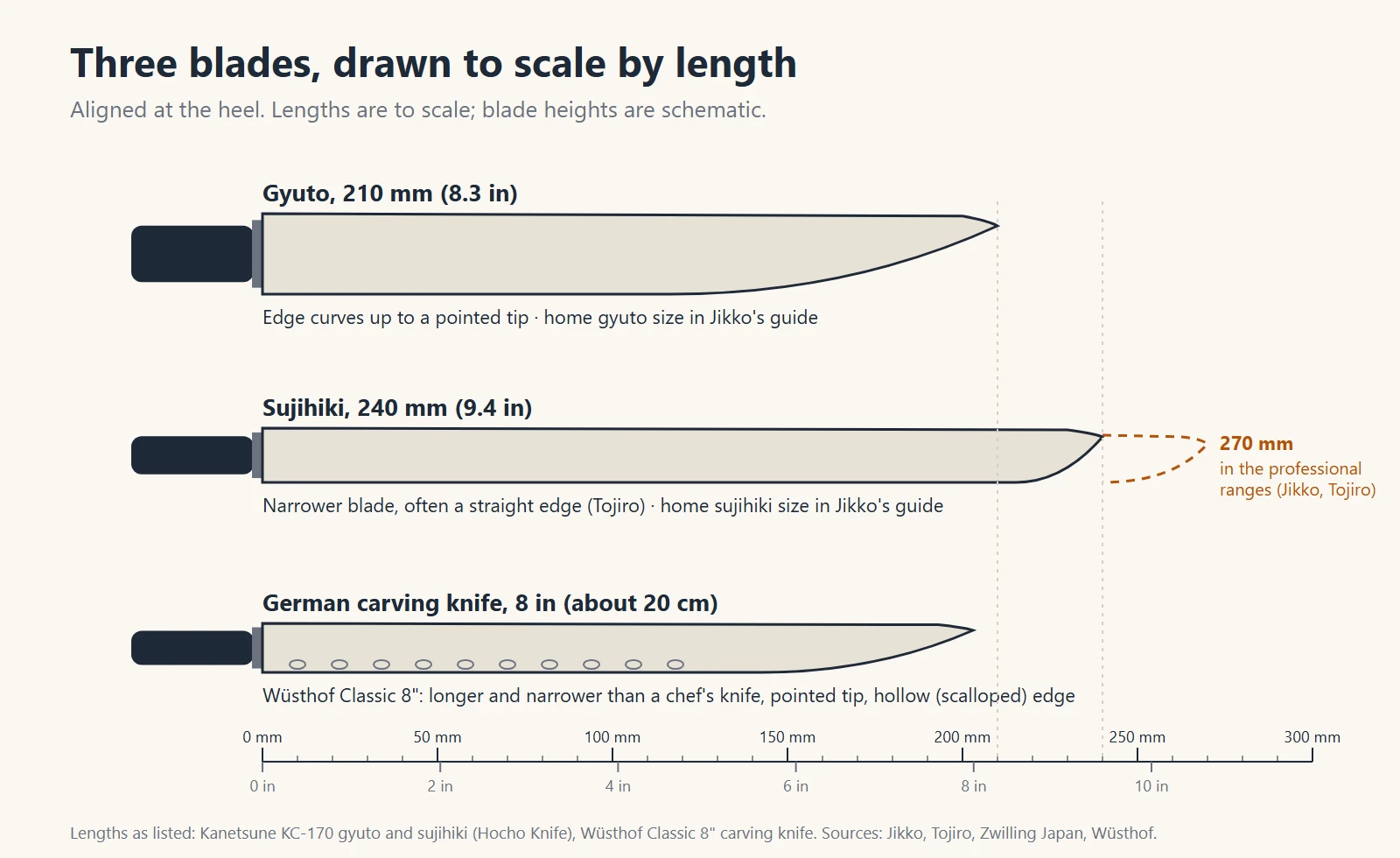
| Knife | Length (as listed) | Shape (as described) | Bevel | HRC (as listed) | Care line | Price |
|---|---|---|---|---|---|---|
| Japanese (Hocho Knife listings) | ||||||
| Kanetsune KC-170 gyuto | 210 mm (8.3 in) | edge curves up to a pointed tip (Tojiro’s gyuto gloss) | double edged | 60–62 | — | about $111 |
| Kanetsune KC-170 sujihiki | 240 mm (9.4 in) | narrower blade, often a straight edge (Tojiro) | double edged | 60–62 | — | about $117 |
| German (maker stores) | ||||||
| Wüsthof Classic 8″ Hollow Edge Carving Knife | 8 in (about 20 cm) | longer, narrower blade than a chef’s knife, pointed tip, hollow (scalloped) edge | — | 58 | wash by hand, towel-dry immediately | about $150 |
A dash means the listing we used doesn’t give that line for that knife. Prices as listed, Oct 13, 2026.
The sujihiki, in Japanese makers’ words
Tojiro distinguishes a sujihiki from the rounded slicer in its terminology: the sujihiki portions and slices large cuts and often has a straighter edge. Its household sujihiki are double bevel; professional models may be single bevel (ground on one side) or double bevel (ground on both sides).
It’s also described as a double-bevel knife suited to cutting sinew from block meat and to slicing meat (Jikko), and as shaped like a chef’s knife with a narrower blade, originally made to cut large blocks of meat along the sinew (Zwilling Japan).
Some professional sujihiki may be single or double bevel, so confirm that a listing says “double edged” before buying; both Kanetsune picks below do. See our guide to single bevel vs. double bevel knives for what the difference means in use.
The Western carving knife, in its makers’ words
The Wüsthof Classic 8″ Hollow Edge Carving Knife has a longer and narrower blade than a chef’s knife, a pointed tip designed to help guide meat away from the bone, and scalloped indentations for reduced food sticking. It’s listed at 58 HRC, 8 in (about 20 cm), hand-finished in Solingen, Germany, with a care line that says to wash it by hand and towel-dry it right away.
The Zwilling Professional S 8-inch Slicing/Carving Knife is made in Germany and is listed at 20 cm (7.9 in) and 55–58 HRC, dishwasher safe with hand washing recommended, for carving roast turkey, slicing ham, and cutting prime rib. Its maker’s carving-knife lineup generally runs 20–23 cm, with a 24 cm sujihiki in its Japanese lineup.
Scoped to the two models compared here: these German carving knives are shorter than the 240 mm home size in Jikko’s guide and listed softer. We wouldn’t stretch that to carving knives generally — it’s two listings, not a category average. For more on how Japanese and German blades differ, see our guide to Japanese vs. German knives.
The gyuto you may already own
A gyuto (牛刀) is a chef’s knife: a Western-born, all-purpose knife with a long blade whose edge curves up to a pointed tip. Jikko’s size guide lists 210 mm as its home gyuto size, a well-balanced 21 cm that keeps the gyuto’s qualities while staying easy to handle in a home kitchen (Tojiro). For large cuts of meat, Jikko gives professional gyuto sizes of 240–270 mm — the same length range as a sujihiki, so a cook who already owns a long gyuto gains less from adding a slicer.
How long should a sujihiki be?
For home use, 240 mm (9.4 in) is where the three cited guides converge: Jikko’s size guide lists 240 mm, within a 210–300 mm sujihiki range given in 30 mm steps; Tojiro’s household range is 210–240 mm (240–270 mm for business use); and Zwilling Japan recommends 24 cm as an easy-to-use size. That’s a convergence across these guides, not an industry standard.
Before buying, check that your board gives a 240 mm blade room for a full stroke. See our guide to a cutting board for Japanese knives for sizing.
Both Jikko and Tojiro include 270 mm (10.6 in) in their professional ranges; Jikko also lists longer sizes. We wouldn’t recommend 270 mm to a first-time buyer.
Stainless or carbon for a knife you use in November?
Stainless steel (ステンレス) resists rust, though it isn’t rust-proof. Carbon steel (hagane, 鋼) can take a sharp edge but rusts more easily and needs regular care. Jikko’s own steel comparison table calls carbon steel 「錆びやすい(手入れ必須)」 — rust-prone and needing upkeep.
On Oct 13, 2026, 12 of the 60 lowest-priced in-stock sujihiki listings in Hocho Knife’s slicer category had “Japanese Steel” in the name. Of those 12 listings, six belonged to two lines whose pages specify high-carbon steel: the Sakai Takayuki line says the blades “will also rust if left wet,” and the Fujiwara Kanefusa line names Hitachi SK-4 steel and says the blade needs rust-preventive care. We did not verify the steel type of the remaining six from their line pages. A low price on a sujihiki listing can mean a carbon blade, so it’s worth reading the steel line before you buy.
A holiday slicer can spend most of the year in a drawer. Sakai Ichimonji Mitsuhide, an Osaka knife shop, recommends a thin coat of camellia oil (tsubaki oil, a plant-based, non-drying oil) for knives used rarely or stored long-term, and advises against salad oil, which turns sticky over time. That advice isn’t limited to carbon steel, so it’s worth doing for a stainless sujihiki too. See our Japanese knife care routine for the rest of the routine.
If you’ll carve a few times a year, we’d buy stainless. Both of our picks below are stainless, as listed. For more on choosing a steel, see our guide to Japanese knife steel for beginners.
Slicing on the day: one long stroke
Zwilling Japan lists 24 cm as the average sujihiki blade length and says one heel-to-tip stroke slices food without crushing its fibers. Let the blade do the work in a single pass instead of sawing back and forth.
Wüsthof designs the pointed tip of its Classic carving knife to help guide meat away from the bone.
Check the slicer before the meal and sharpen it if it has gone dull. See our whetstone grit for beginners guide if you need a refresher.
Our picks, with prices on Oct 13, 2026
We chose the two sujihiki because their listings specify stainless steel, a double-edged blade, a 240 mm length, and a hardness rating. We haven’t used any of these knives.
Budget sujihiki: The Kanetsune KC-950 slicer, 240 mm (9.4 in), is DSR-1K6 high-carbon stainless (as listed), HRC 58–59, double edged, 130 g, made in Japan, about $53 (as of Oct 13, 2026).
Kanetsune KC-950 240 mm stainless sujihiki at Hocho Knife
Step-up sujihiki: The Kanetsune KC-170 slicer, 240 mm (9.4 in), is stainless (as listed — the listing’s own fields give different grade names, so we’re not printing one), HRC 60–62 as listed, double edged, about $117 (as of Oct 13, 2026). It’s the same line as our 210 mm gyuto pick below.
Kanetsune KC-170 240 mm stainless sujihiki at Hocho Knife
If you’d rather skip the slicer: the Kanetsune KC-170 gyuto, 210 mm (8.3 in), is listed at about $111 (as of Oct 13, 2026). We chose it for the same reasons as the sujihiki picks above: the listing specifies stainless steel, a double-edged blade, and a hardness rating. See our gyuto vs. santoku guide for more on that shape.
Kanetsune 210 mm stainless gyuto at Hocho Knife
Hocho Knife’s slicer category lists sujihiki by steel and length. Check the steel line before you buy.
Sujihiki (slicer) knives at Hocho Knife
Shipping rules for kitchen knives vary by country and state. Check the seller’s shipping policy and your local laws before ordering.
FAQ
Is a sujihiki the same as a yanagiba?
No. A yanagiba (柳刃) is a long Japanese knife for slicing sashimi (sliced raw fish) from a block of fish (Tojiro; Jikko). Traditional Japanese knife shapes are mainly single bevel, while household sujihiki are double bevel (Tojiro). See our single bevel vs. double bevel guide for what that means.
Can a sujihiki slice fish?
Yes. The makers cited here describe a sujihiki as suited to sashimi prep, including slicing a block of fish for sashimi, and to slicing foods such as roast beef and ham thinly (Tojiro; Zwilling Japan).
Sources
The facts in this guide were checked against these pages (accessed Oct 13, 2026). Pages marked (in Japanese) are written in Japanese.
- Tojiro: 洋包丁の形状 (in Japanese)
- Tojiro: 牛刀とは?特徴や選び方 (in Japanese)
- Tojiro: 三徳包丁とは?特徴や選び方 (in Japanese)
- Tojiro: 柳刃包丁とは (in Japanese)
- Tojiro: 包丁の種類と使い分け (in Japanese)
- Tojiro: 会社情報 – 燕三条製包丁の藤次郎株式会社 (in Japanese)
- Tojiro: 材料の種類 (in Japanese)
- Sakai Jikko: 包丁のサイズの選び方 (in Japanese)
- Sakai Jikko: 包丁の種類 (in Japanese)
- Sakai Jikko: 三徳と牛刀の違い (in Japanese)
- Sakai Jikko: 片刃と両刃の違い (in Japanese)
- Sakai Jikko: 青紙・白紙どちらを選ぶ? (in Japanese)
- Sakai Jikko: 会社概要 (in Japanese)
- Zwilling (Japan): スライサー・カービングナイフ(筋引) (in Japanese)
- Zwilling (Japan): 包丁の種類 (in Japanese)
- Zwilling (US): Professional S 8-inch Slicing/Carving Knife
- Zwilling (US): Carving & Slicing Knives
- Wüsthof: Classic 8″ Hollow Edge Carving Knife
- Sakai Ichimonji Mitsuhide: 会社概要 (in Japanese)
- Sakai Ichimonji Mitsuhide: サビ止め・保管方法 (in Japanese)
- Sakai Ichimonji Mitsuhide: 包丁の素材「鋼」 (in Japanese)
- hocho-knife.com: Kanetsune KC-950 DSR-1K6 Stainless Hammered Slicer (Sujihiki) 240mm
- hocho-knife.com: Kanetsune KC-170 Stainless Slicer (Sujihiki) 240mm
- hocho-knife.com: Kanetsune KC-170 Stainless Gyuto 210mm
- hocho-knife.com: Sujihiki (Slicer) category
- hocho-knife.com: Sujihiki (Slicer), in-stock, sorted by price, page 1
- hocho-knife.com: Sujihiki (Slicer), in-stock, sorted by price, page 2
- hocho-knife.com: Sakai Takayuki Japanese Steel (Metal Tsuba) line
- hocho-knife.com: Fujiwara Kanefusa Japanese Steel line
Related guides: types of Japanese kitchen knives, gyuto vs. santoku, Japanese knife steel for beginners, Japanese knife care routine, cutting board for Japanese knives, whetstone grit for beginners, Japanese vs. German knives, single bevel vs. double bevel.
Researched and written by the Japanese Toolbox AI editorial team and reviewed by Ken, our editor in Japan. Approved for publication by Ken on October 13, 2026. How we work · @JapaneseToolbox on X