Disclosure: This post contains affiliate links. If you buy through them, we may earn a commission at no extra cost to you. We only recommend tools our editor has handled or researched in depth. Learn more
For ordinary home cooking, buy a double-bevel knife first. Tojiro, a knife maker based in Tsubame, Niigata Prefecture, that makes and sells kitchen knives and cooking tools, says a double-bevel knife is the all-purpose first knife for ordinary home cooking.
Single-bevel knives such as the deba (a knife for preparing fish), yanagiba (a knife for slicing sashimi), and usuba (a thin single-bevel vegetable knife, used in Japanese cuisine for peeling, hollowing and katsuramuki — a thin-sheet peeling technique traditionally paired with the usuba) are specialist Japanese-style knives. They come in right- and left-handed versions, so a left-handed cook needs a left-handed one. Double-bevel knives, on the other hand, work in either hand.
This article draws on research from Japanese makers’ and shops’ own guides, not hands-on testing. Sources include Tojiro (above); Sakai Jikko, a Sakai knife company that makes and sells kitchen knives, run by its fourth-generation president, Toshiyuki Jikko (the fourth family head to run the business); and Sakai Ichimonji Mitsuhide, an Osaka knife shop in Namba, on the Doguyasuji kitchen-tool street, that has sold knives from Sakai since 1953 and offers sharpening and repair.
Single bevel vs double bevel at a glance
| Single bevel | Double bevel | |
|---|---|---|
| Where the edge is ground | Ground on one side only | Ground on both sides |
| Example knives | Sashimi knife (yanagiba, a knife for slicing sashimi), deba (a knife for preparing fish), usuba (a thin single-bevel vegetable knife), and soba-kiri knife (a soba-noodle knife) — Tojiro’s examples | Nakiri (a thin, double-bevel household vegetable knife), santoku (Japan’s everyday all-purpose home knife), and noodle knives among Japanese knives; common on Western knives — Tojiro’s examples |
| Left/right versions | Right- and left-handed versions | Usable by either hand; Ichimonji says right- and left-handers use it almost the same way after it has been sharpened once |
| How it cuts | A right-bevel edge cuts slightly to the left, per Tojiro | Cuts straight in the direction you push it, per Ogawa, a Tojiro Knife Gallery staff member |
| What makers suggest for a first home knife | A specialist knife to add later, per Ogawa, a Tojiro Knife Gallery staff member | The all-purpose first knife, per Tojiro (see above) |
What single bevel and double bevel mean
Single bevel means the edge is ground on one side only; double bevel means it’s ground on both sides, like a Western knife.
Tojiro says single-bevel knives are almost all Japanese-style knives, naming the sashimi knife (yanagiba), deba, usuba, and soba-kiri knife as examples. Double bevel is common on Western knives, and among Japanese knives Tojiro names the nakiri (a thin, double-bevel household vegetable knife with a rectangular blade, a straight edge and no pointed tip), santoku (Japan’s everyday all-purpose home knife for meat, fish and vegetables, “three uses,” with a relatively straight, flatter edge suited to straight-down cutting), and noodle knives.
For a closer look at how a double-bevel nakiri compares with a single-bevel usuba, see nakiri vs santoku (includes nakiri vs usuba).
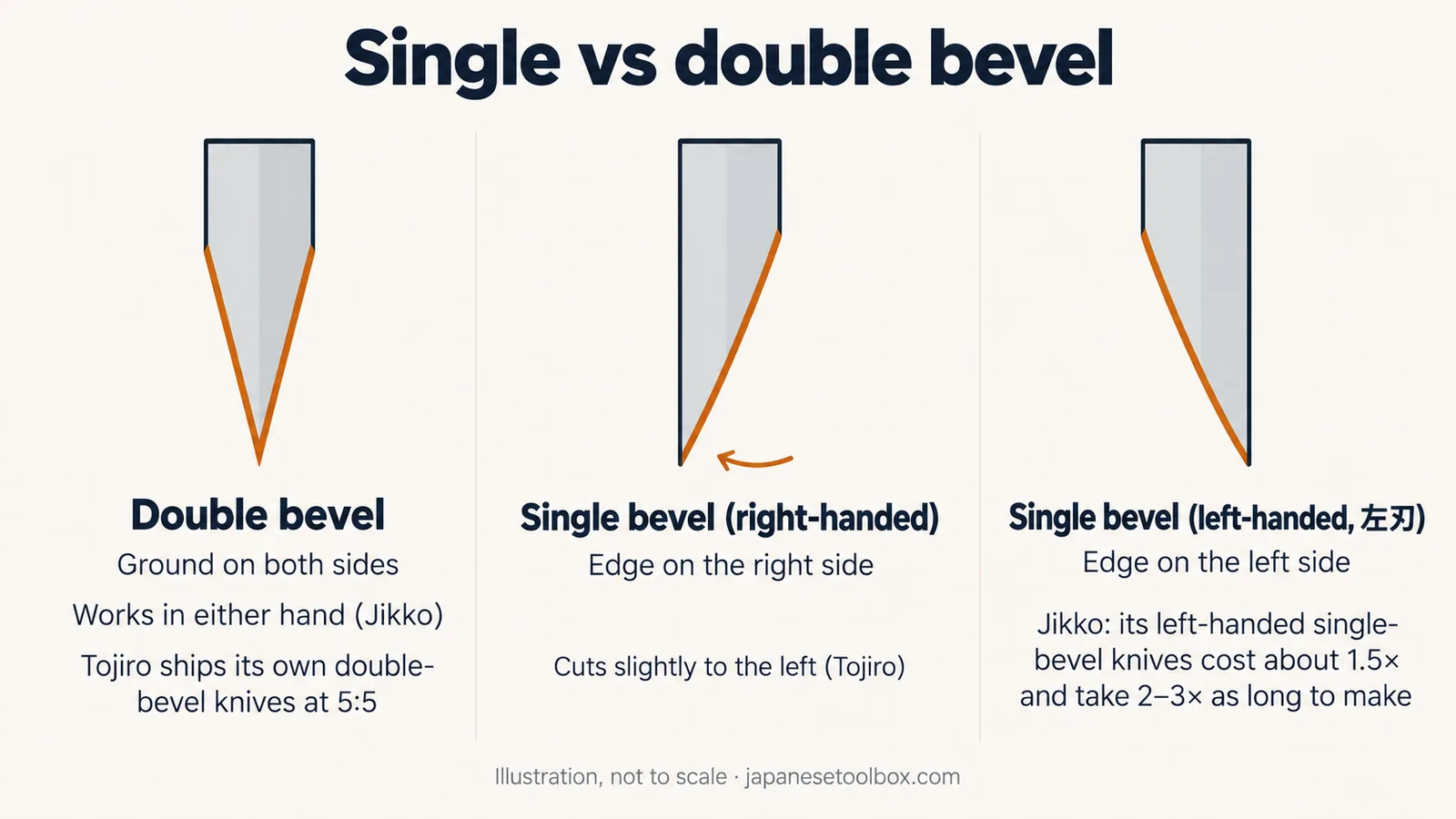
How much of the edge is on each side: the 5:5 grind
Tojiro says it ships its own double-bevel knives with an even 5:5 grind.
Tojiro also says it used to grind some of its knives at 6:4 (front 6, back 4), slightly favoring right-handers, to make sharpening easier. It says the grind ratio can be a maker’s own know-how.
How a single-bevel knife cuts, and why pros use it
Tojiro says a right-bevel edge cuts slightly to the left and separates cut food cleanly, so mincing and other quick prep work goes faster. It also lets a cook fillet fish close to the bone and leaves a clean cut face, which Tojiro says is why professional cooks’ knives are often single-bevel.
Ogawa, the person in charge of Tojiro’s Knife Gallery (the name of Tojiro’s own directly run stores), was interviewed by Wahei Freiz — a company in Tsubame, Niigata Prefecture, founded in 1951, that plans and sells household goods, cooking tools, interior goods and general merchandise. Ogawa said pushing a single-bevel knife sends it toward the side with no edge, so pushing straight gives an angled cut. Ogawa sees an upside to that: it makes thickness control easy. Ogawa also says a double-bevel knife cuts straight in the direction you push it, so it cuts where you intend. Ogawa’s interview was published by Wahei Freiz, but it is a Tojiro staff member’s view.
What Jikko found cutting with both
Jikko’s sharpener (研ぎ師) RYOTA compared a single-bevel and a double-bevel knife cutting tomato, daikon, kabocha, and sea bream. RYOTA’s overall impression was that the single-bevel knife cut better. The clearest difference was with katsuramuki (a thin-sheet peeling technique, traditionally paired with the usuba) on daikon, which RYOTA found far easier with the single-bevel knife. This is one sharpener’s impression from Jikko’s own comparison.
Single-bevel knives are made for Japanese cooking
Ogawa says single bevel is a Japanese-born knife form, used mainly for Japanese cooking and suited to fish and vegetable dishes. Ichimonji gives a broader breakdown: single bevel mainly for washoku (Japanese cuisine), and double bevel for everything else, including home cooking, French, Italian, and Chinese cooking. Ichimonji also notes that the lines cross in practice: French cooks sometimes use Japanese knives, and cooks sometimes use a gyuto (a chef’s knife: a Western-born, all-purpose knife with a long blade whose edge curves up to a pointed tip) in washoku prep.
Is a single-bevel knife good for home cooks?
As noted above, Tojiro recommends a double-bevel knife as the all-purpose first choice for ordinary home cooking. Ogawa, at Tojiro’s Knife Gallery, put it more strongly: for home use Ogawa “overwhelmingly” recommends double bevel, and calls it the knife to choose first “without doubt.” Both of these are Tojiro’s own view: Ogawa’s interview is a Tojiro staff member’s view, not a separate source.
Ogawa, a Tojiro Knife Gallery staff member, suggests a single-bevel knife can make sense as a specialist knife to add later, for example if you break down whole fish (a deba is a knife for preparing fish), if you slice sashimi (a yanagiba is a knife for slicing sashimi), or if you want to try katsuramuki (an usuba is a thin single-bevel vegetable knife, used in Japanese cuisine for peeling, hollowing and katsuramuki).
For picking a first double-bevel knife, see gyuto vs santoku: which to buy first.
Left-handed? What to know before buying a Japanese knife
Double-bevel knives
Jikko says a double-bevel knife works with either hand. Ichimonji says right- and left-handers use a double-bevel knife, including Western knives, almost the same way after it has been sharpened once. Tojiro’s own double-bevel knives ship at 5:5, and Tojiro says the grind ratio can be a maker’s own know-how, so checking the listing or asking the seller about the grind is worth doing before you buy double bevel as a left-handed cook.
Single-bevel knives
Single-bevel knives come in right- and left-handed versions, with the edge on opposite sides: on a right-handed knife the edge is on the right side, and on a left-handed knife it’s on the left side (左刃). Jikko says right-handed is the general default. Ichimonji says a left-handed cook will find a right-handed single-bevel knife difficult to use. Both Jikko and Ichimonji recommend a left-handed knife for left-handed cooks.
Cost and time
Jikko says its left-handed single-bevel knives are priced at about 1.5 times its right-handed price. It says they take its craftsmen 2 to 3 times as long to make, because the work runs opposite to what they’re used to. These figures are Jikko’s own, for its own left-handed single-bevel knives.
Stamped vs. forged
Tojiro says forged single-bevel knives (打ち刃物) can be made left-handed to order. Stamped blades (抜き刃物), which Tojiro describes as made for mass production, would need a newly made, reversed grinding jig, so Tojiro calls a left-handed version of those very difficult.
Separately, Ichimonji’s own column says the Osaka shop stocks many left-handed knives.
Sharpening a single-bevel knife: what to check
Not every sharpener works on single-bevel knives. Kai’s standard pull-through sharpener (product 459) is labeled for double-bevel knives only, and not for single-bevel knives such as the deba. Kai sells a separate model labeled for single-bevel knives. Kyocera’s FAQ says its roll sharpener is only for double-bevel metal knives and warns against sharpening single-bevel knives with it, and that its diamond roll sharpener can’t take single-bevel knives such as the deba or sashimi knife. Check that a sharpener is labeled for single-bevel knives before you use it on one; see which sharpeners work on single-bevel knives. If you plan to sharpen on stones instead, see which whetstone grit to buy first.
What to look for
- For your first or only knife, choose a double-bevel all-purpose knife, as covered above.
- If you’re left-handed and buying single bevel, make sure the listing says left-handed. Expect Jikko-style pricing, about 1.5 times its right-handed price, to run higher for its own left-handed single-bevel knives.
- If you’re left-handed and buying double bevel, check whether the seller states the grind ratio. Tojiro notes the ratio can be a maker’s own know-how.
- Check that your sharpener is labeled for single-bevel knives before you use it on one.
Left-handed knives at Hocho Knife
Left-handed knives at Hocho Knife
Shipping rules for kitchen knives vary by country and state. Check the seller’s shipping policy and your local laws before ordering.
Glossary
- single bevel / double bevel (片刃 / 両刃) — single bevel: the edge is ground on one side only; double bevel: ground on both sides, like a Western knife.
- deba (出刃) — a knife for preparing fish.
- yanagiba (柳刃) — a knife for slicing sashimi.
- usuba (薄刃) — a thin single-bevel vegetable knife, used in Japanese cuisine for peeling, hollowing and katsuramuki.
- 5:5 grind — Tojiro says it ships its own double-bevel knives with an even 5:5 grind — ground the same amount on both sides.
- left-handed (左刃) single-bevel knife — a single-bevel knife with the edge on the left side; a right-handed one has the edge on the right side.
- katsuramuki (桂剥き) — a thin-sheet peeling technique, traditionally paired with the usuba.
FAQ
Is a single-bevel knife good for home cooks?
Tojiro says the first knife for ordinary home cooking should be double-bevel. Ogawa, a Tojiro Knife Gallery staff member, suggests adding a specialist single-bevel knife later, such as the deba, yanagiba, or usuba.
Can a left-handed person use a Japanese knife?
For a double-bevel knife, yes: Jikko says it works with either hand, and Ichimonji says right- and left-handers use it almost the same way after it has been sharpened once. For a single-bevel knife, both Jikko and Ichimonji recommend buying a left-handed version.
Why do left-handed single-bevel knives cost more?
Jikko says its left-handed single-bevel knives take its craftsmen 2 to 3 times as long to make and are priced at about 1.5 times the right-handed version.
Is a santoku single or double bevel?
Double bevel. Tojiro describes the santoku as double-bevel, with the same structure as a Western knife.
Does a single-bevel knife cut better?
In Jikko’s own comparison, sharpener RYOTA’s overall impression was that the single-bevel knife cut better, and found katsuramuki with daikon far easier with single bevel. That’s one sharpener’s impression from one comparison, not a broader test.
Sources
The facts in this guide were checked against these pages (accessed September 2026). Pages marked (in Japanese) are written in Japanese.
- Tojiro: 会社情報 – 燕三条製包丁の藤次郎株式会社 (in Japanese)
- Tojiro: 刃の向きと利き手 (in Japanese)
- Tojiro: 和包丁の形状 (in Japanese)
- Tojiro: 菜切包丁(なきり包丁)とは? プロが教える特徴・使い方・三徳との違い【もっと千切りしたくなる野菜用包丁】 (in Japanese)
- Sakai Jikko: 片刃包丁は右利き、左利き用に分かれています (in Japanese)
- Sakai Jikko: 会社概要 | 包丁通販なら明治33年創業の大阪 堺の實光刃物 (じっこう) (in Japanese)
- Sakai Jikko: 實光刃物とは (in Japanese)
- Sakai Ichimonji Mitsuhide: 企業情報 | 堺一文字光秀 (in Japanese)
- Sakai Ichimonji Mitsuhide: 大阪の包丁専門店、堺一文字光秀の歴史 (in Japanese)
- Sakai Jikko: 片刃包丁と両刃包丁で切れ味は変わるのか?実際に切り比べてみた (in Japanese)
- Tojiro: 三徳包丁とは?特徴・選び方・おすすめ5選 (in Japanese)
- Sakai Ichimonji Mitsuhide: プロがおすすめする菜切り包丁の選び方と通販 (in Japanese)
- wahei.co.jp: 包丁のプロに聞いてきました【第二回】両刃・片刃について (in Japanese)
- Tojiro: 包丁メーカー藤次郎が浅草・かっぱ橋道具街に「藤次郎ナイフギャラリー東京店」オープン (in Japanese)
- wahei.co.jp: 会社概要 | 和平フレイズ株式会社 (in Japanese)
- Tojiro: 牛刀とは?特徴・三徳との違い・おすすめサイズの選び方【包丁メーカー解説】 (in Japanese)
- Sakai Jikko: 菜切包丁のメリットとデメリット:科学が解明する切れ味の秘密 (in Japanese)
- Sakai Ichimonji Mitsuhide: 左利きの和包丁 (in Japanese)
- Kai: 【公式】関孫六 ダイヤモンド&セラミックシャープナー (in Japanese)
- Kai: 包丁の研ぎ方|貝印包丁サイト (in Japanese)
- Kyocera: FAQ シャープナー (in Japanese)
Related guides
- Nakiri vs santoku
- Gyuto vs santoku
- Sharpener vs whetstone for Japanese knives
- Whetstone grit for beginners
Researched and written by the Japanese Toolbox AI editorial team and reviewed by Ken, our editor in Japan. Approved for publication by Ken on September 30, 2026. How we work · @JapaneseToolbox on X