Disclosure: This post contains affiliate links. If you buy through them, we may earn a commission at no extra cost to you. We only recommend tools our editor has handled or researched in depth. Learn more
A petty knife is a small Western-style knife (洋包丁). Tojiro, a knife maker based in Tsubame, Niigata Prefecture, that makes and sells kitchen knives and cooking tools, describes it as a scaled-down gyuto (a chef’s knife: a Western-born, all-purpose knife with a long blade whose edge curves up to a pointed tip). The name comes from the French petit, meaning “small.” In the maker classifications covered here, paring knives sit at the shorter end of the range. Sakai Jikko, a Sakai knife company that makes and sells kitchen knives, run by its fourth-generation president, Toshiyuki Jikko (the fourth family head to run the business), says its own paring knife is easy to handle when you hold the food in your hand.
Japanese makers draw the line between petty and paring at different lengths, so it helps to check the blade length (刃渡り, hawatari) on a listing rather than relying on the label alone. Tojiro calls the santoku (Japan’s everyday all-purpose home knife for meat, fish and vegetables) plus petty combination the one it most recommends for a home knife set, which is useful to know if you already own a santoku or gyuto and are weighing a second, smaller knife. This guide is built from Japanese makers’ own buying guides, not hands-on testing. Sources include Tojiro and Jikko above, Kai, a Japanese cutlery company, and Zwilling J.A. Henckels Japan (ツヴィリング J.A. ヘンケルス ジャパン株式会社), the Japanese company of the Zwilling knife brand, based in Seki, Gifu Prefecture.
Petty vs paring knife at a glance
| Paring knife | Petty knife | |
|---|---|---|
| What it is | Kai calls a knife with a blade of 100 mm (3.9 in) or less a paring knife. | Tojiro describes it as a scaled-down gyuto, a Western-style knife. |
| Length | Varies by maker — see the size breakdown below | Varies by maker — see the size breakdown below |
| Where you use it | In your hand. Zwilling Japan’s own 8–11 cm (80–110 mm, 3.1–4.3 in) class is for when you often cut in your hand, and Jikko’s paring knife is easy to handle when holding the food in your hand. | On the board, for small items. Zwilling Japan puts 11 cm (110 mm, 4.3 in) and up in this role. |
| Typical tasks | Jikko’s paring knife: peeling fruit, decorative cuts, small-fish prep, used in professional kitchens for both Japanese and Western cooking. | Tojiro’s list: peeling fruit and vegetables, decorative cutting (飾り切り), slicing small items, fish prep, bento making. |
| Role | — | Tojiro’s sub knife for detailed work and small items, alongside a santoku or gyuto as the main knife. |
What is a petty knife?
A petty knife (ペティナイフ) is a small Western-style knife that Tojiro describes as a scaled-down gyuto; the name comes from the French petit, meaning “small.” Kai adds that it has a narrow blade, 150 mm (5.9 in) or less. Zwilling Japan describes it as having a shorter blade and narrower blade width than a santoku or gyuto.
Tojiro lists its uses as peeling fruit and vegetables, decorative cutting (飾り切り), slicing small items, fish prep, and bento making.
Single or double bevel?
Jikko’s petty guide describes double bevel (両刃) as symmetrical and easy for either hand, and single bevel (片刃) as suited to Japanese-knife tasks such as pull-cutting sashimi — drawing the blade back as it cuts — and decorative cuts. See our guide to single bevel vs double bevel knives for more on the difference.
What is a paring knife?
Kai calls a knife with a blade of 100 mm (3.9 in) or less a paring knife (パーリングナイフ). Zwilling Japan’s own classification puts blades around 8–11 cm (80–110 mm, 3.1–4.3 in) in this class.
Jikko sells a smaller “paring” of about 80–90 mm (3.1–3.5 in) in its own lineup. Jikko says it’s easy to handle when you hold the food in your hand, for peeling fruit, decorative cuts, and small-fish prep, and that it’s used in professional kitchens for both Japanese and Western cooking.
How Japanese makers size them
Japanese makers describe the boundary differently. Here is each one’s, in its own numbers.
| Paring | Petty | Larger | Maker’s own size advice | |
|---|---|---|---|---|
| Kai | 100 mm (3.9 in) or less | 150 mm (5.9 in) or less by definition; its comparison table shows a petty range of 90–150 mm (3.5–5.9 in) | Gyuto (シェフズナイフ) 150–270 mm (5.9–10.6 in), per Kai’s comparison table | Comes in 90, 120, and 150 mm (3.5, 4.7, and 5.9 in). With a main knife, choose 90 or 120 mm; if the petty is your only knife — camping, parties — choose 150 mm. |
| Zwilling Japan | Around 8–11 cm (80–110 mm, 3.1–4.3 in), its own classification | Basically about 9–15 cm (90–150 mm, 3.5–5.9 in) overall; its own classification puts petty specifically around 11–13 cm (110–130 mm, 4.3–5.1 in) | Prep knife / compact chef (プレップナイフ / コンパクトシェフ) around 14–15 cm (140–150 mm, 5.5–5.9 in), its own classification | 8–11 cm for in-hand work like peeling or hulling strawberries; 11 cm and up to cut small things on the board; 14 cm and up is close to an all-purpose knife. |
| Sakai Jikko | About 80–90 mm (3.1–3.5 in), Jikko’s own lineup | Its petty article: generally about 120–180 mm (4.7–7.1 in). Its size page separately lists petty sizes from 120 to 210 mm (4.7–8.3 in) in 15 mm steps | — | 135 or 150 mm are its standard sizes, chosen by use and hand size; its size page recommends 135 mm (5.3 in) for home cooks and 150 mm (5.9 in) for professional cooks. |
| Tojiro | — | Generally about 80–150 mm (3.1–5.9 in) | — | Three tiers: 100–120 mm (3.9–4.7 in), specialized for detailed work, palm-sized; 130–135 mm (5.1–5.3 in), the balanced type and its “most popular”; 150–180 mm (5.9–7.1 in), also works as a small gyuto. |
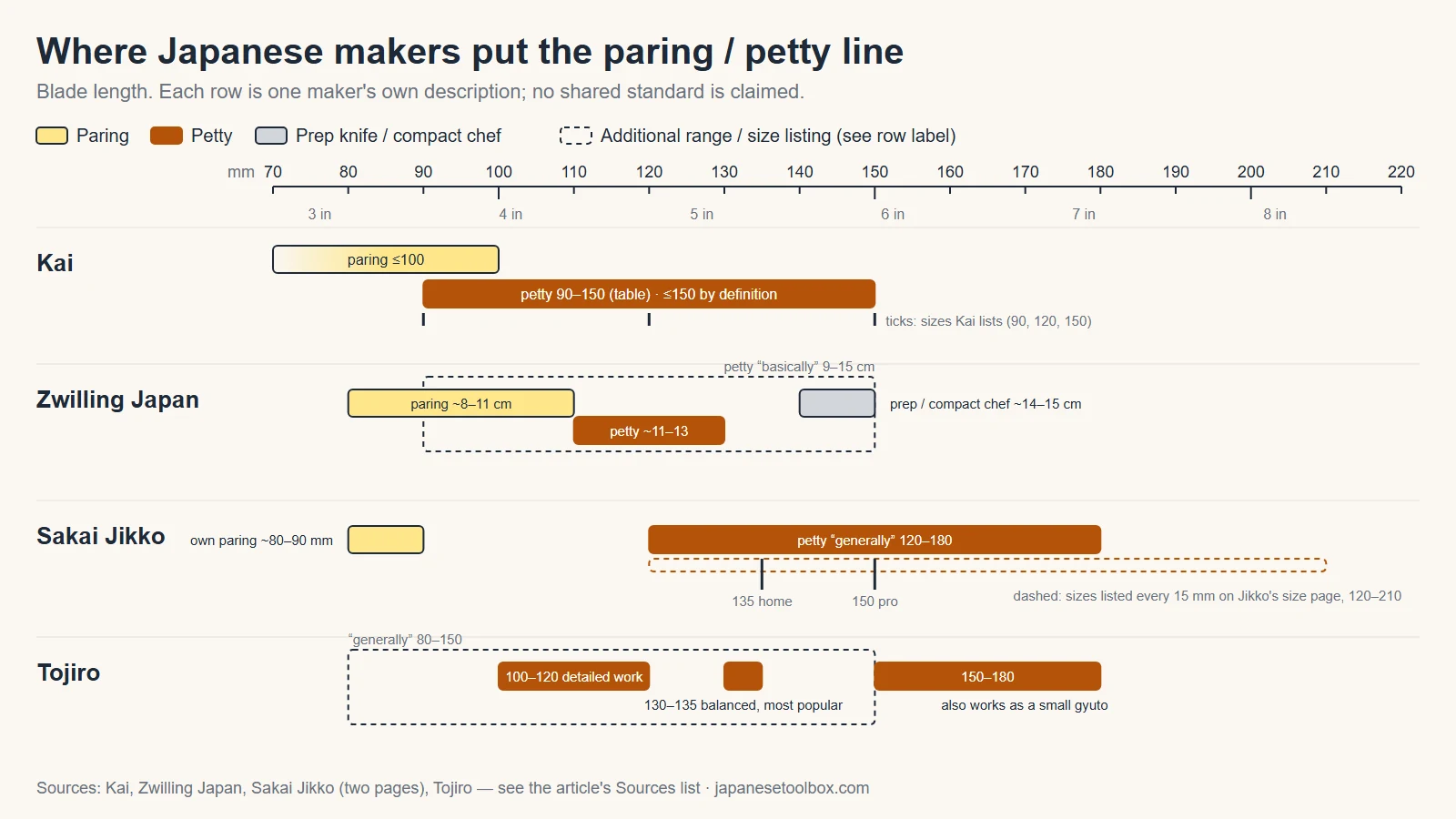
Check the blade length (刃渡り) on the listing and match it to the task you have in mind — that’s our synthesis of the numbers above, worded as advice, not a claim that these makers follow one shared standard.
Petty vs santoku or gyuto: what each is for
Jikko’s task table compares the santoku and the petty across five tasks: shredding cabbage, peeling fruit, decorative cutting, cutting chicken, and fine-tuning before plating. By Jikko’s own ratings, the santoku is better suited to shredding cabbage and cutting chicken, while the petty is better suited to peeling fruit, decorative cutting, and fine-tuning before plating. Jikko gives reasons for some of these: a petty is less suited to a task like shredding cabbage because of insufficient blade length, and it’s better suited to peeling fruit because it’s small, easy to handle, and allows precise peeling.
Tojiro frames it the same way: the santoku or gyuto as the main knife handles large items like shredded cabbage or sliced meat, while the petty is the sub knife for detailed work and small items. Zwilling Japan names the petty’s downside the same way: it’s hard to handle large ingredients.
If you’re also weighing nakiri vs santoku for vegetable prep, that comparison covers where a dedicated vegetable knife fits alongside a main knife.
Petty knife vs fruit knife
Kai says knives sold as “fruit knives” (フルーツナイフ) are often made just to peel and cut fruit. By contrast, Kai says a petty is a scaled-down knife made with the same materials and process as a kitchen knife, so its specs and performance match a kitchen knife and it covers a wider range of tasks. Kai’s advice if you can’t decide between the two: buy the petty.
Jikko draws the line differently: a fruit knife is often not as sharp as a petty, because safety at the table is the priority. Jikko adds that a petty is expected to cut sharply, while a fruit knife is sometimes kept in a case and left on the dining table.
Do you need a petty knife?
Zwilling Japan recommends a petty as a second knife alongside an everyday santoku or gyuto. As noted above, Tojiro calls santoku plus petty its most recommended two-knife combination for a home set. Jikko says the same two-knife combination has many advantages for home cooking as well as professional use, and it strongly recommends it for cooks who care about presentation.
You may not need one yet if most of what you cut is large: Zwilling Japan notes a petty is hard to handle for large ingredients. And if you want just one small knife rather than a pair, Kai notes a 150 mm petty can serve on its own — for example camping or at a party.
How to choose a petty or paring knife
- Length for your use. Match it to the maker advice above: in-hand work calls for a shorter blade, board work for a longer one.
- Steel and care. Kai lists material (材質) among its points to check, and Zwilling Japan lists material (材質) among its points to check. See our guides to steel for a first Japanese knife and a Japanese knife care routine.
- Handle and dishwasher. Kai lists handle material and dishwasher compatibility among its points to check, and Zwilling Japan lists maintenance method among its points to check. Check the specific listing for both.
- Bevel. Double bevel works in either hand, per Jikko. See single bevel vs double bevel knives for the difference.
- Board. If you’ll be cutting on a board rather than in hand, see our guide to choosing a cutting board for Japanese knives.
Our pick for a petty knife: the Kanetsune KC-170 petty (utility) knife, 150 mm (5.9 in), stainless, double edged, 60–62 HRC, listed at $82.99 on Oct 15, 2026. We chose it from the shop’s listings because its listed specs match the criteria above; we haven’t used this exact knife.
Kanetsune 150 mm stainless petty knife at Hocho Knife
Stainless 120–150 mm petty knives at Hocho Knife started at about $39 on Oct 8, 2026.
Shipping rules for kitchen knives vary by country and state. Check the seller’s shipping policy and your local laws before ordering.
Glossary
- petty knife (ペティナイフ) — a small Western-style knife that Tojiro describes as a scaled-down gyuto; the name comes from the French petit, “small.” Kai adds: a narrow blade, 150 mm or less.
- paring knife (パーリングナイフ) — a small knife for work held in the hand; Kai calls a knife with a blade of 100 mm or less a paring knife.
- fruit knife (果物ナイフ / フルーツナイフ) — a small knife sold in Japan for peeling and cutting fruit; Kai says such knives are often made for that purpose, and Jikko says they are often less sharp than a petty, with safety at the table as the priority.
- prep knife / compact chef (プレップナイフ / コンパクトシェフ) — Zwilling Japan’s name for knives of around 14–15 cm in its blade-length classification.
- gyuto (牛刀) — a chef’s knife: a Western-born, all-purpose knife with a long blade whose edge curves up to a pointed tip.
- santoku (三徳) — Japan’s everyday all-purpose home knife for meat, fish and vegetables (“three uses”), with a relatively straight, flatter edge suited to straight-down cutting.
- blade length (刃渡り, hawatari) — the blade-length measurement shown on a listing; measurement conventions can vary by knife type and maker.
FAQ
Is a petty knife the same as a paring knife?
Not universally. Zwilling Japan uses separate approximate length bands, while Kai’s definitions overlap: petty is 150 mm or less and paring is 100 mm or less.
What size petty knife should I buy?
Jikko’s size page recommends 135 mm for home cooks. Kai suggests 90 or 120 mm if you’ll use it alongside a main knife. Tojiro calls its 130–135 mm tier the “most popular.”
Can a petty knife replace a santoku?
Zwilling Japan says a petty around 14 cm and up is close to an all-purpose knife, and Kai says a 150 mm petty can serve as your only knife, for example camping. But Jikko’s own task table rates the santoku better suited for shredding cabbage and cutting chicken.
Is a fruit knife a petty knife?
Not always. Kai and Jikko distinguish the products by intended use and performance, although Jikko notes that the names are often used interchangeably. Kai says knives sold as fruit knives are often made just for peeling and cutting fruit, while a petty matches a kitchen knife’s materials and process, so its specs and performance match a kitchen knife and it covers more tasks. Jikko adds that a fruit knife is often not as sharp as a petty, with safety at the table as the priority.
Sources
The facts in this guide were checked against these pages (accessed September 2026). Pages marked (in Japanese) are written in Japanese.
- Tojiro: tojiro.net/reading/41275
- Tojiro: 会社情報 – 燕三条製包丁の藤次郎株式会社 (in Japanese)
- Tojiro: 牛刀とは?特徴・三徳との違い・おすすめサイズの選び方【包丁メーカー解説】 (in Japanese)
- Sakai Jikko: 会社概要 | 包丁通販なら明治33年創業の大阪 堺の實光刃物 (じっこう) (in Japanese)
- Sakai Jikko: 實光刃物とは (in Japanese)
- Sakai Jikko: www.jikko.jp/news/what-is-a-petty-knife
- Tojiro: 三徳包丁とは?特徴・選び方・おすすめ5選 (in Japanese)
- Tojiro: 包丁の種類と使い分け (in Japanese)
- Kai: 沿革 | KAIグループについて | 貝印 (in Japanese)
- Zwilling: プライバシーポリシー (in Japanese)
- Kai: www.kai-group.com/media/kitchen/319
- Zwilling: www.zwilling.com/jp/magazine/product-guide-knives/knife-about-petty.html
- Sakai Jikko: www.jikko.jp/c/knowledge/select/size
- Sakai Jikko: www.jikko.jp/news/petti-recommended-guide
Related guides
- Gyuto vs santoku: which main knife to buy
- Nakiri vs santoku for vegetable prep
- Single bevel vs double bevel knives
- Steel for a first Japanese knife
Researched and written by the Japanese Toolbox AI editorial team and reviewed by Ken, our editor in Japan. Approved for publication by Ken on October 1, 2026. How we work · @JapaneseToolbox on X