In Sakai’s traditional knife craft, one knife is forged by a blacksmith, sharpened by a separate sharpener and fitted with its handle by another specialist, as Sakai City describes it. One Sakai shop owner gives a five-role list: forging blades, making handles, engraving names, sharpening knives, and selling them.
This explainer draws on Sakai City’s, Osaka Prefecture’s and the traditional crafts association’s own descriptions of the craft, not a workshop visit. It matters when you shop because a listing that names one person may identify only the specialist responsible for one stage.
Sakai is an Osaka Prefecture city known for its forged-knife tradition, which has national traditional-craft designation. The nationally designated craft is called 堺打刃物 (Sakai uchihamono), rendered “Sakai cutlery” on official English pages.
Three trades behind one Sakai knife
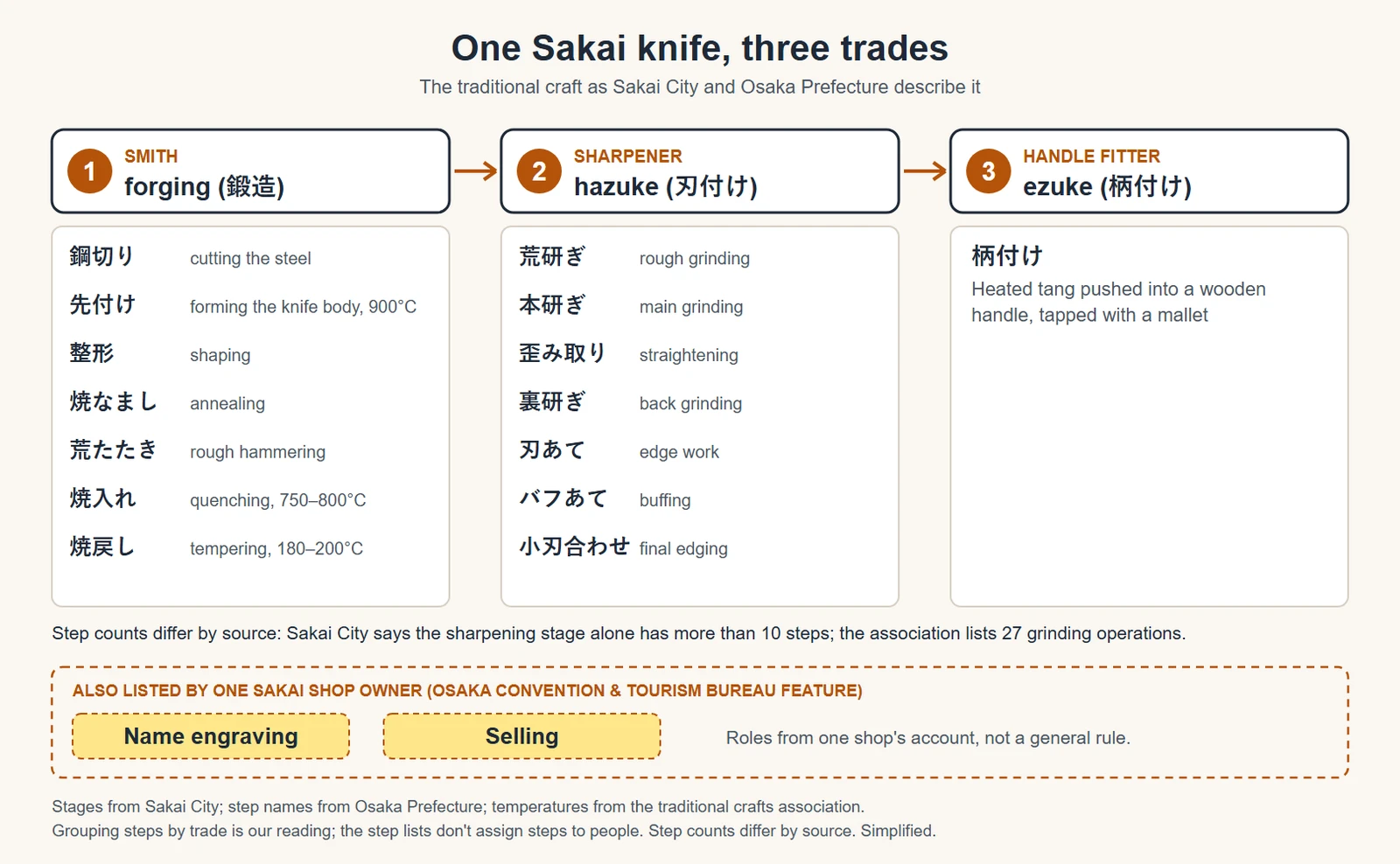
Sakai City names three stages: forging (鍛造), sharpening (刃付け, hazuke) and handle fitting (柄付け, ezuke). The romanizations “hazuke” and “ezuke” come from the city’s English page. A heading on the traditional crafts association’s page says that “a number of craftsmen” contribute to one knife, but it gives no head count.
The flow below sorts Osaka Prefecture’s 15 step names under those three trades. Grouping the steps by trade is our reading; the lists themselves don’t assign steps to people.
- Forging: cutting the steel, forming the knife body (heated to 900°C), shaping, annealing, rough hammering, quenching, tempering
- Sharpening: rough grinding, main grinding, straightening, back grinding, edge work, buffing, final edging
- Handle fitting: fitting the handle
One shop owner’s separate five-role list is covered below.
The smith: forging
The smith’s stage is forging. In the city’s description, two metals are heated red in a furnace, hammered out and shaped repeatedly, and joined. The association names the two as 地金 (the base metal) and 刃金 (hagane, the blade steel), joined by forge-welding. For what different blade steels mean, see our guide to Japanese knife steel.
The city says mastering these skills takes 10 to 15 years or more.
The sharpener: hazuke
The city glosses 刃付け as sharpening (研ぎ) and says this stage alone has more than 10 steps. The association counts 27 grinding operations in its sharpening step. For how sharpening grits work at home, see our whetstone grit guide.
Handle fitting: ezuke
At this stage, the city says, the handle is set straight, without distortion, on the knife the smith and the sharpener made, and the balance point is adjusted. Osaka Prefecture’s step 15 heats the tang (nakago, the narrow part of the blade that goes into the handle), pushes it into the wooden handle and taps the rear end with a wooden mallet. The tourism bureau’s feature describes the same work with a burner and a mallet. For why wa handles are fitted this way, see our wa handle vs Western handle guide.
Engraving and selling: one shop owner’s five-role list
The owner of Wada Shoten, a knife wholesaler in Sakai Ward, Sakai, lists five roles: craftsmen who forge the blades, make the handles, engrave the names, sharpen the knives and sell them. The shop itself “originally started out as a specialist in handle attachment” and now also sells knives and offers sharpening and maintenance.
That is one shop’s account. A name engraved on a blade does not by itself establish who forged it.
The steps, as three official pages count them
Three official pages describe the process, and they count the steps differently. Sakai City names three specialist stages. The traditional crafts association lists nine steps. Osaka Prefecture lists 15. The totals are not directly comparable because the pages divide the workflow at different levels.
| Publisher | How it divides the work | Sharpening-stage steps | Handle fitting included? | Temperatures given |
|---|---|---|---|---|
| Sakai City | Three specialist stages: forging (鍛造), sharpening (刃付け), handle fitting (柄付け) | “More than 10” | Yes, as its own stage | None |
| Traditional crafts association (kougeihin.jp) | 9 steps, from 刃金(鋼)付け to 刃付け(研ぎ) | 27 grinding operations within step 9 | Not in its step list | About 900°C (1,650°F) forge-welding; 750–800°C (1,380–1,470°F) quench; 180–200°C (360–390°F) temper |
| Osaka Prefecture | 15 steps, from 鋼切り to 柄付け | 7 named steps (荒研ぎ to 小刃合わせ) | Yes, step 15 | 900°C (1,650°F) at 先付け |
Table: How three official pages describe the steps of Sakai uchihamono. From each publisher’s page, checked Oct 2026. Step names in English are our translations. The totals are not directly comparable because the pages divide the workflow at different levels.
The association’s nine-step list begins with attaching the blade steel and ends with sharpening; intermediate stages include shaping, annealing, rough hammering, and quenching and tempering. Its page gives about 900°C for forge-welding, 750–800°C for quenching and 180–200°C for tempering.
Osaka Prefecture’s list ends with handle fitting. Its second step heats steel to 900°C (1,650°F) to make the body of the knife. Its sharpening-related names run from rough grinding through main grinding, straightening, back grinding, edge work and buffing to final edging: seven named steps, not seven grinding steps.
Why Sakai splits the work
Sakai’s knives began, in the city’s telling, with the tobacco knife (タバコ包丁), a knife for cutting tobacco leaves that arrived from Portugal in the 16th century. The association puts tobacco-knife making in Sakai in the second half of the 16th century. The Tokugawa shogunate allowed Sakai knives to carry a mark called 堺極 (Sakaikiwame), which the association calls a quality-certification mark (品質証明の印). Osaka Prefecture adds that each specialist trade formed its own guild (株仲間) and so shaped the production area.
As for why the work is split, the sources give their own reasons. The city says the division of labor was established long ago. Two business accounts give a skill-based explanation: Sakai Ichimonji Mitsuhide, an Osaka knife shop, describes a culture in which specialists in forging, sharpening and handle fitting raise their skills by placing demands on each other, while Wada’s owner says the split has let craftsmen hone the skills they excel in.
Reading a Sakai knife listing with this in mind
Three questions help you read a listing, based on the roles above:
- Which trade does the named person belong to: forging, sharpening or handle fitting?
- Is the name on the knife a craftsperson’s, or a shop’s or brand’s? In Wada’s list, engraving and selling are separate roles.
- Does the listing say where each step was done?
The Osaka knife shop also gives a general warning, not one about Sakai: some sellers do only a final step, such as engraving the maker’s mark (銘, mei), and then sell the knife under a place name.
On labels, 堺打刃物 and 堺刃物 are registered as regional collective trademarks. For what craft titles and stickers mean, see our guide to dento kogeishi and traditional-craft labels.
The sources describe the traditional craft, so treat the roles above as that system, not a rule for every knife sold under a Sakai name. A split process is neither better nor worse in itself, and a listing that names one person is simply telling you about one trade.
Related guides
- Dento kogeishi and traditional-craft labels
- Wa handle vs Western handle
- Japanese knife steel for beginners
- Single bevel vs double bevel
- Types of Japanese kitchen knives
- Whetstone grit for beginners
Sources
The facts in this guide were checked against these pages (accessed October 2026). Pages marked (in Japanese) are written in Japanese.
- Sakai City: 堺打刃物 (in Japanese)
- Sakai City: Cutlery (English page)
- Japan’s traditional crafts association: 堺打刃物 | 伝統工芸 青山スクエア (in Japanese)
- Osaka Prefecture: 堺打刃物 (in Japanese)
- Osaka Convention & Tourism Bureau: One of Japan’s three major cutlery producing regions boasting a 600-year history
- Sakai Ichimonji Mitsuhide: 打ち刃物の街、日本の伝統的な包丁名産地 (in Japanese)
- Tojiro: ハンドル・柄の構造 (in Japanese)
Researched and written by the Japanese Toolbox AI editorial team and reviewed by Ken, our editor in Japan. Approved for publication by Ken on October 22, 2026. How we work · @JapaneseToolbox on X