Disclosure: This post contains affiliate links. If you buy through them, we may earn a commission at no extra cost to you. We only recommend tools our editor has handled or researched in depth. Learn more
Pick the width first: Benriner’s catalog lists 64 mm, 95 mm, and 120 mm boards. Only the 120 mm Jumbo comes without the comb blades (toothed blades for julienne, or thin strips).
Between the two 64 mm models sold as “Classic” and “No.64,” the main differences are the adjuster, the board, and two extra parts. The Classic uses a screw and has no fixing groove or non-slip rubber. The No.64 has a dial, a board that moves up and down, and both the groove and the rubber.
This guide draws on Benriner’s own Japanese catalog and dated store listings, not hands-on testing. Benriner, a cooking-tool maker in Iwakuni, Yamaguchi Prefecture, has been making mandoline slicers (vegetable slicers) for nearly 100 years, by its own count. The five models that Hocho Knife (an affiliate partner) listed on Oct 27, 2026 ranged from about $37 to $68 (sale prices).
Start with the width: 64, 95, or 120 mm
Benriner’s official product page groups its slicers by board width (まな板幅). These are board widths, not the overall width of the tool.
- 64 mm (2.5 in): the Classic, the Classic with catch tray (a dedicated tray), and the Pro No.64. The catalog also lists 奏 at this width.
- 95 mm (3.7 in): the Super Standard and the Super Pro No.95, plus 極.
- 120 mm (4.7 in): the Jumbo Pro No.120, which the catalog calls the widest of Benriner’s products.
“Pro” here is the catalog’s own label (プロ仕様, “pro spec”) for the No.64, No.95, and No.120.
The trade-off of a wider board, in the catalog’s own sizes, is a bigger tool. The Classic measures W320 × D113 mm, while the No.95 measures W365.5 × D146 mm.
Benriner’s catalog models compared
| Model (catalog / Hocho Knife title) | Board width | Thickness adjuster | Comb blades | Board, per the catalog | Fixing groove / non-slip rubber | Handle | Weight (Hocho Knife) | Price (Hocho Knife, Oct 27, 2026) |
|---|---|---|---|---|---|---|---|---|
| ベンリナー クラシック / “Classic Series” | 64 mm | screw | yes | basic; slight left-right difference in thickness | no / no | square | 383 g | about $40 |
| クラシック受皿付 / “Classic Series with Catch Tray” | 64 mm | screw | yes | as Classic, plus a tray | no / no | square | 617 g | about $47 |
| プロ仕様No.64 / “No.64 Series” | 64 mm | dial | yes | moves up and down | yes / yes | square | 362 g | about $37 |
| スーパーベンリナー スタンダード / not at Hocho Knife | 95 mm | dial | yes | basic; moves up and down | no / no | square | — | — |
| スーパーベンリナー プロ仕様No.95 / “No.95 – Super Benriner” | 95 mm | dial | yes | moves up and down | yes / yes | round | 615 g | about $68 |
| ジャンボベンリナー プロ仕様No.120 / “No.120 – Jumbo Benriner” | 120 mm | dial | no | sliding board | yes / yes | round | 600 g | about $59 |
From Benriner’s product page and comparison table, checked Oct 27, 2026. Japan-only models (奏, 64 mm, screw; 極, 95 mm, dial) are left out. Weights and prices are from Hocho Knife’s listings; prices are sale prices.
Each of the five models compared here comes with a safety guard (安全器具), per Benriner’s contents lists.
Classic or No.64: screw or dial
They are not the same model. Both are 64 mm, both have square handles in the catalog, and both list the same parts: a body, a flat slicing blade (平刃), three comb blades (fine, medium, and coarse), a safety guard, and a manual. Both have ABS plastic bodies and stainless steel blades.
The catalog describes the differences this way:
- Classic: screw-type adjustment (ネジ式). The maker calls it a basic type with easy adjustment and easy cleaning, and adds that because of how the board works, there is a slight left-to-right difference in thickness. Its table row has no fixing groove and no non-slip rubber.
- No.64: dial-type adjustment (ダイヤル式). It has non-slip and hook parts for stability when slicing, and the board moves up and down, which the maker says makes it easier to cut evenly across the width. Professionals favor it. The catalog’s table lists a fixing groove (固定溝) and non-slip rubber for it.
The Classic with catch tray is the same 64 mm Classic plus a dedicated tray, which the catalog says gives stability when slicing. Hocho Knife lists it at 617 g, against 383 g for the plain Classic.
If even thickness across a slice matters to you, the maker’s own descriptions point to the No.64. On Oct 27, 2026, it was also the cheaper of the two at Hocho Knife.
“Super Benriner” is three models: which one is the No.95?
A listing that says only “Super Benriner” doesn’t tell you which of the catalog’s three 95 mm models you’re getting.
- Super Standard (スタンダード): the basic type, with a dial, a board that moves up and down, and a square handle. No fixing groove or non-slip rubber.
- Super Pro No.95 (プロ仕様No.95): a dial, non-slip and hook parts, a board that moves up and down, and a round handle.
- 極: non-slip and hook parts and a sliding board. The maker calls it the top of the Benriner line (ベンリナーの最高峰).
Hocho Knife’s “No.95 – Super Benriner” is the Super Pro No.95: its barcode, 4976654953336, matches the catalog’s beige No.95. Hocho Knife’s vegetable slicer category didn’t list the Standard or the 極 on Oct 27, 2026.
No.64 versus No.95: the catalog gives them the same description (dial, non-slip and hook, up-and-down board) and the same parts list. The listed differences are the board width (64 versus 95 mm), the overall size, and the handle label (square versus round). The catalog doesn’t explain the handle labels.
Jumbo No.120: flat slices only
The catalog describes the Jumbo’s board as a sliding mechanism (スライド機構) for even slices. At 120 mm it’s the widest Benriner, and the maker states plainly that it has no comb (julienne) function. Its parts list is a body, a flat blade, a safety guard, and a manual, with no comb blades. Hocho Knife’s page lists “Safety Guard included.”
Matching an English listing to the Japanese catalog
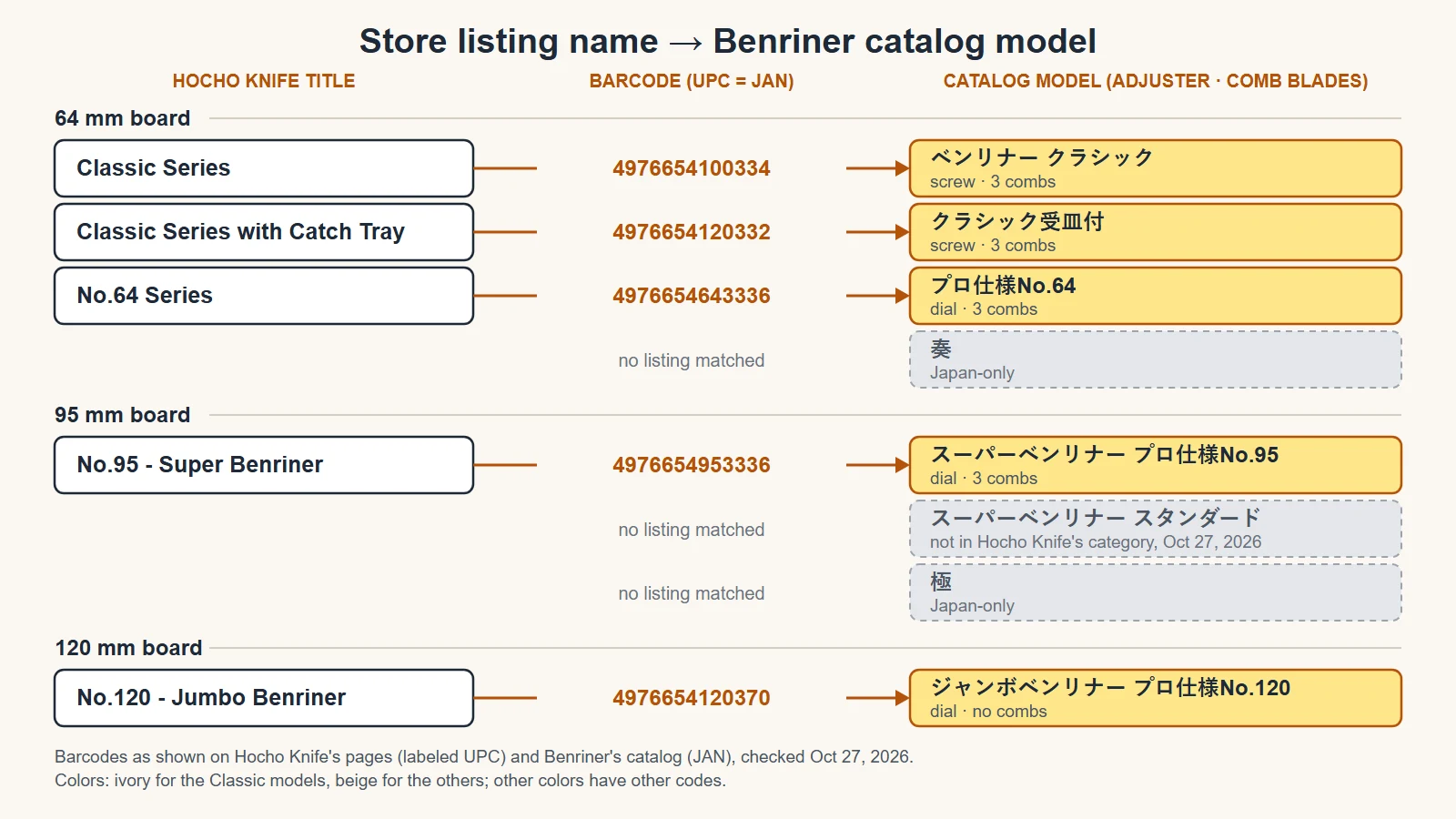
English store titles don’t always match the catalog’s names, but each model has a 13-digit barcode number that the catalog calls a JAN code. Hocho Knife labels the same kind of number “UPC.” Here is a method you can use at any store:
- Find the 13-digit barcode number on the listing.
- Look it up on Benriner’s official product page, where each model and color has its own JAN code.
- If the listing gives no code, use the catalog’s width, adjuster type, and parts list to tell the models apart.
The five matches from Oct 27, 2026, each checked between Hocho Knife’s page and the catalog:
- “Classic Series” is ベンリナー クラシック (ivory), 4976654100334.
- “Classic Series with Catch Tray” is クラシック受皿付 (ivory), 4976654120332.
- “No.64 Series” is プロ仕様No.64 (beige), 4976654643336.
- “No.95 – Super Benriner” is スーパーベンリナー プロ仕様No.95 (beige), 4976654953336.
- “No.120 – Jumbo Benriner” is ジャンボベンリナー プロ仕様No.120 (beige), 4976654120370.
The other colors have other codes. An English title like “Super Benriner” or “No.64 Series” may not match the catalog’s own name, so the code is the safer check.
The Japan-only models, 奏 and 極, are marked 【国内限定販売】 in the catalog, so there’s no need to hunt for them outside Japan.
How thick does a Benriner slice?
The maker’s catalog gives no range. It calls the adjustment stepless (無段階) and says that tightening or loosening the adjuster lets you freely set fine, millimeter-level thicknesses.
Two sources give numbers. Tingstad’s listing for its 6.4 cm Benriner says “adjustable setting from 0.5 to 7 mm.” A True Keepers review of the No.95 states 0.5 to 8.0 mm.
Neither figure comes from Benriner, and they cover different models. Treat any number as that listing’s claim, and ask the seller if the upper limit matters to you.
Where to buy the five models
These are picks from the store’s listings, and we haven’t used them. Prices are Hocho Knife’s sale prices on Oct 27, 2026, so check the current price before you buy.
Classic (ベンリナー クラシック, ivory). A 64 mm slicer with a screw adjuster, listed at 383 g, for about $40. It’s the maker’s basic-type model.
Benriner Classic (64 mm) at Hocho Knife
Classic with catch tray (クラシック受皿付, ivory). The same 64 mm Classic with a dedicated tray, listed at 617 g, for about $47.
Benriner Classic with catch tray at Hocho Knife
No.64 (プロ仕様No.64, beige). A 64 mm slicer with a dial and an up-and-down board, listed at 362 g, for about $37. It was the lowest-priced of the five.
Benriner No.64 (64 mm) at Hocho Knife
No.95 Super (スーパーベンリナー プロ仕様No.95, beige). The 95 mm model with a dial and an up-and-down board, listed at 615 g, for about $68. It was the highest-priced of the five.
Super Benriner No.95 (95 mm) at Hocho Knife
No.120 Jumbo (ジャンボベンリナー プロ仕様No.120, beige). The 120 mm sliding-board model with no comb blades, listed at 600 g, for about $59.
Jumbo Benriner No.120 (120 mm) at Hocho Knife
In short: the No.64 if even thickness across the slice matters to you, the No.95 if you want a wider board and can live with a bigger tool, and the Jumbo only if you want wide flat slices and don’t need julienne from the same tool.
Use the guard that comes with your slicer: the maker says it helps prevent injury and lets you slice food almost to the end, which also cuts food waste.
Hocho Knife’s vegetable slicer category had these five Benriner models and nothing else on Oct 27, 2026.
Benriner slicers at Hocho Knife
If you’d rather cut julienne by knife, see our nakiri vs santoku guide.
Benriner traces its start to 1934, when its founder made a daikon (radish) cutting tool to help a local restaurant that was short of hands. The company says it assembles each unit by hand after visually inspecting all parts.
Related guides
- Nakiri vs santoku
- Cutting boards for Japanese knives
- Japanese knife gift guide
- Japanese knife care routine
- Oroshigane vs Microplane: how Japanese graters differ
Sources
- Benriner product page and comparison table
- Benriner top page, company profile, and how it’s made
- Hocho Knife: vegetable slicer category and the five product pages linked above
- Tingstad’s Benriner 6.4 cm listing
- True Keepers’ Super Benriner No.95 review
Researched and written by the Japanese Toolbox AI editorial team and reviewed by Ken, our editor in Japan. Approved for publication by Ken on October 27, 2026. How we work · @JapaneseToolbox on X