Disclosure: This post contains affiliate links. If you buy through them, we may earn a commission at no extra cost to you. We only recommend tools our editor has handled or researched in depth. Learn more
Start with two knives that do different jobs. Tojiro, a knife maker in Niigata, calls a santoku plus a small petty knife the classic combination for home cooks, and a gyuto plus a petty the step up. Buy the pair as singles or as a two-piece set, and add a third knife only when your cooking gives it a job.
This guide draws on Japanese makers’ own household guides and dated shop listings, not hands-on testing. If you are buying for someone else, see our Japanese knife gift guide. If you are still deciding on your first knife, start with the best Japanese knife for beginners.
The knife pair Japanese makers recommend for home cooks
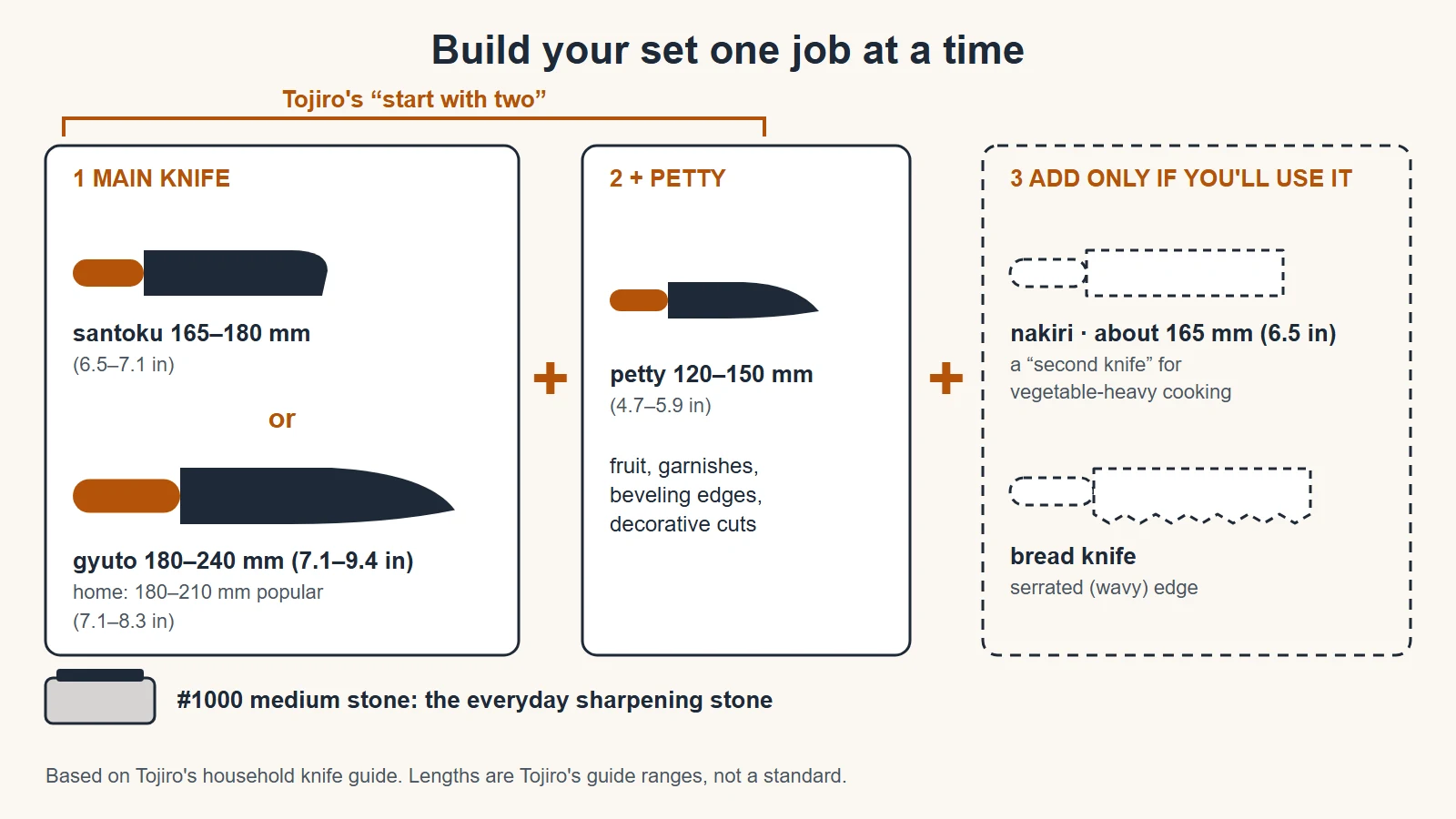
Tojiro’s household guide has a section called 「まずは2本」 (“start with two”). It adds a nakiri or a bread knife only “depending on use”. The guide also calls the santoku, gyuto, and petty the home’s “three pillars”.
Tojiro’s petty guide splits the jobs the same way. The santoku and gyuto are “main” knives for tasks such as shredding cabbage and slicing meat, while the petty is the “sub” knife for detailed work and smaller ingredients. It goes as far as calling santoku plus petty the most recommended combination for a home knife set.
The main knife: santoku or gyuto
A santoku (三徳) is Japan’s everyday all-purpose home knife for meat, fish, and vegetables, with a relatively straight, flatter edge suited to straight-down cutting. A gyuto (牛刀) is a chef’s knife: a Western-born, all-purpose knife with a long blade whose edge curves up to a pointed tip.
Other Japanese sources point the same way for the first knife. Zwilling Japan recommends choosing a santoku or a chef’s knife as the first knife. Sakai Ichimonji Mitsuhide, an Osaka knife shop, says that for home use you won’t be stuck if you start with a santoku.
On size, Tojiro’s guide gives 165–180 mm (6.5–7.1 in) for a santoku and 180–240 mm (7.1–9.4 in) for a gyuto, with 180–210 mm (7.1–8.3 in) popular for homes. These are one maker’s guide ranges, not a standard. For the choice between the two, see gyuto vs santoku.
The petty: what the second knife is for
A petty knife (ペティナイフ) is a small Western-style knife that Tojiro describes as a scaled-down gyuto. Tojiro’s household guide lists fruit, garnishes, beveling edges, and decorative cuts as its jobs, and gives 120–150 mm (4.7–5.9 in) as its size.
Sakai Jikko, a knife company in Sakai, says that owning a santoku and a petty has many merits for home cooking too, not only for professionals. Its reasoning is that using the right knife for each job improves efficiency, safety, and finish. Its comparison table rates the santoku best for shredding cabbage and the petty best for peeling fruit. If you wonder whether a paring knife would do the same job, see petty knife vs paring knife.
A third knife earns its place by doing a new job
- Nakiri. A nakiri (菜切) is a thin, double-bevel household vegetable knife with a rectangular blade, a straight edge, and no pointed tip, about 165 mm (6.5 in). Tojiro recommends it as a “second knife” that makes cooking easier, not as a replacement for the santoku. Its list of who the nakiri suits includes people who cook a lot of vegetables, do a lot of fine shredding or slicing, and already own a santoku. See nakiri vs santoku for the full comparison.
- Bread knife. Tojiro lists a bread knife as an add-on. It is for slicing bread, ham, and the like, with a serrated (wavy) edge.
- Slicer. A sujihiki is a separate topic; see sujihiki vs carving knife.
Here is our own reading, not a maker’s rule. Tojiro’s petty guide calls both the santoku and the gyuto the 「メインの包丁」 (main knife). So a set that holds both a santoku and a gyuto but no small knife overlaps where the makers’ pair does not. Use that as a way to read a set’s contents, not as a rule.
Boxed set or separate knives: one shop’s prices on one day
Does a set save money? We have one dated comparison, from one shop on one day, so treat it as an example and not a rule.
Hocho Knife (an affiliate partner) has no knife-set category in its main navigation, so we used its site search to find sets (checked Oct 20, 2026). The example below is a Sakai Takayuki damascus set, a core-clad blade of two or more metals layered over a core material, with a wood-grain-like pattern.
Take the Sakai Takayuki 33-layer VG10 damascus set of gyuto 210 mm (8.3 in), santoku 180 mm (7.1 in), and nakiri 160 mm (6.3 in). It was $474.99. The three single listings had the same listed steel and handle (the set listed HRC 60 and the singles HRC 60 ±1, a hardness rating). They were $171.99 for the gyuto, $150.99 for the santoku, and $150.99 for the vegetable knife, which adds up to $473.97 (our arithmetic). All four listings say “Made in JAPAN” and “double edged” (a double-bevel edge is ground on both sides, like a Western knife).
So on that day the box saved nothing. Our takeaway is also about the contents: the set included two main knives, a gyuto and a santoku, and no small knife. That is one dated observation, and it doesn’t mean sets are never cheaper.
Sets that match the makers’ pair do exist. Zwilling Japan lists a santoku-and-petty 2-piece set (ツヴィリング アーク) at ¥30,800, marked 日本製 (made in Japan) on the listing, on Oct 20, 2026. Tojiro also promotes its own knife sets on its petty guide. So makers aren’t against sets. If a set holds the pair and the price is right, buying it boxed is fine.
The set in the Hocho Knife comparison is damascus. Whether the pattern is worth paying for is a separate question; see are damascus knives worth it.
Check where every knife in the box was made
A set that says “Japanese” is not the same as a set made in Japan. Check the origin line for each knife in the box.
Japan’s Consumer Affairs Agency defines 原産国 (country of origin) as the country where the product’s substantial change took place. In the US, imported articles must generally be marked with the English name of their country of origin for the ultimate purchaser. The rule allows the mark to go on the container in some cases and has exceptions, so check the box as well as the blades.
- Find an origin line (“Made in …”, 原産国, or “Country of Origin”) on the listing or box, and check that it covers the set itself, not just the brand.
- When some sets in a range carry an origin line and others don’t, open each set’s own page.
- “Japanese steel” or a Japanese-sounding name is not an origin line.
For example, on Zwilling Japan’s set category page on Oct 20, 2026, some sets showed 日本製 on the listing and others showed no origin label there. That tells you nothing about where the unlabeled sets are made, which is why the check matters. For the full method, see cheap Japanese knives made in Japan.
Building the pair at Hocho Knife
These are picks from Hocho Knife’s listings by type, steel, length, and origin. We haven’t used them.
Shipping rules for kitchen knives vary by country and state. Check the seller’s shipping policy and your local laws before ordering.
Main knife. The Kanetsune 180 mm (7.1 in) stainless santoku was about $111 on Oct 20, 2026, listed as double edged and “Made in JAPAN”.
Kanetsune 180 mm stainless santoku at Hocho Knife
If you prefer the gyuto route, the Kanetsune 210 mm (8.3 in) stainless gyuto was about $111 on Oct 8, 2026, so check the current price.
Kanetsune 210 mm stainless gyuto at Hocho Knife
Petty. The Kanetsune 150 mm (5.9 in) stainless petty was about $83 on Oct 20, 2026, also double edged and “Made in JAPAN”. It is listed with a black plywood (laminated wood) handle with a stainless bolster, the same handle as the santoku, so the two match without buying a set. The santoku and petty together come to about $194 (as of Oct 20, 2026).
Kanetsune 150 mm stainless petty knife at Hocho Knife
Optional third knife. If you cook a lot of vegetables, the Kanetsune 165 mm (6.5 in) stainless nakiri was about $114 on Oct 8, 2026, so check the current price.
Kanetsune 165 mm stainless nakiri at Hocho Knife
Sharpening. Stainless knives still go dull. A medium stone (the everyday sharpening stone, generally around #1000) is the usual starting point. See whetstone grit for beginners. The Naniwa #1000 stone with a stand was about $76 on Oct 20, 2026, listed as “Made in JAPAN”.
Naniwa #1000 whetstone with stand at Hocho Knife
Related guides
- Gyuto vs santoku
- Petty knife vs paring knife
- Nakiri vs santoku
- Best Japanese knife for beginners
- Japanese knife gift guide
- Cheap Japanese knives made in Japan
- Whetstone grit for beginners
- Japanese knife care routine
Sources
The facts in this guide were checked against these pages (accessed October 2026). Pages marked (in Japanese) are written in Japanese.
- Tojiro: 包丁の種類と使い分け (in Japanese)
- Tojiro: 小さい包丁の選び方とペティナイフおすすめ (in Japanese)
- Tojiro: 三徳包丁とは?特徴・選び方・おすすめ5選 (in Japanese)
- Tojiro: 牛刀とは?特徴・三徳との違い・おすすめサイズの選び方【包丁メーカー解説】 (in Japanese)
- Zwilling: 包丁セットの通販 (in Japanese)
- Sakai Ichimonji Mitsuhide: 包丁の種類。使用目的から包丁を選ぶ (in Japanese)
- Sakai Jikko: ペティナイフは何に使う?三徳包丁とペティの違いを解説 (in Japanese)
- Tojiro: 和包丁の形状 (in Japanese)
- Tojiro: 菜切包丁(なきり包丁)とは? プロが教える特徴・使い方・三徳との違い【もっと千切りしたくなる野菜用包丁】 (in Japanese)
- Tojiro: 洋包丁の形状 (in Japanese)
- hocho-knife.com: Hocho Knife
- Zwilling: ダマスカス包丁とは?メリット・デメリットやおすすめの包丁をご紹介 (in Japanese)
- hocho-knife.com: Sakai Takayuki 33-Layer VG10 Damascus Hammered Japanese Chef’s Knife SET
- hocho-knife.com: Sakai Takayuki 33-Layer VG10 Damascus Hammered Japanese Chef’s Gyuto Knife 210mm
- hocho-knife.com: Sakai Takayuki 33-Layer VG10 Damascus Hammered Japanese Chef’s Santoku Knife 180mm
- hocho-knife.com: Sakai Takayuki 33-Layer VG10 Damascus Hammered Japanese Chef’s Vegetable Knife 160mm
- Sakai Jikko: 片刃包丁と両刃包丁で切れ味は変わるのか?実際に切り比べてみた (in Japanese)
- caa.go.jp: 商品の原産国に関する不当な表示 (in Japanese)
- law.cornell.edu: 19 U.S. Code § 1304
- hocho-knife.com: Kanetsune KC-170 Whole AUS10 Stainless Steel Japanese Chef’s Santoku Knife 180mm
- hocho-knife.com: Kanetsune KC-170 Whole AUS10 Stainless Steel Japanese Chef’s Gyuto Knife 210mm
- hocho-knife.com: Kanetsune KC-170 Whole AUS10 Stainless Steel Japanese Chef’s Petty Knife(Utility) 150mm
- hocho-knife.com: Kanetsune KC-150 Swedish Stainless Steel Japanese Chef’s Nakiri(Vegetable) 165mm
- Tojiro: 包丁の研ぎ方 (in Japanese)
- hocho-knife.com: Naniwa Super Ceramic Waterstone (Whetstone) with Stand [S-1000]
Researched and written by the Japanese Toolbox AI editorial team and reviewed by Ken, our editor in Japan. Approved for publication by Ken on October 20, 2026. How we work · @JapaneseToolbox on X