Disclosure: This post contains affiliate links. If you buy through them, we may earn a commission at no extra cost to you. We only recommend tools our editor has handled or researched in depth. Learn more
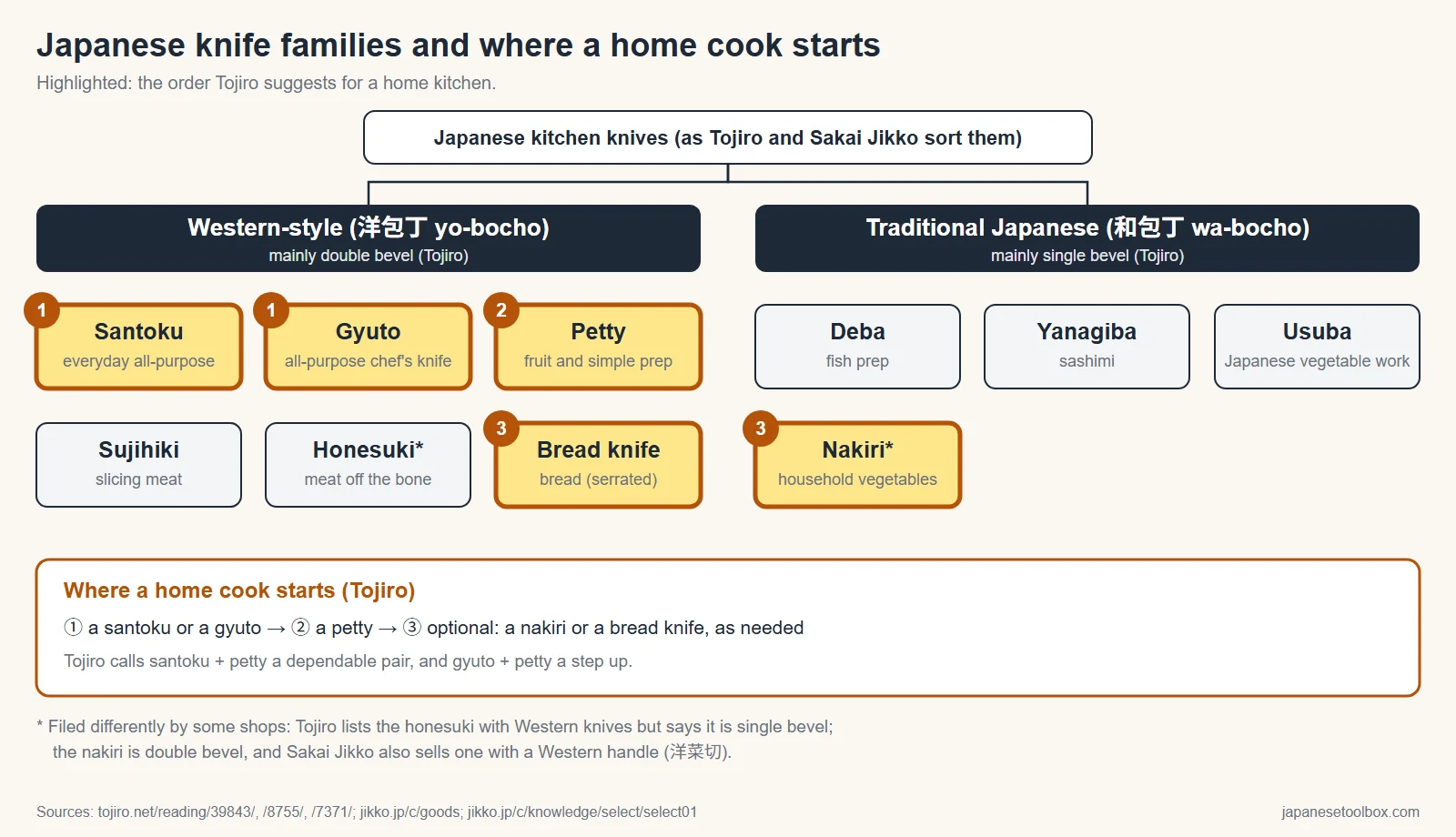
Japanese makers and shops sort kitchen knives into two families: Western-style knives (洋包丁, yo-bocho), such as the santoku, gyuto and petty, and traditional Japanese knives (和包丁, wa-bocho), such as the yanagiba, deba and usuba.
For a home kitchen, the makers’ own guides point to one all-purpose knife first. Sakai Ichimonji Mitsuhide’s types guide says a home kitchen won’t be stuck for choice with just a santoku, and Tojiro calls santoku plus petty a dependable pair (weighing a boxed set instead? See knife set or single knives). This guide maps the main types of Japanese knives the way Tojiro and Sakai Jikko sort them, with one to three sentences on each type and a link to our in-depth article where one exists.
This article is based on research from Japanese makers’ and shops’ own guides, not hands-on testing. The sources below include Tojiro, a knife maker based in Tsubame, Niigata Prefecture, that makes and sells kitchen knives and cooking tools; Sakai Jikko (實光刃物), a Sakai knife company that makes and sells kitchen knives, run by its fourth-generation president, Toshiyuki Jikko (the fourth family head to run the business); and Sakai Ichimonji Mitsuhide, a knife shop in Osaka that opened in 1953 and sells knives and kitchen equipment.
The two families: Western-style and traditional Japanese
Sakai Jikko says Western-style knives (洋包丁) are made to cut many kinds of food with one knife. Tojiro’s heading for the group is “mainly double bevel.” Tojiro says the gyuto came to Japan in the Meiji era (1868–1912) and that Western-style knives, which Japan adopted from meat-eating countries abroad, evolved here using Japanese technique.
Sakai Jikko says traditional Japanese knives (和包丁) are made for Japanese cuisine, as the name says. Tojiro’s heading for the group is “mainly single bevel.” Tojiro’s guide to traditional knife shapes says that in Japan, where fish and vegetables were the main foods, a range of fish-specific knives developed.
Single bevel means the edge is ground on one side only; double bevel means it’s ground on both sides, like a Western knife. Tojiro adds that double bevel works for either hand and suits home use. See single bevel vs double bevel: which should you buy first for more on the two grinds.
The words wa and yo also label handle styles — a separate choice from which blade family a knife belongs to. See wa handle vs Western handle before you buy.
Western-style knives: the everyday family
| Type | What it’s for | Bevel | Read more |
|---|---|---|---|
| Santoku | Japan’s everyday all-purpose home knife for meat, fish and vegetables | Double bevel, same structure as Western knives (Tojiro) | Gyuto vs santoku |
| Gyuto | A Western-born, all-purpose chef’s knife | Double bevel, per Tojiro’s “mainly double bevel” heading for the family | Gyuto vs santoku |
| Petty | A small knife, handy for cutting fruit and simple prep (Sakai Jikko) | Double bevel (Sakai Jikko) | Petty knife vs paring knife |
| Sujihiki | Dividing fairly large cuts of meat by part, called a slicer or carving knife abroad (Tojiro) | Double bevel (Sakai Jikko) | — |
| Honesuki / garasuki | Taking meat off the bone, called a boning knife abroad (Tojiro) | Single bevel (Tojiro) | — |
| Bread knife | Slicing bread, ham and the like (Tojiro) | Serrated (wavy) edge (Tojiro) | — |
Santoku (三徳) is Japan’s everyday all-purpose home knife for meat, fish and vegetables (“three uses”), with a relatively straight, flatter edge suited to straight-down cutting. Sakai Jikko calls it common for home use, the standard knife that cuts anything, and Tojiro calls it a good choice for a first knife or a replacement. See gyuto vs santoku: which to buy first and nakiri vs santoku.
Gyuto (牛刀) is a chef’s knife: a Western-born, all-purpose knife with a long blade whose edge curves up to a pointed tip. The name means “beef knife”; Tojiro says it came to Japan in the Meiji era (1868–1912) and was mainly used for meat then. Tojiro calls it a serious knife with many sizes and many ways to cut. See gyuto vs santoku: which to buy first.
Petty knife (ペティナイフ) is a small Western-style knife that Tojiro describes as a scaled-down gyuto; the name comes from the French “petit”. Sakai Jikko describes it as a small double-bevel knife handy for cutting fruit and simple prep. See petty knife vs paring knife.
Sujihiki (筋引) is a slicing knife. Tojiro describes it as a knife for dividing fairly large cuts of meat by part, called a slicer or carving knife abroad, and Sakai Jikko describes it as a double-bevel knife for slicing meat and cutting away sinew. See sujihiki vs carving knife.
Honesuki / garasuki (骨スキ / ガラスキ) is a knife for taking meat off the bone, called a boning knife abroad. Tojiro says the honesuki/garasuki is a uniquely Japanese shape, made using traditional-knife technique, and is single bevel — an edge case within the Western family.
Bread knife (パンスライサー / パン切り) is, per Tojiro, a knife for slicing bread, ham and the like, with a serrated (wavy) edge. Tojiro’s home-knife advice lists it as an add-on, as needed. See our guide to buying a Japanese bread knife.
Yo-deba (洋出刃) is, per Tojiro, shaped like a gyuto but with a very thick blade, so it can also cut through small bones — one of Japan’s own Western-style knives.
Traditional Japanese knives: the specialist family
You’ll see these in Japanese knife shops; Tojiro’s guide to traditional knife shapes ties them to Japan’s fish- and vegetable-based food culture.
Deba (出刃) is a knife for preparing fish. Tojiro’s size guide describes it as for filleting fish into three pieces and dealing with small bones. See single bevel vs double bevel.
Yanagiba (柳刃) is a knife for slicing sashimi. Tojiro describes it as a sashimi knife used widely across Japan, cut with one pull from heel to tip. See single bevel vs double bevel.
Usuba (薄刃) is a thin single-bevel vegetable knife, used in Japanese cuisine for peeling, hollowing and katsuramuki (a thin-sheet peeling technique). See nakiri vs santoku.
Nakiri (菜切) is a thin, double-bevel household vegetable knife with a rectangular blade, a straight edge and no pointed tip. It was once common in Japanese homes and has largely been replaced by the santoku. Shops also file it under different headings; see Where shops file a knife differently below. See nakiri vs santoku.
Bunka (文化) is an older home-knife style with the tip cut off at an angle, an early form of the santoku. Tojiro and Sakai Ichimonji Mitsuhide describe it differently today: Tojiro says the style is now rarely seen, while Sakai Ichimonji Mitsuhide’s English-language page says bunka knives are still sold in knife shops throughout Japan. For the full comparison, see Bunka vs santoku: same knife or a different tip?.
Tojiro’s guide to traditional knife shapes also lists knives for specific fish and foods, including the eel knife (うなぎ裂き), the pike conger knife (ハモ切) and the soba knife (そば切り). Sakai Ichimonji Mitsuhide’s types guide says the shapes it currently stocks number 80.
Where shops file a knife differently
Japanese stores don’t all file every shape under the same heading. If you’re browsing a Japanese maker or shop site, here’s where a few common knives turn up:
- Santoku: Tojiro’s size guide and its guide to Western knife shapes list it as a Western-style knife, and Tojiro’s guide to traditional knife shapes also includes it, saying it is double bevel with the same structure as Western knives. Sakai Jikko’s shop files it under 洋包丁 (Western-style knives).
- Nakiri: Tojiro’s guide to traditional knife shapes lists it among 和包丁, while Sakai Jikko’s shop also sells a 洋菜切 (nakiri with a Western handle) among its Western-style knives.
- Honesuki: Tojiro’s guide to Western knife shapes lists the honesuki there, though it says the honesuki is single bevel.
- Chinese cleaver (中華包丁): a wide-bladed all-purpose knife used in Chinese cooking, where most ingredients are prepared with this one knife (Sakai Jikko). Sakai Jikko’s shop files it under 和包丁 (traditional Japanese knives), while Sakai Ichimonji Mitsuhide’s table lists it under professional knives for non-Japanese cuisine.
Which Japanese knives do you need?
Step 1: one all-purpose knife. Start with a santoku or a gyuto. Sakai Ichimonji Mitsuhide’s types guide says a home kitchen won’t be stuck for choice with just a santoku, and Sakai Jikko calls the santoku, an all-purpose knife, the basic knife for home use. Tojiro calls the santoku the home’s main knife, good for a first knife, and suggests a gyuto plus a petty as a step up. Several Japanese maker and shop guides recommend a santoku to beginners and first-time buyers. See gyuto vs santoku: which to buy first.
Step 2: a petty. Tojiro calls santoku plus petty a dependable pair, and Sakai Jikko says a petty suited to peeling vegetables and fruit is handy. See petty knife vs paring knife.
Step 3: optional. Tojiro suggests adding a nakiri or bread knife as needed. See nakiri vs santoku.
Traditional knives, added when a job calls for them. Sakai Ichimonji Mitsuhide’s table lists a deba under its home rows, for a cook who wants to prepare fish, and also groups the yanagiba, deba and usuba together as the basic three knives for Japanese cuisine, with the gyuto and petty as the basic two for other cuisines. A home cook can add one of these when a specific job calls for it — a deba for breaking down a whole fish, for example.
| Your cooking | Where to start | Read next |
|---|---|---|
| Everyday home cooking | A santoku or a gyuto | Gyuto vs santoku |
| Fruit and quick prep | A petty | Petty vs paring knife |
| Vegetables, as needed | A nakiri | Nakiri vs santoku |
| Whole fish, sashimi, Japanese vegetable work | Deba for whole-fish preparation, yanagiba for sashimi, usuba for Japanese vegetable work | Single bevel vs double bevel |
| Non-Japanese cuisine, professional kitchens | Gyuto and petty | Gyuto vs santoku |
Before you buy
- Steel and rust. What a knife is made from affects how it holds an edge and how much care it needs. See Japanese knife steel for beginners.
- Handle: wa or Western. The handle is a separate choice from blade family. See wa handle vs Western handle.
- Keeping it sharp. Decide between a whetstone and a sharpener, and which grit to start with. See sharpener vs whetstone for Japanese knives and whetstone grit for beginners.
- Daily care and the board. What you cut on affects edge life, and promptly drying a knife helps prevent rust. See Japanese knife care routine and cutting board for Japanese knives.
Shipping rules for kitchen knives vary by country and state. Check the seller’s shipping policy and your local laws before ordering.
Glossary
- wa-bocho (和包丁) — traditional Japanese knives.
- yo-bocho (洋包丁) — Western-style knives.
- single bevel / double bevel (片刃 / 両刃) — single bevel: the edge is ground on one side only; double bevel: ground on both sides, like a Western knife.
- santoku (三徳) — Japan’s everyday all-purpose home knife for meat, fish and vegetables.
- gyuto (牛刀) — a chef’s knife: a Western-born, all-purpose knife with a long blade whose edge curves up to a pointed tip.
- petty knife (ペティナイフ) — a small Western-style knife, a scaled-down gyuto.
- deba (出刃) — a knife for preparing fish.
- yanagiba (柳刃) — a knife for slicing sashimi.
FAQ
What are the main types of Japanese knives?
Japanese makers and shops split kitchen knives into two families: Western-style knives (洋包丁), such as the santoku, gyuto and petty, and traditional Japanese knives (和包丁), such as the yanagiba, deba and usuba. See the sections above for what each type is for and where to read more.
Which Japanese knife should I buy first?
Sakai Ichimonji Mitsuhide says to start with a santoku for home use, Sakai Jikko calls the santoku the basic home knife, and Tojiro calls the santoku good for a first knife, suggesting a gyuto plus a petty as a step up. See gyuto vs santoku: which to buy first.
Is a santoku a traditional Japanese knife?
Tojiro’s guides and Sakai Jikko’s shop list the santoku among Western-style knives, though Tojiro’s guide to traditional knife shapes also includes it. See Where shops file a knife differently for how Tojiro and Sakai Jikko describe it there.
Do I need a single-bevel knife at home?
Tojiro says double bevel works for either hand and suits home use, while single bevel is the grind Tojiro’s guides use for the specialist traditional knives, such as the yanagiba, deba and usuba. See single bevel vs double bevel: which should you buy first.
What’s the difference between a nakiri and an usuba?
A nakiri is a thin, double-bevel household vegetable knife with a rectangular blade, a straight edge and no pointed tip, while an usuba is a thin single-bevel vegetable knife used for peeling, hollowing and katsuramuki. See nakiri vs santoku (includes nakiri vs usuba).
Sources
The facts in this guide were checked against these pages (accessed September 2026). Pages marked (in Japanese) are written in Japanese.
- Tojiro: 包丁の種類と使い分け (in Japanese)
- Sakai Jikko: 必読!購入前ガイド 包丁の種類 (in Japanese)
- Sakai Ichimonji Mitsuhide: 包丁の種類。使用目的から包丁を選ぶ (in Japanese)
- Tojiro: 会社情報 – 燕三条製包丁の藤次郎株式会社 (in Japanese)
- Sakai Jikko: 会社概要 | 包丁通販なら明治33年創業の大阪 堺の實光刃物 (じっこう) (in Japanese)
- Sakai Jikko: 實光刃物とは (in Japanese)
- Sakai Ichimonji Mitsuhide: 企業情報 | 堺一文字光秀 (in Japanese)
- Sakai Ichimonji Mitsuhide: 大阪の包丁専門店、堺一文字光秀の歴史 (in Japanese)
- Tojiro: 牛刀とは?特徴・三徳との違い・おすすめサイズの選び方【包丁メーカー解説】 (in Japanese)
- National Astronomical Observatory of Japan: 暦Wiki/歴史/元号 (in Japanese)
- Tojiro: 洋包丁の形状 (in Japanese)
- Tojiro: 和包丁の形状 (in Japanese)
- Sakai Jikko: 片刃包丁と両刃包丁で切れ味は変わるのか?実際に切り比べてみた (in Japanese)
- Sakai Jikko: 和包丁の柄の材質・種類について (in Japanese)
- Tojiro: 三徳包丁とは?特徴・選び方・おすすめ5選 (in Japanese)
- Tojiro: 小さい包丁の選び方とペティナイフおすすめ (in Japanese)
- Sakai Jikko: 菜切包丁のメリットとデメリット:科学が解明する切れ味の秘密 (in Japanese)
- Tojiro: 菜切包丁(なきり包丁)とは? プロが教える特徴・使い方・三徳との違い【もっと千切りしたくなる野菜用包丁】 (in Japanese)
- Sakai Ichimonji Mitsuhide: Santoku Vs. Gyuto: What's the Difference?
- Sakai Jikko: 包丁の種類や包丁の研ぎ直し・カスタマイズ (in Japanese)
- Sakai Jikko: 中華 和包丁/両刃包丁 (in Japanese)
- Tojiro: 包丁の切れ味を長持ちさせるために (in Japanese)
Related guides
Choosing a knife
- Gyuto vs santoku
- Nakiri vs santoku
- Petty knife vs paring knife
- Single bevel vs double bevel
- Japanese knife steel for beginners
- Wa handle vs Western handle
Keeping it sharp and clean
- Whetstone grit for beginners
- Sharpener vs whetstone for Japanese knives
- Japanese knife care routine
- Cutting board for Japanese knives
Researched and written by the Japanese Toolbox AI editorial team and reviewed by Ken, our editor in Japan. Approved for publication by Ken on October 1, 2026. How we work · @JapaneseToolbox on X