Disclosure: This post contains affiliate links. If you buy through them, we may earn a commission at no extra cost to you. We only recommend tools our editor has handled or researched in depth. Learn more
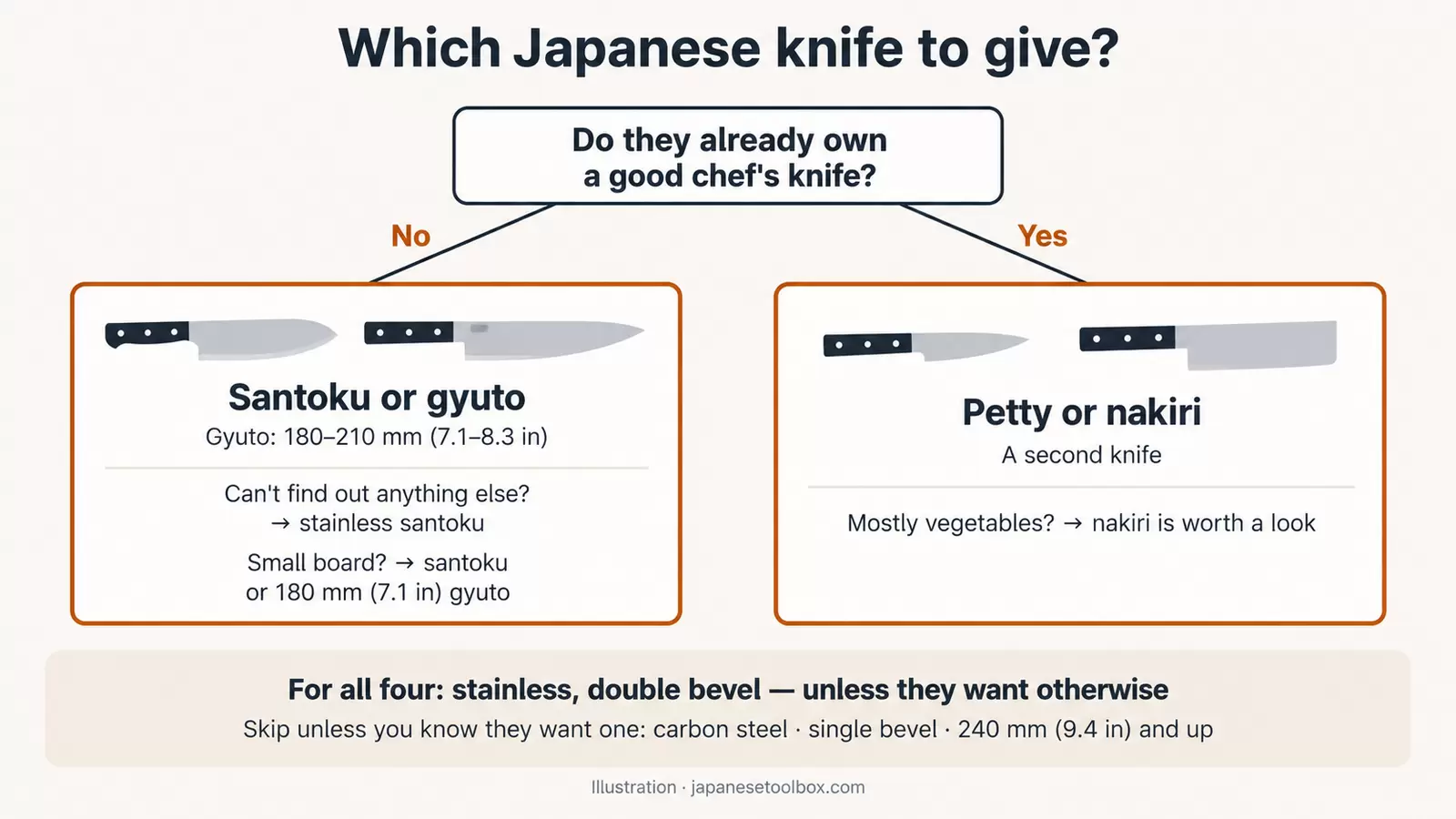
For someone who cooks at home, the safest Japanese knife gift is a stainless santoku (Japan’s everyday all-purpose kitchen knife) or a 180–210 mm (7.1–8.3 in) stainless gyuto (a chef’s knife). If they already own a good chef’s knife, a petty (a small Western-style knife) or a nakiri (a vegetable knife) makes a better second knife.
Skip carbon steel and single-bevel knives unless you already know the recipient wants one. The same goes for blades of 240 mm (9.4 in) and up. Some people in Japan connect knives with “cutting ties,” so check the recipient’s views, especially for a wedding or house move — more on this below. This guide draws on Japanese makers’ and knife shops’ own advice, not hands-on testing.
Four questions to ask before you buy
- What do they already own? No good chef’s knife yet → a santoku or gyuto. Already have one → a petty or a nakiri.
- What do they cook most? Mostly vegetables → a nakiri is worth a look. A bit of everything → a santoku or gyuto.
- How big is their board and counter? Small → a santoku or a 180 mm (7.1 in) gyuto.
- Do they sharpen, or will they? No → stick with stainless and double bevel, and skip the whetstone add-on below.
If you can’t find out anything else about the recipient, choose the stainless santoku. Several Japanese maker and shop guides recommend a santoku to beginners and first-time buyers. Tojiro, a knife maker in Niigata, puts it plainly for a first household knife: 「迷ったら三徳を。」 (“If you’re unsure, choose a santoku.”) Sakai Ichimonji Mitsuhide, an Osaka knife shop, says that for someone who just wants something useful for daily life, “a santoku is the perfect choice.”
Matching the knife to the cook
| Knife | Good gift for | Typical length (source’s own figure) | Best if they already own… | Read more |
|---|---|---|---|---|
| Santoku | an everyday home cook; anyone you’re unsure about | about 165–180 mm (6.5–7.1 in) | nothing yet | gyuto vs. santoku |
| Gyuto (180–210 mm) | a cook who loves cooking and has room on the board | 180–210 mm (7.1–8.3 in), popular at home | nothing yet, or an old Western chef’s knife | gyuto vs. santoku |
| Petty | a cook who already has a main knife | 120–150 mm (4.7–5.9 in) in Tojiro’s household guide | a santoku or chef’s knife | petty knife vs. paring knife |
| Nakiri | a cook who mostly cuts vegetables | about 165 mm (6.5 in) | a santoku or chef’s knife, ideally | nakiri vs. santoku |
Lengths are each maker’s own figures. For all four, choose stainless and double bevel unless you know the recipient wants otherwise. See types of Japanese kitchen knives for the other Japanese knife types.
Santoku: for the everyday home cook
A santoku (三徳) is Japan’s everyday all-purpose home knife for meat, fish and vegetables — the name means “three uses” — with a relatively straight, flatter edge suited to straight-down cutting. Tojiro’s household guide gives a typical length of about 165–180 mm (6.5–7.1 in). Zwilling’s Japanese company offers the same advice when a buyer is unsure: 「悩んだら、「三徳包丁」か「牛刀・シェフナイフ」がおすすめです」 (“If you’re torn, we recommend either a santoku or a chef’s knife.”) See our gyuto vs. santoku guide for how the two compare day to day.
Our pick: the Kanetsune KC-170 santoku, 180 mm (7.1 in), stainless, double edged, 60–62 HRC, listed at $110.99 on Oct 8, 2026. We chose it from the shop’s listings because its listed specs match the criteria above; we haven’t used this exact knife.
Kanetsune 180 mm stainless santoku at Hocho Knife
In-stock 165–180 mm santoku at Hocho Knife started at about $50 on Oct 8, 2026.
Gyuto: for someone who loves to cook
A gyuto (牛刀) is a chef’s knife: a Western-born, all-purpose knife with a long blade whose edge curves up to a pointed tip. Tojiro’s household guide says 180–210 mm is popular for home use. Zwilling Japan’s sizing guide says about 18 cm is easiest for general home use and 21 cm covers more ingredients with one knife, and its gift page also suggests a chef’s knife for home cooks who take cooking seriously. See gyuto vs. santoku for more on the two shapes.
Our pick: the Kanetsune KC-170 gyuto, 210 mm (8.3 in), stainless, double edged, 60–62 HRC, listed at $110.99 on Oct 8, 2026. We chose it from the shop’s listings because its listed specs match the criteria above; we haven’t used this exact knife.
Kanetsune 210 mm stainless gyuto at Hocho Knife
Stainless 180–210 mm gyuto at Hocho Knife started at about $50 on Oct 8, 2026.
Petty: a second knife for the cook who has everything
A petty knife (ペティナイフ) is a small Western-style knife that Tojiro describes as a scaled-down gyuto; the name comes from the French “petit.” Its household guide lists 120–150 mm and calls it a popular sub-knife. Zwilling Japan’s gift page also suggests a petty as a gift. For how a petty differs from a Western paring knife, see petty knife vs. paring knife.
Our pick: the Kanetsune KC-170 petty knife, 150 mm (5.9 in), stainless, double edged, 60–62 HRC, listed at $82.99 on Oct 8, 2026. We chose it from the shop’s listings because its listed specs match the criteria above; we haven’t used this exact knife.
Kanetsune 150 mm stainless petty knife at Hocho Knife
Stainless 120–150 mm petty knives at Hocho Knife started at about $39 on Oct 8, 2026.
Nakiri: for the vegetable-heavy cook
A nakiri (菜切) is a thin, double-bevel household vegetable knife with a rectangular blade, a straight edge and no pointed tip, about 165 mm (6.5 in) long. Tojiro notes that its square blade can also double as a scraper. See nakiri vs. santoku for how the two compare on vegetables.
Our pick: the Kanetsune KC-150 nakiri, 165 mm (6.5 in), Swedish stainless steel, double edged, 60–61 HRC, listed at $113.99 on Oct 8, 2026. We chose it from the shop’s listings because its listed specs match the criteria above; we haven’t used this exact knife.
Kanetsune 165 mm stainless nakiri at Hocho Knife
Double-bevel nakiri in the 160–180 mm range at Hocho Knife started at about $50 on Oct 8, 2026.
Gifts that can backfire
These are good knives in the right hands. The problem is giving one to someone who didn’t ask for it.
Carbon steel, for someone who won’t dry it right away
Carbon steel (hagane, 鋼) takes a sharp edge but rusts more easily than stainless steel — which resists rust, though it isn’t rust-proof — and needs regular care. Sakai Jikko, a knife company in Sakai, describes carbon steel as 「錆びやすい(手入れ必須)」 (“rusts easily, upkeep required”), compared with stainless steel, which Jikko calls 「錆びにくい(比較的メンテナンスが容易)」 (“resists rust, relatively easy to maintain”).
Aogami (Blue) and Shirogami (White) are carbon steels sold under those grade names, so the same care notes apply to a knife listed that way. Sharpenability also varies by grade: Jikko says Shirogami is generally easier to sharpen than the harder Aogami. Kai, a Japanese cutlery company, states in its FAQ that knives with carbon-steel blades, carbon-steel-core clad blades, or wooden handles aren’t suited to a dishwasher or dish dryer, and, according to Ichimonji’s gift page, stainless steel knives are the best choice for home users, so look for “stainless” in a listing if you’re not sure. More on steel choices: Japanese knife steel for beginners.
Single-bevel knives, unless you know which hand
Single-bevel knives (片刃) have the edge ground on one side only, unlike a double-bevel (両刃) knife ground on both sides, like a Western knife. They come in right- and left-handed versions, and Ichimonji says a left-hander will struggle with a right-handed one: 「左利きの方が右利き用の片刃包丁を使用することは困難です。」 Sakai Jikko prices its own left-handed single-bevel knives at about 1.5 times the right-handed version. Tojiro’s household guide points first-time buyers toward double-bevel knives rather than single-bevel ones for a first home knife.
Some pull-through and roll sharpeners are double-bevel only: Kai’s roll sharpener (store item 459) states it’s for double-bevel knives only and can’t be used on single-bevel knives such as deba. Kyocera’s official kitchen store gives the same limit for its own roll sharpener: 「金属の両刃の包丁専用の研ぎ器です。片刃の包丁は研がないでください。」 (“This sharpener is for double-bevel metal knives only. Do not use it on single-bevel knives.”) (See our guide to sharpeners for Japanese knives for more on these limits.)
Common single-bevel types include deba, a knife for preparing fish, and yanagiba, a knife for slicing sashimi. Ichimonji does suggest a yanagiba or deba as a gift for someone working in Japanese cuisine. More on the difference: single bevel vs. double bevel.
Very long blades, for a small kitchen
Zwilling Japan’s sizing guide says 24 cm (9.4 in) or more is for handling large ingredients, and Sakai Jikko says a 240–270 mm (9.4–10.6 in) gyuto is chosen for cutting large pieces of meat — well above the 180–210 mm Tojiro calls popular for home use, covered above. A 240 mm-plus gyuto and a sujihiki (筋引, a slicing knife) are long-blade picks best kept for cooks who have already asked for one.
An expensive damascus-pattern knife is still a working knife, so the same three checks above still apply to a “showpiece” gift.
Is it bad luck to give a knife?
What the Japanese etiquette guides say
nippon.com, a multilingual site about Japan run by the nonprofit Nippon Communications Foundation, publishes a gift-giving etiquette guide supervised by Shibazaki Naoto, an associate professor at Gifu University who specializes in manners education. It says: “Knives and scissors remind some people of ‘cutting ties,’ so they are frowned upon as gifts for a wedding or a house move.” It adds: “On the other hand, they may be considered a good omen, as they help ‘cut a path forward.’”
Zwilling Japan’s gift page, from a knife company, argues for the positive reading: 「日本では古来から包丁をはじめとする刃物のプレゼントは、「災いを断ち切る」「未来を切り開く」として縁起が良いものと捉えられています。」 (“In Japan, gifts of knives and other blades have long been seen as a good omen, for ‘cutting off misfortune’ and ‘cutting open the future.’”) It points to cutting a wedding cake and ribbon-cutting ceremonies as examples of blades showing up at celebrations.
The coin and go-stone customs
Ichimonji’s English gift page describes two customs: some gift-givers add a very hard item, like a go stone, to a knife gift so it “cannot cut your good luck or our relationship,” and others add a five-yen coin, since five yen is read as go-en, which can also mean “luck and relationship.” The shop adds that “this kind of belief has faded over recent years.” Knifewear, a knife retailer, describes a coin custom found in several cultures: including a coin in the box so the recipient can symbolically “purchase” the knife from the giver.
If the gift is for a wedding, a move, or a recipient who cares about these customs, ask them first and consider a different gift if you’re not sure a knife is welcome. Once you know a knife is welcome, a coin or a short card is an optional, easy courtesy to add.
Extras, wrapping and ordering in time
Small add-ons that help
- Camellia oil (tsubaki oil), a plant-based, non-drying oil. Ichimonji recommends a thin coat for knives that are used rarely or stored for a long time. Kurobara camellia cutlery oil
- A hinoki cutting board. Shun says hinoki is a medium-soft wood that “gives” under the knife as you cut, so there’s less impact on the board and less dulling. See cutting boards for Japanese knives for more. Our pick: the Japanese Domestic Wood Cutting Board Antibacterial Hinoki [M], 300 × 190 × 20 mm, hinoki (Japanese cypress), listed at $85.99 on Oct 8, 2026. We chose it from the shop’s listings because its listed specs match the criteria above; we haven’t used this exact board. Hinoki cutting boards at Hocho Knife started at about $73 on Oct 8, 2026. hinoki cutting board (300 × 190 mm) at Hocho Knife hinoki cutting boards at Hocho Knife
- A medium whetstone, generally around #1000 grit. Ichimonji’s Father’s Day column suggests a whetstone alongside a knife as a gift, since it’s an important tool for keeping an edge sharp. Only add this if the recipient already sharpens, or wants to learn — see whetstone grit for beginners. Our pick: the Naniwa Super Ceramic Waterstone (Whetstone) with Stand [S-1000], #1000 grit, 210 × 70 × 20 mm, with stand, listed at $75.99 on Oct 8, 2026. We chose it from the shop’s listings because its listed specs match the criteria above; we haven’t used this exact stone. Single-grit #1000 whetstones at Hocho Knife started at about $46 on Oct 8, 2026. Naniwa #1000 whetstone with stand at Hocho Knife medium whetstone
- A printed care card: see our Japanese knife care routine for what to put on it.
How Japanese shops wrap a knife gift
Zwilling Japan’s gift page suggests adding engraving to make a knife gift feel special, and for wrapping it describes choosing noshi (a type of Japanese gift wrapping) with red-and-white mizuhiki (decorative paper cords) appropriate for celebrations, plus wording suited to the occasion. Ichimonji’s English gift page offers a paulownia box and free engraving as part of its own service.
Ordering from Japan before the holidays
Hocho Knife, an online shop in Kobe that sells Japanese knives worldwide (an affiliate partner), ships knife gifts from Japan. Its payment and shipping page says you can add gift wrapping with Japanese-inspired designs and a message card, and that for eligible U.S. orders, Hocho Knife advances and fully pays the import duties, although some couriers may still charge a small customs-administration fee (as of Oct 2026). Order early and check the shop’s own shipping table for current timing.
Shipping rules for kitchen knives vary by country and state. Check the seller’s shipping policy and your local laws before ordering.
Sources
The facts in this guide were checked against these pages (accessed September 2026). Pages marked (in Japanese) are written in Japanese.
- Tojiro: 包丁の種類と使い分け (in Japanese)
- Sakai Jikko: 青紙・白紙どちらを選ぶ?プロが教える包丁の鋼材「ハガネ」の種類と特徴 (in Japanese)
- Tojiro: 刃の向きと利き手 (in Japanese)
- Zwilling: 牛刀とは?三徳包丁との違いや用途についてわかりやすく解説!おすすめの包丁もご紹介 (in Japanese)
- nippon.com: Gift-Giving Etiquette in Japan
- Sakai Ichimonji Mitsuhide: Knife Gift Etiquette
- Zwilling: プレゼント向きの包丁をご紹介!贈る意味から選び方まで (in Japanese)
- Tojiro: 三徳包丁とは?特徴・選び方・おすすめ5選 (in Japanese)
- hocho-knife.com: Kanetsune KC-170 Whole AUS10 Stainless Steel Japanese Chef's Santoku Knife 180mm
- hocho-knife.com: Santoku knife
- Tojiro: 牛刀とは?特徴・三徳との違い・おすすめサイズの選び方【包丁メーカー解説】 (in Japanese)
- hocho-knife.com: Kanetsune KC-170 Whole AUS10 Stainless Steel Japanese Chef's Gyuto Knife 210mm
- hocho-knife.com: Gyuto(Chef's Knife)
- Tojiro: 小さい包丁の選び方とペティナイフおすすめ (in Japanese)
- hocho-knife.com: Kanetsune KC-170 Whole AUS10 Stainless Steel Japanese Chef's Petty Knife(Utility) 150mm
- hocho-knife.com: Petty Knife(Utility)
- Tojiro: 和包丁の形状 (in Japanese)
- hocho-knife.com: Kanetsune KC-150 Swedish Stainless Steel Japanese Chef's Nakiri(Vegetable) 165mm
- hocho-knife.com: Vegetable Knife(Usuba)
- Sakai Ichimonji Mitsuhide: 包丁の素材「鋼」職人の技と科学が生み出す最高の切れ味 (in Japanese)
- Kai: 食器洗浄機や食器乾燥機に包丁を入れてもよいのでしょうか? (in Japanese)
- Sakai Jikko: 片刃包丁と両刃包丁で切れ味は変わるのか?実際に切り比べてみた (in Japanese)
- Sakai Ichimonji Mitsuhide: 左利きの和包丁 (in Japanese)
- Sakai Jikko: 片刃包丁は右利き、左利き用に分かれています (in Japanese)
- Kai: 【公式】関孫六 ダイヤモンド&セラミックシャープナー (in Japanese)
- Kyocera: FAQ シャープナー (in Japanese)
- Sakai Jikko: 三徳包丁 vs. 牛刀:包丁のプロが解説する違いと使い分けのコツ (in Japanese)
- Tojiro: 洋包丁の形状 (in Japanese)
- nippon.com: Nippon.com Tenth Anniversary Event “Communicating Japan to the World”
- Knifewear: Is it Bad Luck to Give a Knife as a Gift?
- Sakai Ichimonji Mitsuhide: 包丁の錆止め (in Japanese)
- Shun (Kai USA): Hinoki Wood Cutting Boards
- hocho-knife.com: Japanese Domestic Wood Cutting Board Antibacterial Hinoki [M]
- hocho-knife.com: Accessories
- Kai: 砥⽯の種類と選び⽅を解説!プロが認める⾙印おすすめの砥⽯や、初⼼者にも易しい研ぎ器を紹介 (in Japanese)
- Tojiro: 砥石の選び方 (in Japanese)
- Sakai Ichimonji Mitsuhide: 父の日プレゼントにおすすめの包丁と砥石 (in Japanese)
- hocho-knife.com: Naniwa Super Ceramic Waterstone (Whetstone) with Stand [S-1000]
- hocho-knife.com: Accessories
- kyodonewsprwire.jp: Hocho-Knife.com: Online Store for Authentic Japanese Knives with Over 12 Years of Experience…
- hocho-knife.com: Payment & Shipping
Related guides
- Gyuto vs. santoku
- Nakiri vs. santoku
- Petty knife vs. paring knife
- Single bevel vs. double bevel
- Japanese knife steel for beginners
- Japanese knife care routine
Researched and written by the Japanese Toolbox AI editorial team and reviewed by Ken, our editor in Japan. Approved for publication by Ken on October 6, 2026. How we work · @JapaneseToolbox on X